

 Travel Essentials
 Travel Essentials

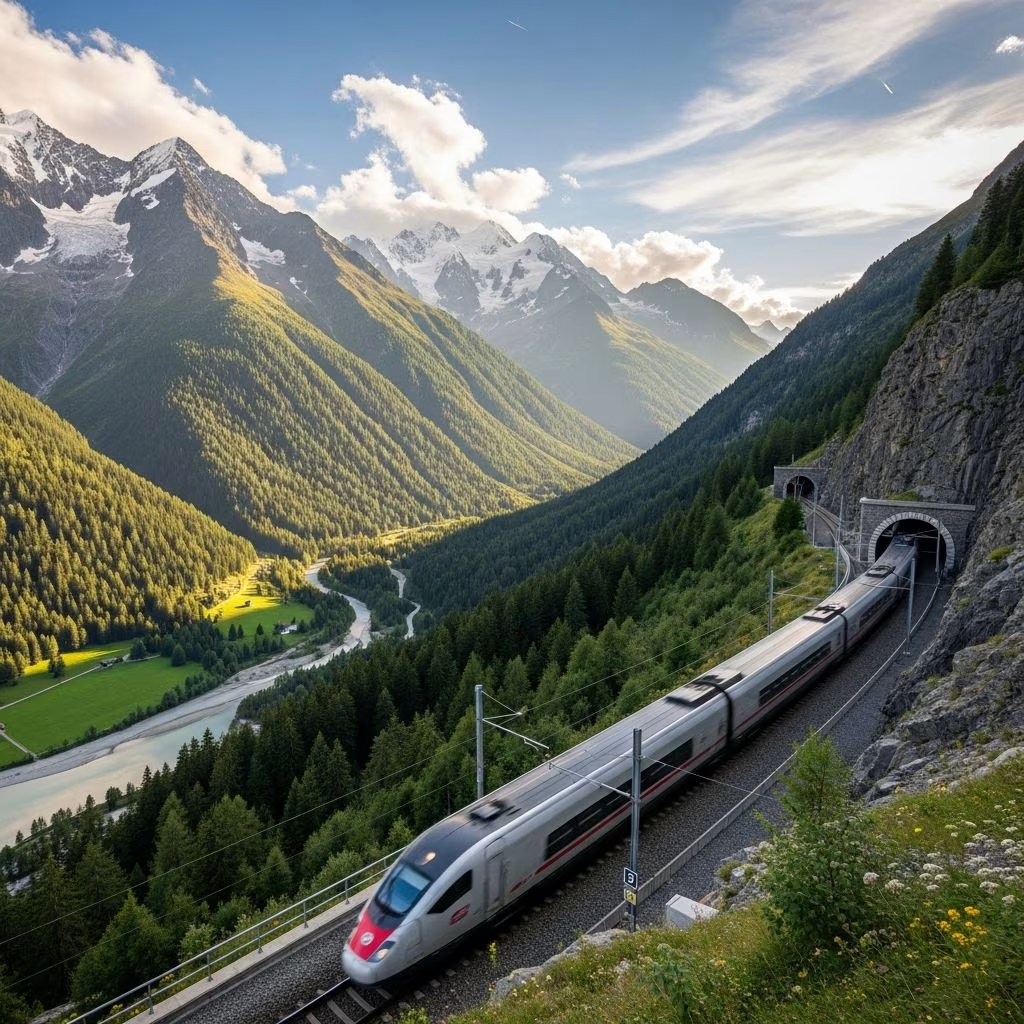
The Paris-Milan rail corridor reopened in March 2025 following a major Alpine landslide. Travelers can now enjoy direct high-speed train service between these major European cities.
 Travel Essentials
After nearly two decades of disruption, one of Europe’s most important transportation corridors has returned to full operation. The direct rail link between Paris and Milan, which carries hundreds of thousands of travelers annually, resumed service in March 2025 following an extended closure caused by significant geological instability in the French Alps. This restoration represents a major milestone for European connectivity and demonstrates the complexity of maintaining critical cross-border infrastructure in mountainous terrain.
The Paris-Milan railway corridor depends on several interconnected routes and critical infrastructure points, most notably the Frejus tunnel system that pierces through the Alpine mountain range. For nearly two decades prior to 2023, this route facilitated seamless travel between Western Europe’s economic powerhouses, with up to thirty trains traversing the Maurienne Valley daily. This extraordinary volume of daily service reflected the route’s importance to European commerce, tourism, and passenger mobility.
The transportation corridor utilizes a combination of high-speed sections and classic railway lines. The initial leg from Paris to Lyon features high-speed rail technology, allowing trains to reach speeds of three hundred kilometers per hour. Beyond Lyon, the route transitions through the scenic Alpine valleys before crossing into Italy near the Italian border town of Modane. This geographical diversity creates unique engineering and operational challenges that require specialized infrastructure and expertise.
In August 2023, a substantial rockfall in the Maurienne Valley disrupted this critical transportation artery, forcing authorities to suspend all rail traffic through the affected section. The landslide specifically impacted the rail corridor between Modane and Saint-Michel-Valloire, rendering the entire Paris-Milan connection inoperable in both directions. This unexpected geological event created significant logistical complications for travelers, freight operators, and the regional economies dependent on reliable cross-border transportation.
The closure extended for approximately nineteen months, making it one of the longest interruptions to this particular route in recent history. During this extended period, railway authorities had to assess structural integrity, implement safety protocols, and execute comprehensive repairs to ensure the route could safely accommodate the volume of traffic it previously handled. The disruption demonstrated the vulnerability of infrastructure in geologically active regions and the importance of maintaining robust contingency plans for critical transportation networks.
Despite the closure of the direct Paris-Milan route, rail operators maintained service on alternative connections, ensuring that European rail travel networks remained partially functional. Trenitalia France continued operating five daily round trips between Paris and Lyon, allowing travelers to reach southern France even as the cross-Alpine connection remained unavailable. This maintained service prevented complete transportation collapse while engineers worked on restoring the primary route.
The Paris-Lyon connection provided an essential interim solution for business travelers and tourists who could access Italy through alternative routing, albeit with significantly longer journey times and additional transfers. Regional economies in both France and Italy experienced measurable impacts from the disruption, as reduced mobility affects tourism, commerce, and worker productivity across international corridors.
On March thirty-first, twenty twenty-five, direct rail service between Paris and Milan returned to operation, marking a significant achievement in European infrastructure management. The reopening enabled two daily round-trip services to operate through the restored Alpine corridor, reconnecting millions of potential passengers across Western and Southern Europe. This restoration did not simply return to previous service levels; it represented validation that comprehensive repair work had been successfully completed to modern safety and operational standards.
The reinstatement of service involved coordination between multiple national rail operators, engineering firms, and government agencies across France and Italy. Such cross-border infrastructure projects require exceptional cooperation and alignment of technical standards, safety protocols, and operational procedures. The successful completion of repairs and restoration of service demonstrated the commitment of European transportation authorities to maintaining the continent’s integrated rail network.
Two primary operators now provide direct service on the Paris-Milan corridor, each offering distinct service characteristics and passenger experiences. The TGV Inoui, operated by France’s national railway SNCF Voyageurs, represents French high-speed railway technology and tradition. Simultaneously, Trenitalia’s Frecciarossa trains provide Italian high-speed rail service with their own operational characteristics and network advantages.
These two operators employ different route variations through the Alps, reflecting their respective network architectures and technical capabilities. The Frecciarossa typically calls at Lyon Part-Dieu station in downtown Lyon, providing connectivity opportunities for passengers traveling from northern Europe or alternative starting points. The TGV generally bypasses Lyon while utilizing dedicated high-speed infrastructure. Both trains ultimately reach their Milan destinations but via slightly different pathways through the Alpine region.
Travelers can now complete the Paris-Milan journey in approximately six and a half to seven hours, making this route competitive with alternative transportation methods when considering total travel time including airport procedures and ground transfers. This journey duration encompasses the rapid high-speed section from Paris to Lyon, the scenic Alpine transit through the Maurienne Valley, and the final approach into the Milan metropolitan area.
The routing takes passengers through several notable waypoints, including Chambéry, Saint-Jean-de-Maurienne (served on weekends since December 2024), Modane, Oulx, and Turin before reaching final destination Milan. This itinerary provides passengers with exceptional views of French Alpine scenery while offering practical stops that serve regional communities and travelers with intermediate destinations.
The journey represents a compelling alternative to air travel, particularly for environmentally conscious travelers seeking to minimize their carbon footprint. Rail travel through mountain corridors offers unique aesthetic experiences unavailable through other transportation methods, combining efficiency with scenic beauty.
Direct train service between Paris and Milan now offers accessibility across multiple price points, accommodating diverse traveler budgets. Passengers can discover fares beginning from thirty-five euros, depending on booking timing, travel dates, and specific service selections. Early booking generally yields more favorable pricing, with some operators offering even more attractive rates for advance reservations.
The availability of competitive pricing from multiple operators creates genuine market competition that benefits consumers. Travelers now have the opportunity to compare service quality, schedule convenience, and pricing across both TGV and Frecciarossa offerings, enabling informed decision-making based on individual preferences and financial considerations.
Multiple platforms facilitate ticket acquisition for Paris-Milan train service, each offering distinct advantages and user experiences. The Trenitalia website (trenitalia.com) provides access to Frecciarossa services specifically, though it functions in euros and focuses primarily on Italian rail services. Alternatively, comprehensive rail booking websites like Rail Europe and The Train Line offer unified access to both TGV and Frecciarossa options, simplifying comparison shopping and reservation processes.
Booking windows vary by operator, with TGV tickets typically becoming available four months in advance, while Frecciarossa reservations open six months ahead. This distinction allows travelers with flexible schedules to secure the most competitive pricing by booking during optimal windows. Major timetable changes occurring in mid-December typically trigger later-than-normal booking opening dates, typically around mid-October.
The restoration of direct Paris-Milan rail service generates substantial economic benefits across multiple regions and sectors. Tourism boards in both France and Italy anticipate increased visitor arrivals from enhanced accessibility. Business travel between Paris and Milan, essential for international commerce and corporate coordination, has resumed at full efficiency. Regional communities along the corridor, including Alpine villages and secondary cities, benefit from restored passenger traffic that supports local economies and employment.
The psychological impact of restored connectivity extends beyond mere statistics. The route symbolizes European integration and the commitment to maintaining seamless cross-border transportation networks that define modern continental mobility. For travelers, the restoration represents a return to convenience and connectivity that characterized pre-disruption travel experiences.
Railway travel, particularly on high-speed corridors, offers compelling environmental advantages compared to automobile or air transport. The Paris-Milan connection enables travelers to reduce carbon emissions significantly by choosing rail instead of driving or flying. Each train carrying hundreds of passengers achieves remarkable passenger-per-kilometer efficiency, representing a sustainable transportation choice for environmentally conscious travelers.
The restoration of this corridor strengthens Europe’s overall rail network, encouraging modal shift away from carbon-intensive transportation methods. Enhanced connectivity makes rail travel more competitive with alternative modes, supporting broader European sustainability objectives and climate change mitigation strategies.
The journey typically requires six and a half to seven hours of travel time, combining high-speed sections with Alpine valley transit and approach into Milan.
Both SNCF Voyageurs’ TGV Inoui and Trenitalia’s Frecciarossa operate direct services, providing passengers with competing options and service preferences.
Two daily round-trip services currently operate on the restored corridor, with potential for expansion as infrastructure optimization continues.
Direct service resumed on March thirty-first, twenty twenty-five, following comprehensive repair work on infrastructure damaged by the August twenty twenty-three landslide.
Fares begin from thirty-five euros for advance bookings, with prices varying based on booking timing, travel dates, and service selections.
The successful restoration of the Paris-Milan corridor establishes foundation for potential service expansion and optimization. Rail operators and infrastructure authorities continue evaluating opportunities to increase daily service frequency, which could accommodate growing demand and enhance schedule convenience for both business and leisure travelers. Technological improvements and ongoing infrastructure maintenance ensure that this critical European corridor will continue supporting efficient cross-border mobility for decades to come.
