

 Travel Essentials
 Travel Essentials

Explore the Parthenon Marbles debate: history, law, ethics, and why calls to return the sculptures to Greece keep growing.
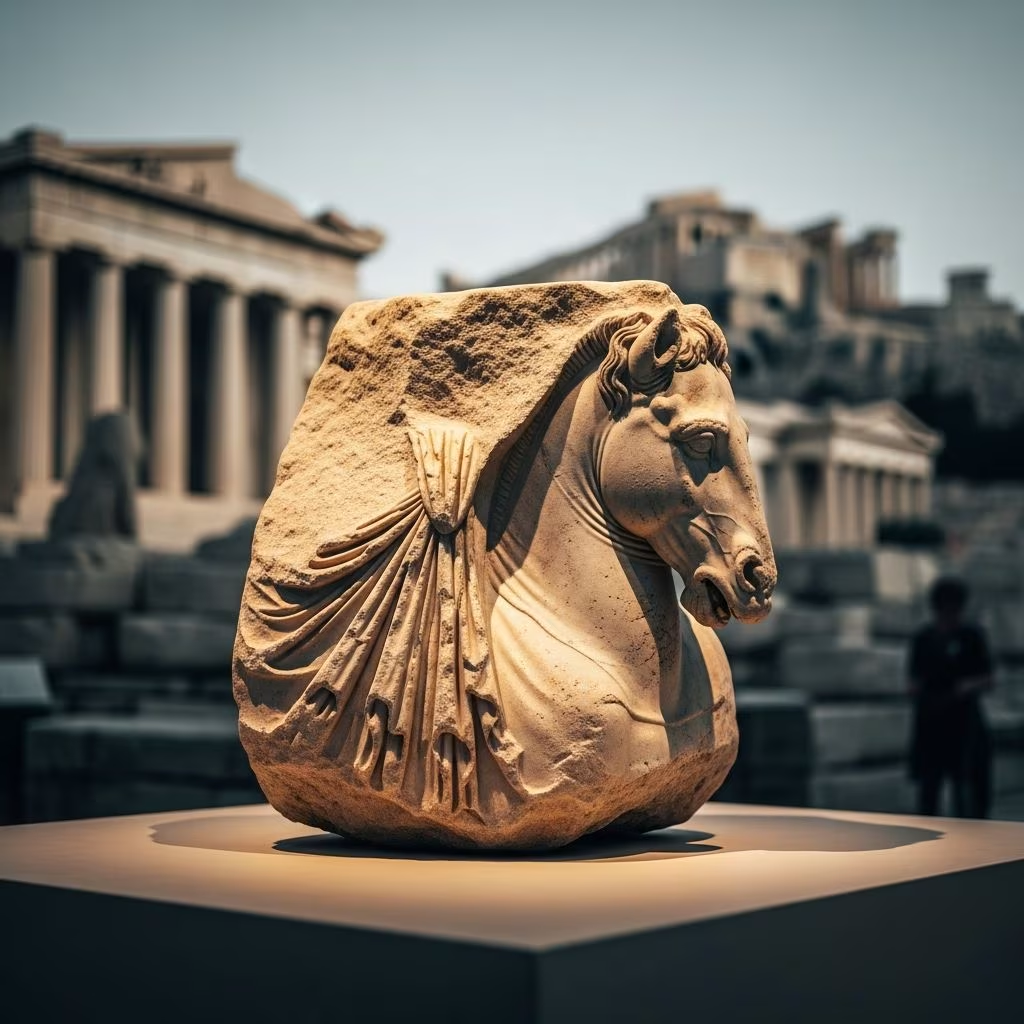 Travel Essentials
The Parthenon Marbles, also known as the Elgin Marbles, represent one of the most enduring controversies in the world of cultural heritage. These ancient sculptures, originally adorning the Parthenon temple on Athens’ Acropolis, have been housed in the British Museum since the early 19th century. The debate over their return to Greece continues to ignite passions, blending historical facts, legal disputes, ethical dilemmas, and contemporary political shifts like Brexit. This article delves into the origins of the collection, key arguments on both sides, recent developments, and potential paths forward.
Constructed in the 5th century BCE, the Parthenon stood as a pinnacle of ancient Greek artistry under Pericles’ patronage. Its friezes, metopes, and pedimental sculptures depicted mythological scenes and processions, embodying classical ideals of beauty and harmony. By the 19th century, the structure had suffered damage from earthquakes, invasions, and neglect under Ottoman rule.
Thomas Bruce, the 7th Earl of Elgin, served as British ambassador to the Ottoman Empire from 1799 to 1803. He obtained a document—known as a firman—purportedly authorizing the removal of sculptures from the Parthenon. Critics argue this permission was limited to making plaster casts and excavating rubble, not dismantling intact pieces. Historical analysis suggests Elgin exceeded any granted scope, motivated partly by personal ambition to enhance his Scottish estate.
Between 1801 and 1812, Elgin’s agents sawed off and shipped around half of the surviving sculptures to Britain. Facing financial ruin, he sold them to the British government in 1816 for £35,000—below his asking price but still a hefty sum. Parliament debated the acquisition intensely before approving it, placing the marbles in the British Museum as part of its ‘universal’ collection.
Proponents of return emphasize cultural integrity and moral restitution. The marbles form an inseparable part of the Parthenon, a UNESCO World Heritage site. Displaying them fragmented—half in London, half in Athens—diminishes their narrative power. Greece built the Acropolis Museum in 2009 specifically to house them alongside originals, using modern climate controls and natural lighting to recreate their original context.
Greek Prime Minister Kyriakos Mitsotakis has called the removal outright theft, amplifying calls during UK visits.
The British Museum maintains that retention serves the global public. Trustees argue the marbles are safer in London, citing 19th-century evidence of casts showing Elgin’s intervention prevented further decay from pollution and conflict.
| Argument For Retention | Supporting Evidence |
|---|---|
| Legal Ownership | Parliamentary purchase in 1816; UK law (1963 Act) protects deaccession. |
| Preservation Record | Protected from wars, pollution; available to millions annually. |
| Universal Museum | Contextualized with global artifacts; return sets dangerous precedent. |
| Shared Benefit | Division between museums enhances appreciation. |
Opponents of return warn of a ‘slippery slope,’ where repatriation demands could empty institutions like the Louvre or Met of non-European treasures. Figures like Stephen Fry counter that solidarity with Greece, especially post-financial crisis, justifies gesture without precedent.
British law poses the biggest barrier. The British Museum Act 1963 prohibits permanent disposal of collection items except in narrow cases like duplicates or fakes. Amending this requires parliamentary action, historically avoided to prevent wider claims.
Greece pursues loans rather than outright transfer, but the UK insists on ‘no strings’ returns to avoid ownership precedents. Talks stalled under past governments, with the museum’s trustees holding final say independent of ministers.
The UK’s 2016 EU exit reshaped repatriation dynamics. Pro-EU voices saw return as mending EU ties; post-Brexit, some frame it as reasserting global cultural leadership. Greece leverages the moment, arguing isolation warrants goodwill gestures. Yet, UK officials view it as internal museum policy, not diplomatic bargaining.
Public debates, like Intelligence Squared events, highlight shifting opinion. Polls show growing UK support for return, fueled by ethical heritage discourses.
Athens’ Acropolis Museum boasts state-of-the-art facilities: UV-filtered glass walls offer Acropolis views, precise humidity controls safeguard stone. Digital reunification projects use 3D scans and casts for virtual wholeness.
The British Museum counters with its own upgrades, but critics note Athens’ proximity to origin site enhances authenticity. Long-term loans with rotation could bridge divides, preserving both access and unity.
The marbles debate mirrors wider trends. Benin Bronzes returned from Germany to Nigeria; France loaned Ethiopian relics. These signal shifting norms toward source-country restitution, pressuring holdouts like the UK.
Surveys indicate majority UK youth favor return, viewing retention as outdated imperialism. Greek identity ties deeply to the Parthenon, making marbles a national symbol.
Debates feature luminaries: historians debunk preservation myths, while curators stress encyclopedic value.
Options include full return, long-term loan, or joint custody. A 2022 UK-Greece agreement for cultural exchanges hints at progress, though marbles remain off-table.
With mounting pressure, a hybrid model—displaying originals in Athens with casts in London—gains traction, balancing ethics and access.
Sculptures from the 5th-century BCE Parthenon temple, including friezes depicting the Panathenaic procession.
Named after Lord Elgin, who removed them from Athens 1801-1812.
Disputed; firman scope contested, but moral case emphasizes cultural wholeness.
Unlikely; one case sets no automatic precedent, as each artifact’s history differs.
Ongoing discussions focus on loans amid post-Brexit diplomacy.
This saga challenges museums to confront colonial acquisitions. Resolution could model collaborative stewardship, fostering international trust. As global south voices amplify, expect more such reckonings, prioritizing origin narratives without erasing shared human history.
(Word count: 1687)
