

 Travel Essentials
 Travel Essentials

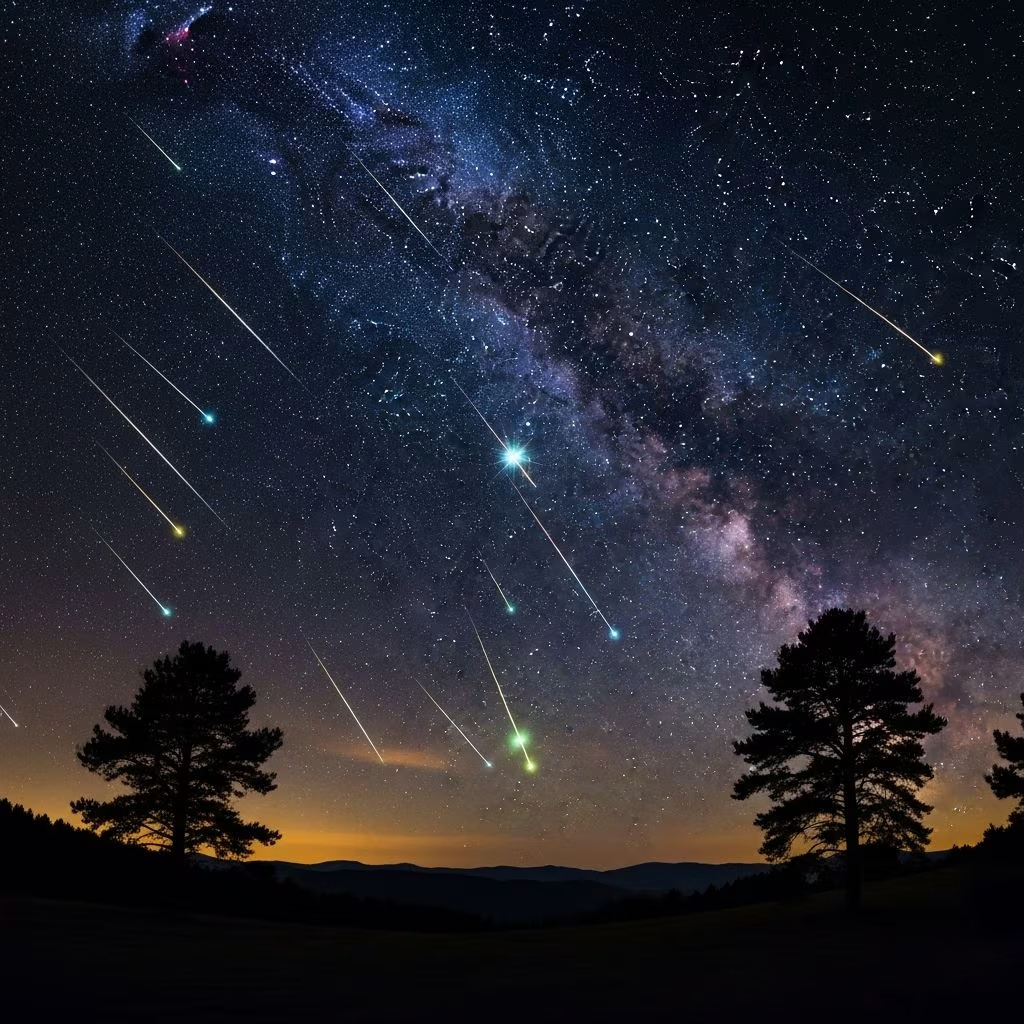
Explore everything about the 2026 Perseid meteor shower: peak on August 12-13 with up to 100 meteors/hour, best after midnight, no moon interference, and top US locations for stunning views.
 Travel Essentials
The Perseid meteor shower stands out as one of the year’s most reliable and spectacular celestial events, drawing stargazers worldwide with its bright, swift meteors streaking across the night sky. In 2026, this annual display promises exceptional conditions due to the absence of moonlight during its peak, allowing observers to spot up to 100 meteors per hour under pristine dark skies. Originating from debris left by Comet Swift-Tuttle, the Perseids offer a dazzling show visible primarily in the Northern Hemisphere from mid-July through late August.
Meteor showers occur when Earth plows through streams of cosmic dust and ice particles shed by comets. For the Perseids, these particles come from Comet 109P/Swift-Tuttle, which orbits the Sun every 133 years and last passed close to Earth in 1992. As these tiny fragments—most no larger than sand grains—enter Earth’s atmosphere at speeds of about 37 miles per second (59 km/s), they incinerate, creating the glowing trails we call meteors.
The shower’s name derives from its radiant point, the apparent origin in the constellation Perseus, which rises higher as the night progresses. Under ideal conditions, Zenithal Hourly Rate (ZHR)—the theoretical maximum meteors visible per hour from a point directly overhead—reaches 100 for the Perseids. In 2026, with the new moon aligning perfectly, real-world rates could approach this peak.
The Perseids will be active from July 17 to August 24, 2026, building gradually to a crescendo before tapering off sharply. The predicted peak hits at 14:53 UTC on August 13, making the pre-dawn hours of August 12 and 13 the optimal windows, with August 14 still viable.
This moonless peak elevates 2026’s Perseids above recent years, rivaling the best displays in decades. Observers during the August 12 total solar eclipse totality might even catch early Perseids against the darkened sky.
To maximize sightings, time your session for the late-night to pre-dawn period when the radiant is prominent and meteor flux peaks. Allow 20-30 minutes for your eyes to dark-adapt, avoiding bright screens or lights beforehand.
| Time Period | Recommended Viewing | Expected Meteors/Hour |
|---|---|---|
| Evening (10 PM – Midnight) | Fair; radiant low | 20-40 |
| Midnight – 3 AM | Good; radiant rising | 50-80 |
| 3 AM – Dawn | Excellent; radiant high | 90-100+ |
Lie back comfortably, letting your peripheral vision scan about 50 degrees from the radiant for the swiftest, brightest streaks—many leaving persistent trains. No telescopes needed; the naked eye suffices for this wide-field spectacle.
Success hinges on escaping light pollution. Head to remote areas with Bortle Scale Class 1-3 skies, far from urban glow. National parks and wilderness areas shine for Perseid viewing.
Check park reservations early, as Perseid weekends fill fast. Apps like Dark Sky Finder or Light Pollution Map pinpoint ideal spots near you.
Equip yourself for comfort during long sessions under chilly pre-dawn skies.
Monitor weather via Clear Outside or 1-Hour Precip apps; clear, dry nights amplify visibility.
Document the show with wide-angle lenses (14-24mm) on tripods, set to f/2.8, ISO 1600-3200, 15-25 second exposures. Time-lapse sequences at 300-600 images/hour capture dozens of trails. Foreground elements like mountains or tents add drama. Software like Sequator stacks images for composite masterpieces.
While Perseids dominate August, 2026 features other showers:
| Shower | Peak Date | ZHR | Moon Interference |
|---|---|---|---|
| Lyrids | April 22 | 18 | Low (first quarter) |
| Eta Aquariids | May 5-6 | 30-50 | High (gibbous) |
| Perseids | Aug 12-13 | 100 | None (new moon) |
| Ursids | Dec 22-23 | 10 | High (94% full) |
The Perseids outshine most, especially with their 2026 moon-free peak.
Target after midnight to dawn on August 12 and 13, peaking around 14:53 UTC on August 13.
No—naked eyes work best. Binoculars narrow the field; use for constellations only.
No, the new moon ensures dark skies, boosting faint meteor visibility.
National parks like Great Basin, Death Valley, and Big Bend offer Bortle 1-2 skies.
50-100 per hour at peak from dark sites; more in 2026’s optimal conditions.
Limited; best in northern latitudes where the radiant rises high.
Beyond numbers, the Perseids evoke wonder—swift fireballs evoking ancient omens, now understood as comet remnants. In 2026’s perfect setup, they invite shared awe, connecting us to the cosmos. Plan now for an unforgettable night under the stars.
