

 Travel Essentials
 Travel Essentials

Comprehensive guide to the 2026 Perseid meteor shower: peak dates, best viewing spots, preparation tips, and family-friendly advice for spotting up to 100 shooting stars per hour.
 Travel Essentials
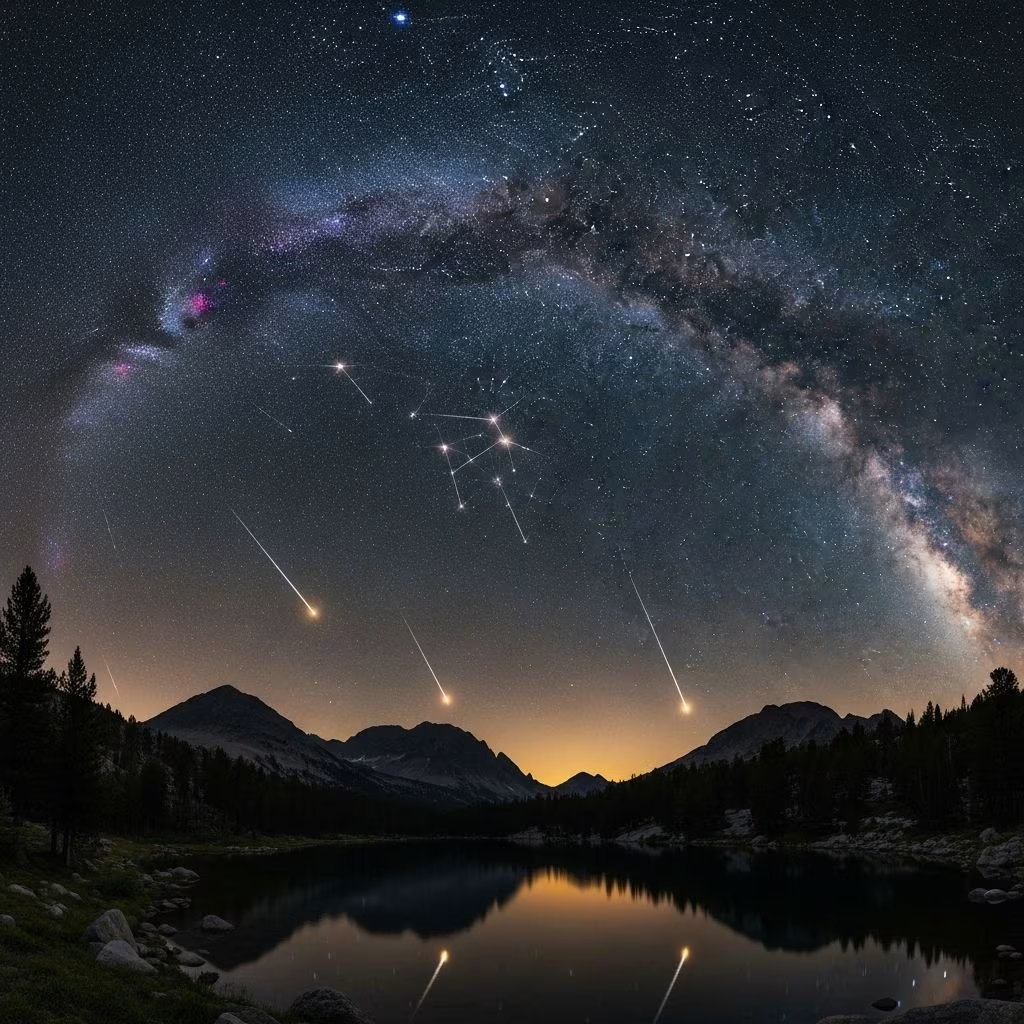
The Perseid meteor shower stands out as one of the most reliable and spectacular annual celestial events, captivating skywatchers with its bright, swift meteors streaking across the summer night sky. Originating from debris left by Comet 109P/Swift-Tuttle, this shower offers observers in the Northern Hemisphere the chance to see dozens to over 100 meteors per hour under ideal conditions.
Meteor showers occur when Earth plows through streams of cosmic dust and particles shed by comets. For the Perseids, these tiny fragments—mostly no larger than sand grains—enter our atmosphere at speeds of about 37 miles per second, incinerating high up and creating the glowing trails we call shooting stars. The name ‘Perseid’ derives from the constellation Perseus, the apparent origin point or radiant of the meteors.
Comet Swift-Tuttle, discovered in 1862, orbits the Sun every 133 years and last passed close to Earth in 1992, intensifying the debris trail. As Earth crosses this path annually, the shower recurs predictably. In peak years, rates can surge due to denser debris concentrations, sometimes reaching 150-200 meteors per hour during rare outbursts.
The Perseid shower activates from July 17 to August 24, 2026, with the climax expected on the night of August 12-13, extending into the early morning of August 13. Activity builds gradually, plateaus during peak nights, and drops sharply afterward, making August 12-14 the prime window.
Visibility spans latitudes from 90°N to 35°S, favoring northern observers where the radiant rises higher.
Meteors become noticeable after 11 p.m. local time as darkness deepens, but the display intensifies post-midnight when the radiant climbs higher. Optimal hours run from midnight to 5:30 a.m., culminating pre-dawn when the sky offers the widest dark canvas.
In 2026, a near-new moon during peak enhances darkness, unlike moonlit years that dim fainter streaks. Still, target moonset times—often 2-4 a.m.—to minimize interference. Patience pays off; rates can double from evening to morning.
| Time of Night | Meteor Activity Level | Best Strategy |
|---|---|---|
| 11 p.m. – Midnight | Moderate | Eye adjustment begins |
| Midnight – 3 a.m. | High | Radiant rises; scan northeast |
| 3 a.m. – Dawn | Peak | Widest sky view; lie back |
Success hinges on escaping light pollution. Urban glow can obscure 90% of fainter meteors, so venture 35-60 km from cities to rural fields, national parks, or hilltops. Use tools like light pollution maps (e.g., Dark Site Finder) to pinpoint Bortle Scale 1-3 skies—pristine dark zones.
Ideal U.S. spots include Great Smoky Mountains, Death Valley, or Cherry Springs State Park. In Europe, try the Yorkshire Moors or Scottish Highlands. Southern viewers near equator may catch fewer due to lower radiant elevation.
No telescopes needed—the naked eye captures the full panorama. Focus on comfort and dark adaptation for 20-30 minutes to spot subtle trails.
Arrive early, lie back at 45° facing northeast, and relax. Meteors radiate from Perseus but streak anywhere; peripheral vision catches many.
Spot the distinctive ‘W’ of Cassiopeia circling Polaris, then trace to Perseus trailing it. By 2 a.m., the radiant at 50° elevation yields faster, longer trains. Apps like SkySafari pinpoint it precisely.

Pro tip: Trace an arc from Cassiopeia’s tip through the Milky Way to Perseus’ sword-like shape.
Photographing Perseids requires wide-angle lenses (14-24mm), tripods, and long exposures (15-30 seconds) at high ISO (1600-6400). Intervalometers snap hundreds of frames for stacking later. Time shots post-moonset; apps like PhotoPills plan radiant paths and moon phases.
Involve kids with games: count meteors, sketch trails, or learn myths (Perseus slaying Medusa). Start early evenings with constellations; bring telescopes for planets as bonuses. Safety first: bug protection, supervision near roads.
Discuss science: why meteors glow (friction), comet origins, space debris. It sparks lifelong astronomy passion.
Clouds foil plans—monitor forecasts 48 hours ahead. UK-style regional variations mean northeast clears often beat southwest storms. If grounded, live streams from observatories fill gaps. Multi-night vigils hedge bets; pre-peak (Aug 10-11) dodges crowds.
Peak hits August 12-13 night into morning, best pre-dawn.
No—naked eyes suffice; comfort gear enhances experience.
Light pollution hides 80-90% of them; rural dark skies essential.
Limited; radiant low on northern horizon up to 35°S.
Fainter meteors vanish; view post-moonset or pre-full moon nights.
Perseids shone brightest in 2016’s outburst (200+/hr). 2026 promises standard brilliance, potentially more sans heavy moonlight. Track updates from International Meteor Organization for surprises.
This guide equips you for cosmic wonder—mark calendars, scout sites, and prepare for shooting star magic.
