

 Travel Essentials
 Travel Essentials

Learn everything about the 2026 Perseid meteor shower: peak dates on August 12-13, best viewing tips, locations, and why it's the year's top celestial event with moonless skies.
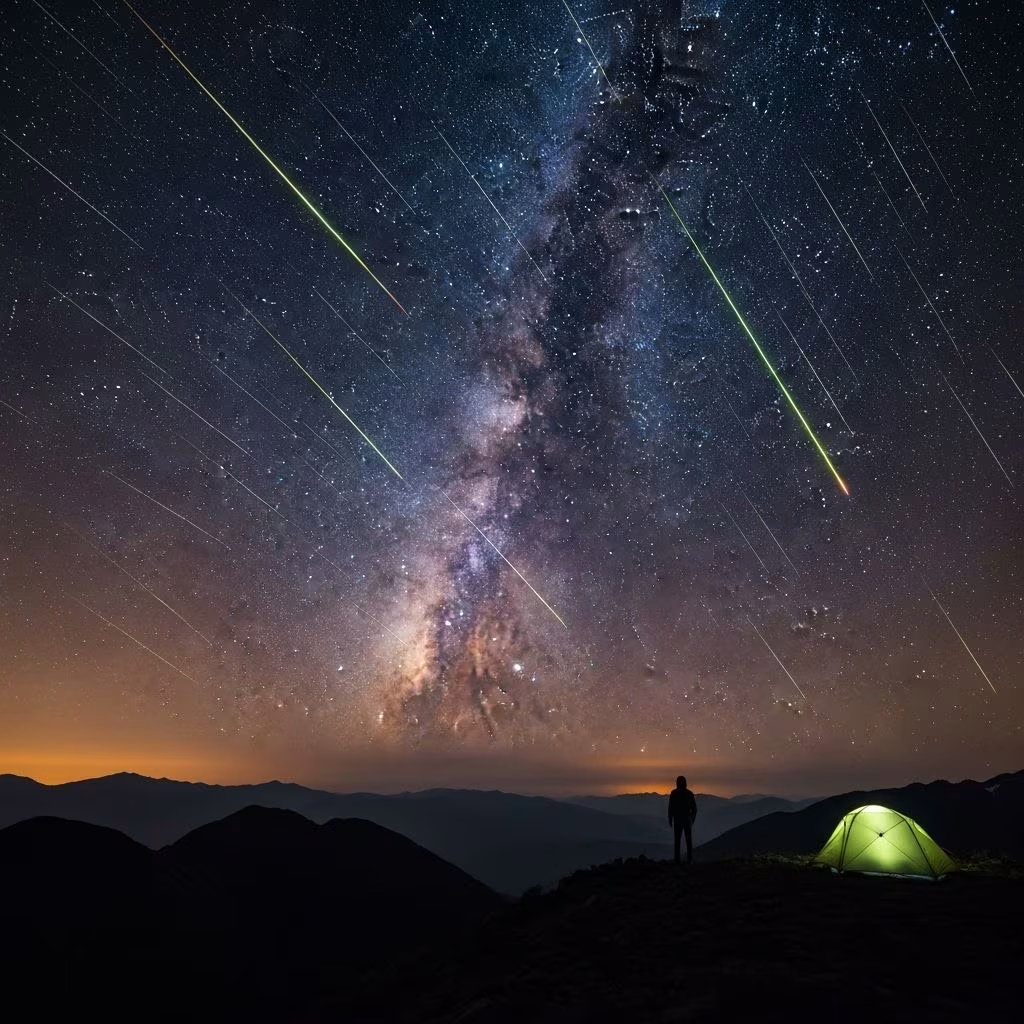 Travel Essentials
The Perseid meteor shower stands out as one of the most anticipated annual celestial displays, particularly for Northern Hemisphere observers. In 2026, it promises exceptional conditions with a new moon aligning perfectly during its peak, offering dark skies ideal for spotting up to 90 or more meteors per hour under optimal circumstances.
Meteor showers occur when Earth plows through streams of cosmic debris left by comets. The Perseids specifically originate from dust and particles shed by Comet 109P/Swift-Tuttle, which orbits the Sun every 133 years. As these tiny fragments—mostly smaller than a grain of sand—enter our atmosphere at speeds around 37 miles per second (60 km/s), they incinerate, creating the brilliant streaks we call shooting stars.
This shower earns its name from the constellation Perseus, where the meteors appear to radiate. Active from mid-July to early September, the Perseids build gradually to a crescendo before tapering off sharply. Their reliability, brightness, and frequent glowing trains make them a favorite among skywatchers.
For 2026, the Perseids will be active from July 14 to September 1, but the prime viewing window centers on the peak predicted at 14:53 UTC on August 13. This translates to the mornings of August 12 and 13 as the top opportunities, with August 14 still viable though rates drop quickly post-peak.
Unlike some showers disrupted by moonlight, 2026’s alignment with the new moon—coinciding near a total solar eclipse on August 12—sets up pristine conditions. Observers during eclipse totality might even catch early Perseids.
| Condition | Expected Meteors/Hour | Notes |
|---|---|---|
| Ideal dark skies, no moon | 90+ | Reported by skywatchers; frequent bright fireballs |
| Average suburban skies | 50-75 | Still impressive with persistent trains |
| Post-peak (Aug 14+) | 20-50 | Rapid decline after maximum |
Perseid meteors are swift, colorful, and often leave lingering ionized trails that can persist for minutes. Rates can surge during outbursts, historically hitting 150-200 per hour, though 50-100 is typical at zenith.
To maximize sightings, seek Bortle Scale Class 1-3 sites—remote areas far from city glow with horizons free of obstructions. National parks, rural fields, or designated dark-sky preserves are ideal. In the U.S., consider Great Basin National Park (Nevada), Cherry Springs State Park (Pennsylvania), or Big Bend National Park (Texas).
Northern Hemisphere latitudes (above 35°N) offer the best radiant elevation; southern viewers may see fewer.
Preparation elevates your experience from casual glance to memorable spectacle.
No equipment needed beyond patience, but wide-field binoculars enhance fainter meteors. Avoid telescopes—they limit field of view.
Combine viewing with astronomy basics: Locate Perseus using apps like Stellarium or SkySafari. The constellation’s W-shaped asterism aids identification post-midnight.
Photography tips:
For families, pack hot cocoa, snacks, and star charts to engage kids in counting meteors—a fun STEM activity.
Beyond numbers, Perseids symbolize summer’s cosmic fireworks. Their consistency since ancient records—Chinese astronomers noted them in 36 AD—adds historical allure. In 2026’s moonless peak, expect a surge in reports from amateurs worldwide, potentially rivaling Geminids for top shower status.
Environmental note: Minimal footprint viewing preserves dark skies for future generations. Support International Dark Sky Association efforts.
The predicted peak is 14:53 UTC on August 13, making mornings of August 12-13 optimal.
No—naked eyes suffice. Binoculars optional for wide views.
No, new moon on August 12 ensures dark skies.
50-100 per hour in dark sites; fewer near cities.
Limited; radiant low on horizon south of 35°S.
Yes, meteors burn up 60-100 miles high; no risk.
Perseids have produced ZHR (Zenithal Hourly Rate) peaks over 200 in outbursts like 1993 and 2016. NASA monitors Swift-Tuttle for predictions; next close approach in 2126. For 2026, standard strong display expected absent anomalies.
Expand your astronomy calendar: Follow with Orionids (October) or Geminids (December).
