

 Travel Essentials
 Travel Essentials

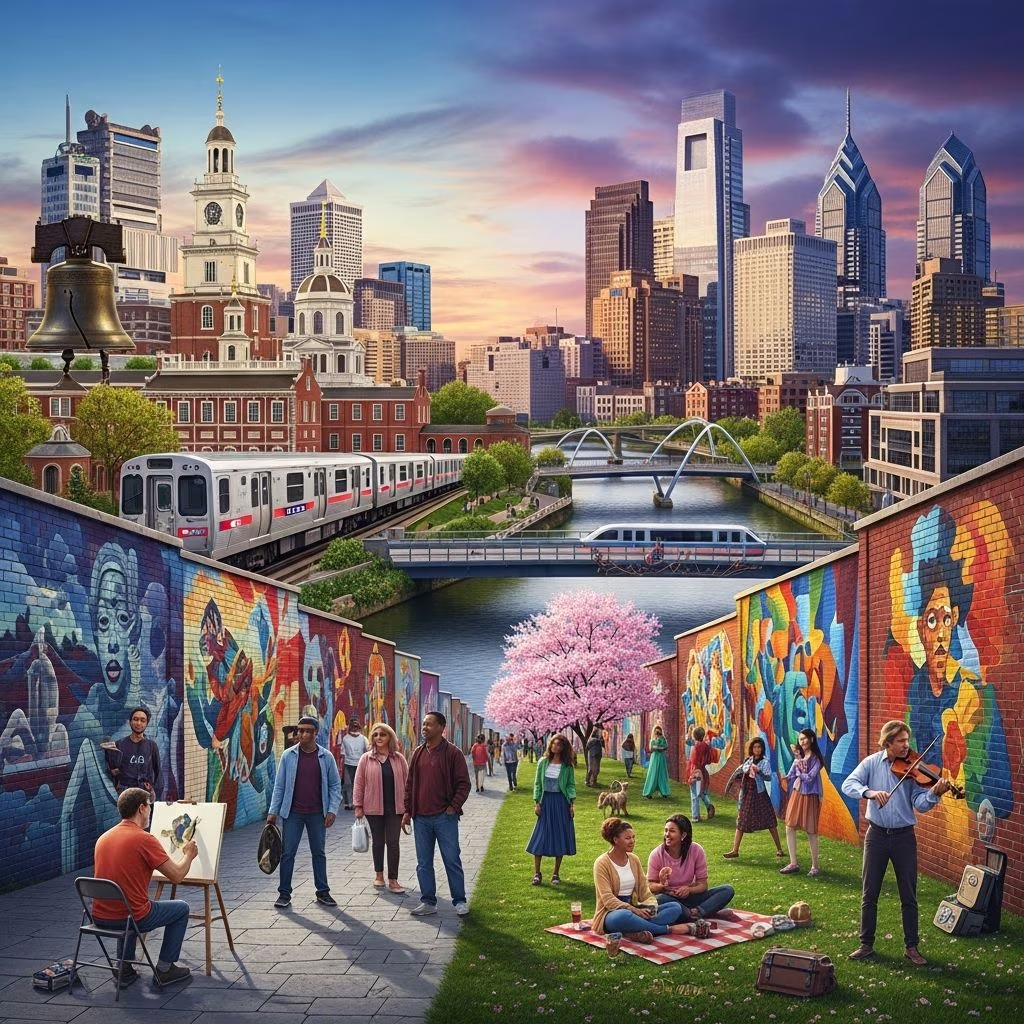
Philadelphia’s 2020 “City of Sisterly Love” campaign honored women’s suffrage, civic history, and the city’s evolving inclusive identity.
 Travel Essentials
Philadelphia stands as one of America’s most historically significant urban centers, yet its identity extends far beyond the well-known epithet that has defined it for generations. The city represents a complex tapestry of historical achievement, progressive civic values, and contemporary cultural vitality that continues to evolve with each passing year. Understanding Philadelphia requires looking deeper into the city’s layers of meaning, its celebration of diverse populations, and the ongoing conversations about representation and recognition that shape its modern character.
The etymology of Philadelphia derives from ancient Greek, with philos meaning “beloved” and adelphos referring to brotherhood. This linguistic foundation created a naming convention that persisted for centuries, yet the city’s actual demographics and values have always encompassed far more than this single interpretation suggests. Philadelphia was founded in 1682 by William Penn as a beacon of religious tolerance and democratic principles, making it a natural location for the Revolutionary Congress and the birthplace of American independence.
Throughout its history, Philadelphia has been home to influential thinkers, activists, and ordinary citizens who shaped not just the city but the entire nation. The city’s identity has continuously been negotiated and renegotiated by its residents, reflecting broader social movements and values shifts that characterize American cultural development.
One of the most significant moments in Philadelphia’s identity evolution occurred in 2020, when the city officially acknowledged a momentous historical anniversary. The ratification of the 19th Amendment to the United States Constitution on August 18, 1920, granted women the constitutional right to vote, fundamentally transforming American democracy and women’s civic participation. This marked the culmination of nearly a century of persistent advocacy and activism by the women’s suffrage movement, a movement in which Philadelphia played a central role.
To commemorate the centennial of this achievement, Philadelphia City Council unanimously passed a resolution updating the city’s nickname to reflect this historical moment. City Councilmember Katherine Gilmore Richardson, along with the city’s Women’s Caucus, proposed that Philadelphia temporarily adopt the moniker “City of Sisterly Love” for the year 2020, recognizing the contributions of women who fought for voting rights and democratic participation. This symbolic gesture represented more than mere linguistic alteration; it constituted a public acknowledgment of often-overlooked historical narratives and the women whose activism fundamentally reshaped American governance.
The nickname change was not merely ceremonial. Visit Philadelphia, the region’s official tourism authority, partnered with advertising agency Allen & Gerritsen to develop a comprehensive marketing campaign that extended throughout 2020. This initiative aimed to position Philadelphia as a destination that celebrates women’s achievements, historical contributions, and contemporary culture.
The campaign utilized multiple platforms and geographic reach to spread its message:
This multifaceted approach recognized that civic identity extends beyond a simple nickname—it encompasses the experiences visitors have, the stories they encounter, and the values a city projects to the world. By centering women’s history and contemporary female voices, Philadelphia positioned itself as a destination that actively engages with progressive values and inclusive representation.
Philadelphia’s role in the women’s suffrage movement was substantial and multifaceted. The city served as a gathering place for activists, a location where important organizational meetings occurred, and a community where women’s voices were heard and amplified. Pennsylvania itself ratified the 19th Amendment on June 24, 1919, several months before the nation’s official ratification, reflecting strong regional support for voting rights.
The city’s historical narrative includes numerous women whose names may not appear in mainstream textbooks but whose contributions shaped Philadelphia and the broader nation. From early abolitionists to labor organizers, from artists to physicians, Philadelphia has consistently attracted and produced women who challenged status quo assumptions and expanded possibilities for their communities.
The temporary nickname change raised important questions about how cities acknowledge their histories and what stories they choose to emphasize. While the original moniker references universal brotherly values, the 2020 initiative demonstrated that civic identity can be flexible, contextual, and responsive to specific historical moments and contemporary values. The decision to spotlight women’s suffrage acknowledged that complete democratic participation remains a relatively recent achievement in American history.
Furthermore, the resolution passed by Philadelphia City Council explicitly recognized that the journey toward full democratic participation for all Americans remained incomplete. The resolution noted that women of color faced ongoing voter suppression and intimidation for decades after the 19th Amendment’s ratification, with effective voting rights for Black women and other women of color not secured until the Voting Rights Act of 1965—more than 45 years after the amendment’s passage. This contextualization demonstrated Philadelphia’s commitment to acknowledging complex historical realities rather than celebrating simplified narratives.
Throughout 2020, Philadelphia hosted numerous events and programs designed to educate residents and visitors about women’s history while celebrating contemporary women’s achievements. These initiatives spanned multiple cultural domains:
| Category | Examples of Programming | Cultural Impact |
|---|---|---|
| Historical Education | Museum exhibitions, historical walking tours, archival research projects | Increased public awareness of women’s historical contributions |
| Contemporary Arts | Exhibitions by female artists, theatrical productions, literary events | Platform for current female creators and storytellers |
| Community Wellness | Fitness events, wellness workshops, health advocacy programs | Integration of women’s wellbeing into civic celebration |
| Culinary Culture | Food festivals, chef showcases, women-owned restaurant promotions | Economic support and visibility for female entrepreneurs |
The nickname change was explicitly temporary, designated for the year 2020 only. This temporary status reflected both the commemoration’s specific historical anchor—the centennial of the 19th Amendment—and broader understandings about civic identity. Philadelphia returned to its traditional moniker, “City of Brotherly Love,” in 2021, demonstrating that the city maintains its original identity while remaining open to periodic reinterpretation and expansion.
This flexibility suggests a mature approach to civic identity: the recognition that cities can honor their historical foundations while remaining responsive to contemporary values and historical reassessment. The decision did not invalidate the original nickname or suggest that the original values were insufficient; rather, it expanded the conversation to encompass additional dimensions of the city’s character and history.
Beyond the 2020 nickname initiative, contemporary Philadelphia continues to develop its identity through its residents, institutions, and cultural offerings. The city hosts world-class museums, theaters, music venues, and educational institutions. Its neighborhoods reflect diverse ethnic, cultural, and socioeconomic communities, each contributing distinct perspectives and traditions to the city’s overall character.
Philadelphia’s waterfront has undergone significant revitalization, attracting residents and visitors while preserving historical sites that connect the city to its founding era. The city’s food scene has earned national recognition, reflecting both its historical culinary traditions and contemporary innovation. Its universities and research institutions contribute substantially to American intellectual and scientific advancement.
Philadelphia temporarily changed its nickname to “City of Sisterly Love” in 2020 to commemorate the 100th anniversary of the 19th Amendment’s ratification, which granted women the right to vote. The change aimed to highlight women’s historical contributions and ongoing civic participation.
No, the nickname change was temporary and designated for 2020 only. The city returned to “City of Brotherly Love” beginning in 2021, though the year’s initiatives raised ongoing discussions about civic identity and historical recognition.
Philadelphia City Councilmember Katherine Gilmore Richardson proposed the change in collaboration with the city’s Women’s Caucus and Visit Philadelphia. The resolution passed unanimously through City Council.
Visit Philadelphia partnered with advertising agency Allen & Gerritsen to develop a comprehensive marketing campaign featuring digital displays, targeted regional marketing, and year-long programming centered on art, food, history, and women’s contributions.
Philadelphia derives from Greek terms: philos meaning “beloved” and adelphos referring to brotherhood. The 2020 initiative creatively reinterpreted this linguistic foundation to acknowledge sisterhood and female civic participation.
Philadelphia’s 2020 nickname initiative demonstrates that civic identity functions as a living, evolving process rather than a fixed designation. The city’s willingness to temporarily reframe its identity to acknowledge specific historical achievements reflects mature engagement with its own narrative complexity. While Philadelphia returned to its original moniker after 2020, the experience expanded public discourse about women’s history, voting rights, and the ongoing work of building truly inclusive democratic participation.
The city continues to balance its historical significance—as the birthplace of American independence and democracy—with its contemporary role as a vibrant, progressive urban center that actively engages with diverse communities and evolving social values. Philadelphia’s identity remains multifaceted, encompassing historical legacy, contemporary culture, diverse populations, and an ongoing commitment to democratic ideals and civic participation.
