

 Travel Essentials
 Travel Essentials

Explore the rich history of Plaza del Mercado in Valencia, tracing its evolution from a Muslim-era trading hub to a site of executions, bullfights, and the iconic Mercado Central.
 Travel Essentials
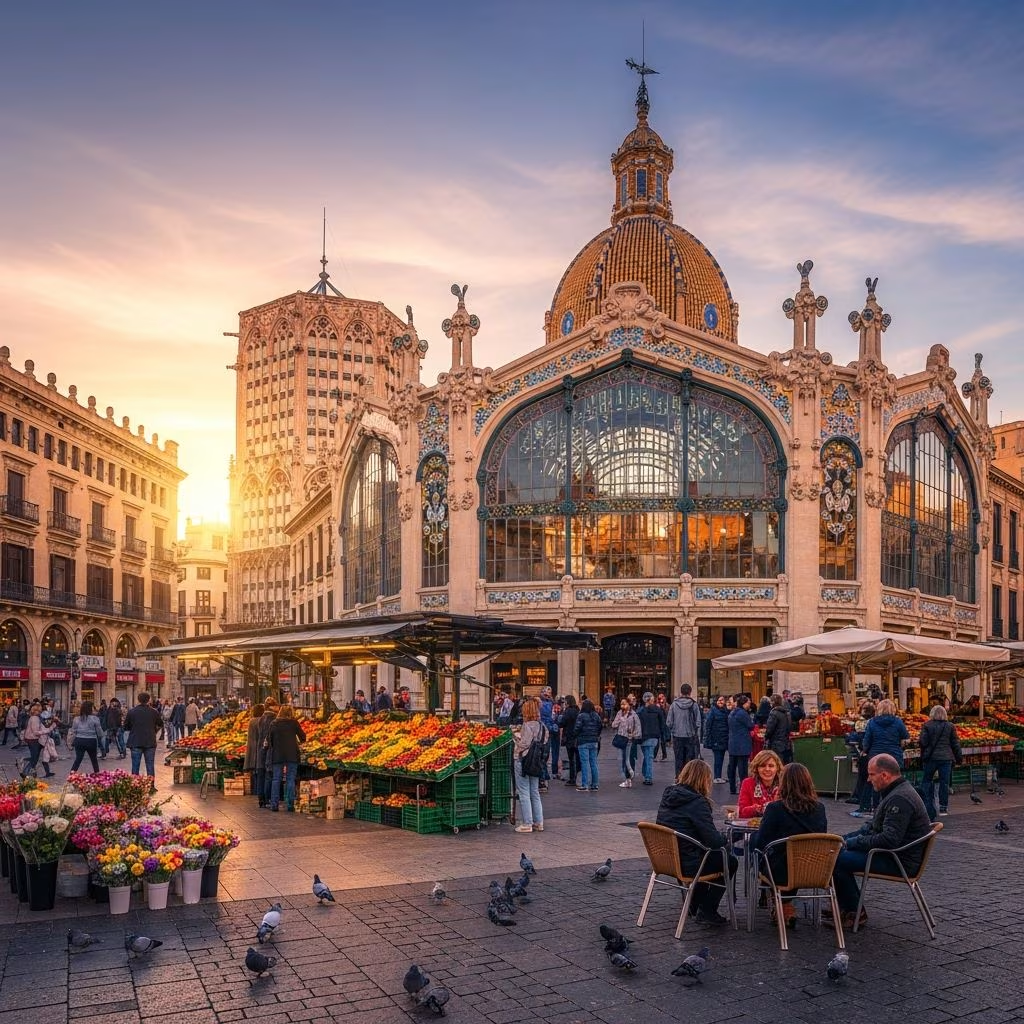
At the bustling core of Valencia lies **Plaza del Mercado**, a square that has pulsed with life for over a millennium. Once a modest trading post in a Muslim quarter, it evolved into a venue for commerce, celebrations, justice, and grim spectacles. Today, it anchors the city’s vibrant market scene, framed by architectural masterpieces like the Mercado Central and La Lonja de la Seda.
The story of Plaza del Mercado begins in the **11th century** during the era of Al-Andalus, when Valencia was under Muslim rule. Located in the La Boatella quarter near the fortress gate of Bab Al Kaisaria, this area served as a vital trading spot just beyond the city walls. Local farmers gathered on the open plain to sell produce, fostering early commercial exchanges that laid the groundwork for Valencia’s market tradition.
Following the Reconquista in 1238, King Jaime I granted rights for public markets in key cities, solidifying the plaza’s role. What started as informal gatherings transformed into structured trading zones, blending economic necessity with community life.
As Valencia expanded in the medieval period, Plaza del Mercado became fully integrated into the urban fabric. By the late 14th century, it hosted a diverse array of events: festivals lit up the nights, funerals drew solemn crowds, protests echoed demands for change, and parades celebrated triumphs. This multifaceted role made it the undisputed heart of Valencian society.
Commerce dominated daily life, with vendors hawking fresh goods amid the throng. The square’s central position ensured constant foot traffic, evolving it from peripheral markets to the city’s primary commercial nexus.
Beneath the festive veneer lurked a darker history. From the late 14th century, Plaza del Mercado doubled as an execution ground, where public hangings served as both deterrent and entertainment. In 15th-century Valencia, crowds flocked to witness these spectacles, treating them like modern sporting events—rowdy, communal affairs.
Gallows stood prominently beside the main market, impossible to ignore. Records from 1601 indicate over one hanging per month, with bodies often left displayed for days to amplify the grim message. One notorious site, now a shaded bench under a palm tree where tourists enjoy ham sandwiches, marks the approximate location of these events.
Notable cases include the 1826 hanging of Ripoll, convicted of serious crimes. Though sentenced to burning at the stake—a punishment too brutal even for the era—authorities simulated flames with painted demons on the gallows.
Executions were not the only bloody diversion. Bullfights added to the square’s repertoire of spectacles, drawing thrill-seekers to watch matadors clash with beasts in improvised arenas. These events, blending tradition with violence, reinforced the plaza’s status as a venue for communal catharsis.
Overlooking it all is **La Lonja de la Seda**, the Silk Exchange built between 1482 and 1533. This late-Gothic gem, a UNESCO World Heritage Site since 1996, symbolizes Valencia’s Golden Age of commerce and wealth from silk trade. Its intricate stonework and twisted columns have silently witnessed centuries of drama.
By the 19th century, open-air markets proved inadequate for a growing Valencia. In 1839, the first stone market—Mercado Nuevo—opened on the site, an uncovered structure handling fresh produce and daily needs.
Population booms and urbanization demanded more. Late 19th-century overcrowding prompted the city council to launch design contests. In 1910, architects **Alejandro Soler March** and **Francisco Guardia Vial**, trained in Barcelona under Modernisme pioneer Luis Doménech Montaner, won with a visionary project.
King Alfonso XIII laid the first stone on October 24, 1910, using a silver pickaxe to demolish old structures. Construction, blending Valencian Art Nouveau with Gothic and Modernist influences, spanned until 1928, completed by Enrique Viedma and Ángel Romaní. The king inaugurated it on January 23, 1928.
Dubbed the “Catedral de los Sentidos” (Cathedral of the Senses), the Mercado Central dazzles with its iron framework, colorful ceramics, mosaics, and stained glass. Over 1,000 stalls offer seafood, meats, produce, olives, rice, and local delicacies, separated by sections for hygiene.
Its design harmonizes with neighbors La Lonja and the Church of the Augustines, using vibrant tiles and ornate details inspired by Antoni Gaudí. Spanning 8,270 square meters, it’s Europe’s largest fresh produce market, attracting 40,000 visitors daily.
| Feature | Description |
|---|---|
| Construction Period | 1914–1928 |
| Architects | A. Soler March, F. Guardia Vial (initial); E. Viedma, Á. Romaní (completion) |
| Style | Valencian Modernisme/Art Nouveau |
| Stalls | Nearly 1,000 |
| Daily Visitors | ~40,000 |
Today, Plaza del Mercado thrives as a lively hub. The Mercado Central buzzes from 7:30 AM to 2:30 PM (closed Mondays), ideal for sampling paella ingredients or horchata. La Lonja entry costs €2, with audio guides at €2.50 recommended for its commerce history.
Efforts ensure this heritage endures. The Mercado Central marked 100 years since groundbreaking in 2010 and 90 since opening in 2018. UNESCO recognition for La Lonja underscores its global significance.
Plaza del Mercado encapsulates Valencia’s journey: from medieval bloodsports to modernist bounty, it remains a testament to resilience and culinary passion.
The plaza is the open square; Mercado Central is the iconic covered market building within it.
A UNESCO Gothic masterpiece symbolizing silk trade prosperity, built 1482–1533.
Yes, from the 14th century, including hangings and simulated burnings as public spectacles.
Open weekdays and Saturdays; closed Sundays and holidays. Arrive early!
Address: Plaza del Mercado, s/n, 46001 Valencia. Walkable from city center.
