


 Food & Culture
Food & Culture
Polar Bears Freeze Prey to Survive Longer Arctic Fasts
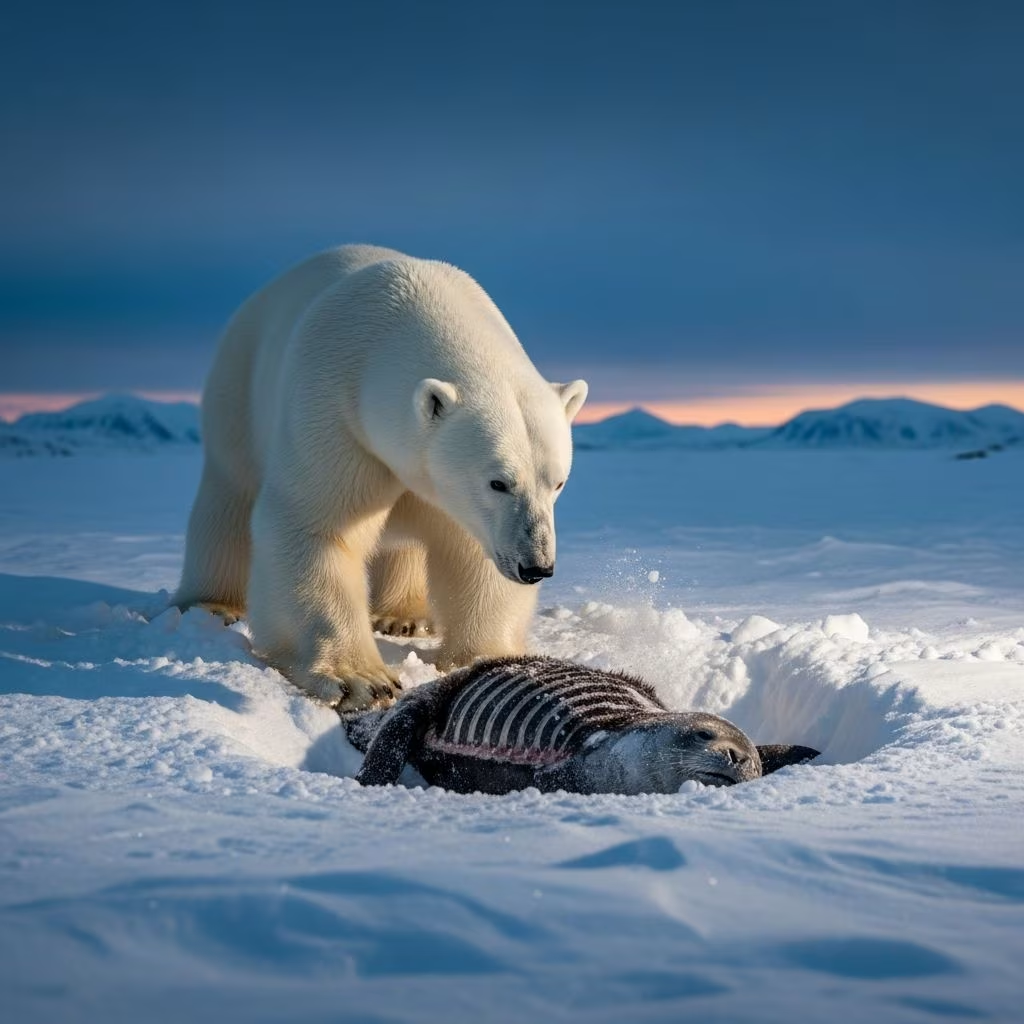
Polar bears showcase remarkable ingenuity by caching seal kills in snowbanks, a vital strategy amid shrinking sea ice and longer fasting periods.
 Food & Culture
In the harsh Arctic environment, polar bears have long been admired for their prowess as hunters, primarily targeting seals on drifting sea ice. Recent observations reveal an even more intriguing survival mechanism: these massive predators are actively freezing portions of their prey to consume later. This behavior, documented in remote regions, highlights their resourcefulness as climate change disrupts traditional hunting grounds.
The Arctic’s Changing Landscape and Bear Survival
Sea ice, the foundational platform for polar bear hunting, is diminishing rapidly due to global warming. Polar bears rely on this ice to stalk ringed and bearded seals, whose blubber provides the high-calorie fuel essential for enduring long fasts. Without ice, bears are forced onto land for extended periods, where alternative foods like berries, bird eggs, and seaweed offer insufficient energy.
Studies from the U.S. Geological Survey indicate that bears in areas like Western Hudson Bay now spend up to 140 days or more ashore annually, a trend projected to worsen. During these ice-free months, their metabolism slows dramatically, akin to hibernation, allowing them to burn fat reserves efficiently. However, prolonged fasting risks severe weight loss, with research showing an average decline of 1 kg per day regardless of activity levels.
- Sea ice melt extends land-bound periods by 5-10 days per decade in key habitats.
- Bears can consume 10-20% of their body weight in a single meal, utilizing 97% of ingested fat.
- Annual seal intake averages 50 per bear to maintain peak condition.
Observed Food Caching: A Game-Changer
Researchers have captured footage of polar bears meticulously burying seal carcasses or portions thereof in snowdrifts. By packing snow around the meat, they create natural freezers, preserving it against spoilage during warmer spells. This caching mirrors tactics used by grizzly bears but is uniquely adapted to the Arctic’s freeze-thaw cycles.
In one notable instance, a bear was seen dragging a freshly killed seal several hundred meters, digging a shallow pit, and covering it with snow before departing. Days later, it returned to unearth and feast on the still-frozen bounty. Such premeditated storage extends food availability, bridging gaps between hunts.
| Behavior | Description | Benefit |
|---|---|---|
| Caching in Snow | Burying prey in snowbanks | Preserves meat for weeks |
| Partial Consumption | Eating blubber first, saving lean meat | Maximizes energy efficiency |
| Site Selection | Choosing shaded, stable drifts | Reduces thaw risk |
Why This Strategy Emerges Now
As ice formation delays and melt accelerates, hunting windows shrink from traditional November-to-July spans. Bears must innovate to stockpile calories before retreating to shore. Fat accumulation peaks in spring (April-June), when seals are abundant, enabling bears to ‘bank’ energy for summer survival.
Unlike brown bears that hibernate through scarcity, polar bears remain active, patrolling coasts for opportunities. Caching allows them to ration kills, preventing waste and sustaining body mass critical for reproduction and winter hunts. Females, in particular, benefit, as healthier mothers produce stronger cubs.
Alternative Foraging Efforts on Land
When caching isn’t feasible, bears turn to terrestrial options, though these pale in nutritional value. Observations show 70% of land-stranded bears actively foraging:
- Berries and Vegetation: Adult females favor gooseberries and kelp, providing minimal calories.
- Bird Eggs and Nests: Raiding snow goose colonies offers quick protein but can’t sustain populations.
- Scavenging: Caribou carcasses, beluga remains, and even chewing antlers supplement diets.
- Marine Scavenging: Rare long swims yield floating seal parts, though hard to consume afloat.
Despite ingenuity, land foods supply only a fraction of seal blubber’s energy density. A study in Nature Communications confirms consistent mass loss across strategies, underscoring caching’s relative superiority.
Physiological Adaptations Supporting Resilience
Polar bears’ biology equips them for extremes. Their stomachs expand to hold massive meals, and fat metabolism hits near-perfect efficiency. During fasts, heart rates drop, and energy expenditure mimics hibernation—some bears rest 90% of the time.
Yet, limits loom. Models predict that without ice, no terrestrial diet can support current numbers. Fatter bears entering summer fare better, caching bolstering this ‘fat bank.’
“Polar bears are creative… they will search the landscape for ways to try to survive.” – Anthony Pagano, USGS Wildlife Biologist
Implications for Conservation
These behaviors signal adaptability but not invincibility. Populations in Hudson Bay and Svalbard show condition declines, with cub survival dropping. Protecting sea ice through emissions cuts is paramount; caching buys time, not a substitute habitat.
International efforts, like those by Polar Bears International, monitor trends and advocate for marine protected areas. Citizen science, including collar cams, reveals more on caching prevalence.
FAQs
How long can polar bears survive without food?
Up to 140+ days using fat reserves, slowed metabolism, and strategies like caching.
Is land food enough for polar bears?
No—terrestrial calories can’t replace seal blubber for population-level survival.
Why freeze food instead of eating it all?
To ration high-fat meals across extended ice-free periods, preventing starvation.
Are all polar bears doing this?
Observed in multiple subpopulations, increasingly as ice loss intensifies.
What threatens this adaptation?
Erratic weather thaws caches; deeper ice loss outpaces behavioral shifts.
Comparing Survival Strategies
| Strategy | Energy Yield | Accessibility | Sustainability |
|---|---|---|---|
| Seal Hunting on Ice | High (blubber-rich) | Seasonal | Declining |
| Food Caching | High | Moderate | Promising short-term |
| Terrestrial Foraging | Low | High | Insufficient |
| Fasting/Resting | Relies on reserves | Always | Temporary |
This table illustrates why caching stands out amid converging pressures.
References
- Why Polar Bears Can’t Survive on Terrestrial Foods — Polar Bears International. 2023-05-15. https://polarbearsinternational.org/news-media/articles/polar-bears-land-based-foods/
- Polar Bears Risk Starvation as Arctic Ice Sheets Melt — Earth.Org. 2023-10-12. https://earth.org/polar-bears-at-risk-of-starvation-as-arctic-ice-sheets-melt-scientists-warn/
- Polar bears’ desperate struggle to find food in a melting Arctic — El Pais. 2024-02-14. https://english.elpais.com/climate/2024-02-14/polar-bears-desperate-struggle-to-find-food-in-a-melting-arctic.html
- This Is How POLAR BEARS FIND FOOD AFTER 140 Days… — YouTube (Wildlife Channel). 2024-08-20. https://www.youtube.com/watch?v=-rJ72MzBbO8
- As Arctic summers lengthen, some polar bears are at increased risk of starvation — The Wildlife Society. 2024-01-10. https://wildlife.org/as-arctic-summers-lengthen-some-polar-bears-are-at-increased-risk-of-starvation/
← Previous
Bosnia and Herzegovina Travel Guide: Nature, History & Adventure
Next →
Washington DC Bike Guide: Best Routes, Rentals & Safety Tips
Related Reading
More in Food & Culture
Food & Culture Food & Culture
 Food & Culture
Best Places to Eat in Rome: Neighborhood Dining Guide
 Food & Culture
 Food & Culture