

 Travel Essentials
 Travel Essentials

Explore Pompeii’s rise, eruption, rediscovery, and must-see ruins, plus practical tips for visiting this unforgettable Roman city.
 Travel Essentials
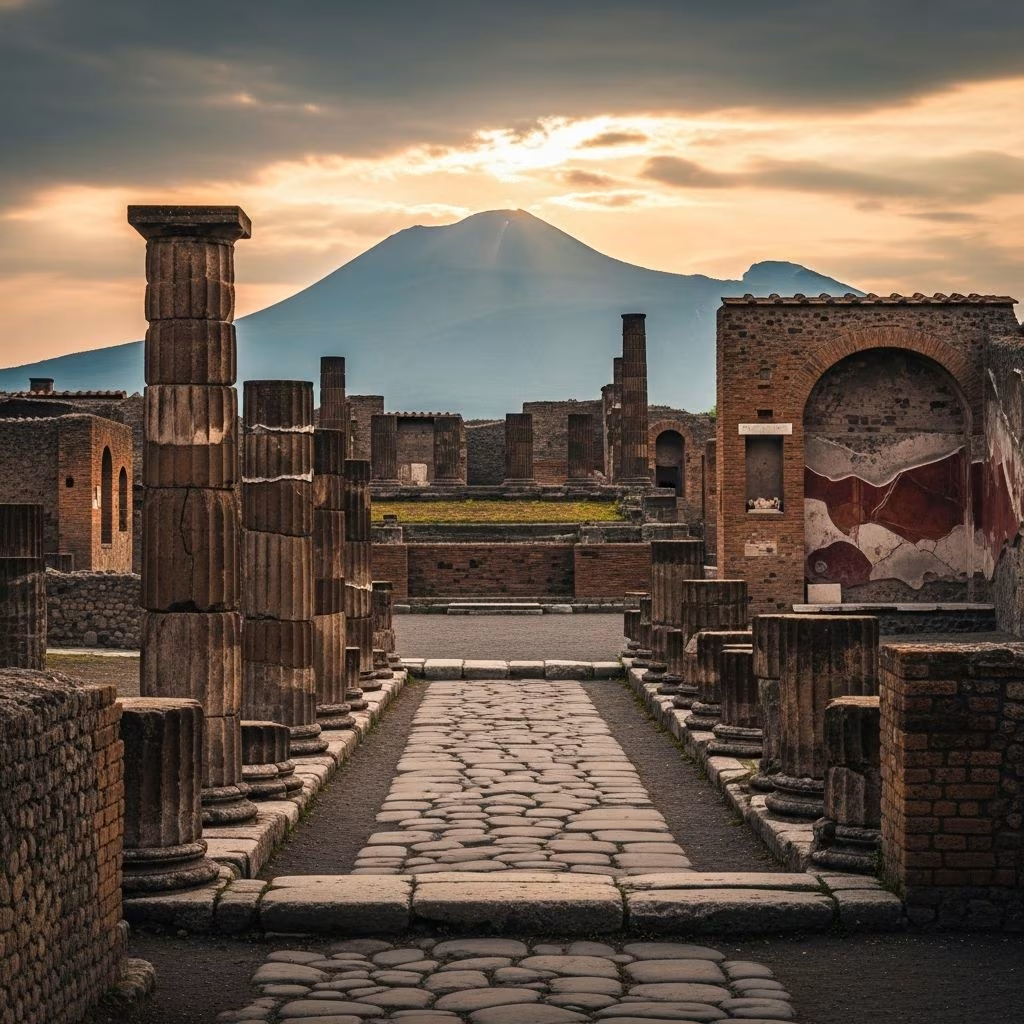
The ruins of Pompeii stand as one of the world’s most evocative archaeological treasures, offering a stark window into daily life in ancient Rome before a volcanic cataclysm sealed its fate. Buried under layers of ash and pumice in 79 AD, this once-thriving city near Naples, Italy, has revealed villas, temples, theaters, and even the plaster casts of its final residents, preserved in haunting detail.
Pompeii’s story begins in the 8th century BC, when Oscans—indigenous people from central Italy—established initial villages along the fertile slopes overlooking the Bay of Naples. These early settlements capitalized on the region’s volcanic soil, ideal for agriculture, and its strategic coastal position, which attracted traders.
By around 740 BC, Greek colonists from nearby Cumae influenced the area, introducing advanced architecture and religious practices. They constructed the Doric Temple in what later became the Triangular Forum, a structure that symbolized the fusion of local and Hellenic cultures. Greek and Phoenician merchants used Pompeii’s natural harbor as a safe anchorage, boosting trade in goods like wine, olive oil, and ceramics.
In the 6th century BC, Etruscans expanded their influence, erecting defensive walls of tufa stone and building the Temple of Apollo near an emerging forum. This period marked Pompeii’s growth into a fortified port city within the Etruscan League. However, control shifted after the Battle of Cumae in 474 BC, when Greeks from Cumae and Syracuse ousted the Etruscans, ushering in a phase of Greek dominance.
Samnite tribes from the Apennines conquered Pompeii around 5th century BC, strengthening its defenses with orthostate walls—slabs of Sarno limestone filled with earth for added resilience. Despite Samnite rule, Pompeii aligned with Rome during conflicts like the Samnite Wars and Pyrrhus’s invasion, earning favor from the expanding republic.
The Second Punic War (218–201 BC) further solidified ties; Pompeii’s loyalty amid Hannibal’s campaign prompted Rome to reinforce its walls with tufa and agger ramps. By the 2nd century BC, prosperity soared from Rome’s eastern conquests. Lucius Mummius, after sacking Corinth, gifted a statue of Apollo, funding grand projects: the Large Theatre, Temple of Jupiter, Basilica, Stabian Baths, and a multi-story portico around the Forum.
At its peak, Pompeii housed 10,000–20,000 residents, including affluent merchants, businesswomen, and slaves. Lavish villas featured frescoes, mosaics, and atriums, while public spaces buzzed with markets, elections, and gladiatorial games. An earthquake in 62 AD damaged structures, but repairs were underway when disaster struck.
| Era | Major Developments | Key Structures |
|---|---|---|
| Pre-Roman (8th–5th BC) | Oscan, Greek, Etruscan influences; trade hub | Doric Temple, Apollo Temple, city walls |
| Roman Era (4th BC–79 AD) | Expansion, wealth from conquests | Forum, Theatre, Baths, Basilica |
On August 24, 79 AD, Mount Vesuvius unleashed a Plinian eruption, one of history’s most documented volcanic events, chronicled by Pliny the Younger. It began mid-day with ash and pumice raining down, blanketing Pompeii in over 9 feet (3 meters) of debris by evening.
The next morning, August 25, pyroclastic surges—scorching clouds of gas, rock fragments, and air racing at high speeds—swept over the city, asphyxiating those sheltering indoors or fleeing. Additional flows and ash rains added another 9 feet, entombing Pompeii under 19–20 feet (6 meters) total. Herculaneum, nearby, suffered even denser nuées ardentes.
Many perished instantly from heat (up to 500°C) or toxic gases; others suffocated under collapsing roofs. Bodies decayed, leaving voids in the ash filled with plaster to create casts revealing final poses: families huddled, a dog chained, lovers embraced.
“Fragments of ash and other volcanic debris began pouring down on Pompeii, quickly covering the city to a depth of more than 9 feet.”
Forgotten for 1,500 years, Pompeii resurfaced in the late 16th century when architect Domenico Fontana uncovered artifacts while digging a water channel. Systematic excavations launched in 1748 under Rocque Joaquin de Alcubierre, revealing streets, homes, and frescoes remarkably intact due to the ash seal.
Early digs were chaotic, plagued by looting and damage; treasures filled European cabinets. By 1960, about two-thirds of the 66 hectares were exposed, though decay set in from exposure. Modern efforts since the 2010s prioritize conservation, with UNESCO status since 1997 and new finds in unexcavated zones.
Visitors wander via 11km of streets lined with chariot ruts, past 200+ bakeries, taverns, and brothels. Standouts include:
Over 1,100 casts capture human tragedy, displayed poignantly amid the ruins.
Pompeii sprawls over 44 excavated hectares; allocate 4–6 hours. Enter via Porta Marina; audio guides or apps enhance context. It’s open daily 9 AM–7 PM (winter 9 AM–5 PM, last entry 90 mins before close). Tickets: €18 standard, €22 with Vesuvius access; book online to skip lines.
Best Times: Spring (April–June) or fall; avoid peak summer heat. Wear sturdy shoes for uneven cobblestones; bring water, hat, sunscreen. Restricted zones require guides; full-site passes available.
| Practical Info | Details |
|---|---|
| Location | 15km southeast of Naples; 25km from Sorrento |
| Access | Circumvesuviana train to Pompeii Scavi station |
| Facilities | Cafes, restrooms, shaded areas; no large bags |
| Duration | Half/full day; combine with Herculaneum |
Combine with Oplontis or Boscoreale for deeper insight. Respect rules: no touching, drones, or littering—fines apply.
Exposure to elements, tourism (4M+ visitors/year), and vandalism threaten the site. Initiatives like the Great Pompeii Project (2012–) restore frescoes, roofs roofs, and drains using EU funds. Innovations include 3D scanning and AI for virtual reconstructions.
Only one-third remains unexcavated, promising more discoveries like recent banquet rooms with frescoes. Sustainable tourism caps daily visitors and promotes off-peak visits.
How long did the Vesuvius eruption last? About 2 days, from August 24–25, 79 AD, with continuous ash fall and surges.
Was Pompeii a wealthy city? Yes, home to opulent villas, public baths, theaters, and diverse commerce.
Can you see Vesuvius from Pompeii? Absolutely; hike its crater (30-min drive, guided tours required).
Are there bodies in Pompeii? Plaster casts of voids left by decayed bodies; originals in museums.
Is Pompeii worth a full day? Yes, for its scale and immersion in Roman life.
Best ticket option? Online advance purchase avoids queues; family/group deals available.
Beyond ruins, Pompeii humanizes antiquity—graffiti of lovers’ quarrels, election posters, bakery counters with carbonized loaves. It reveals a vibrant society: multicultural, commercial, pleasure-seeking. For scholars, it’s a stratigraphy of Roman urbanism; for all, a meditation on impermanence.
Visiting evokes awe and melancholy, bridging 2,000 years. Pair with Naples Archaeological Museum for looted artifacts. Pompeii endures not just as rubble, but as eternity’s snapshot.
