

 Travel Essentials
 Travel Essentials

Explore the Portuguese Way, a historic pilgrimage route combining spiritual journey, cultural immersion, and sustainable travel through Portugal and Spain.
 Travel Essentials
The Camino de Santiago represents one of Christianity’s most significant pilgrimage traditions, with pilgrims traveling hundreds of kilometers to reach Santiago de Compostela in Spain, believed to house the remains of Saint James the Apostle. While multiple routes exist to this spiritual destination, the Portuguese Way stands out as a compelling alternative to more crowded pathways. This centuries-old route connects Portugal and Spain through landscapes rich in history, culture, and natural beauty, offering modern travelers a distinctive approach to one of the world’s great pilgrimages.
The Portuguese Way emerged as a major pilgrimage route during the medieval period, gaining prominence in the 12th century following Portugal’s establishment as an independent nation. Unlike some Camino routes that developed primarily through religious sponsorship and royal patronage, the Portuguese Way grew organically from the natural movement of pilgrims traveling northward from Portuguese territories toward Santiago de Compostela. This route traverses ancient pathways with deep historical roots, including sections of Via XIX, a Roman military road constructed in the first century AD that connected Braga with Astorga through strategic medieval settlements.
The significance of the Portuguese Way extends beyond its historical timeline. Kings, nobility, and clergy from Portuguese territories actively supported and undertook this journey, establishing it as an essential component of the broader Jacobean devotion tradition. Notable among these pilgrims was Dona Isabel of Portugal, a holy queen who walked the route during the 14th century, offering her crown at Santiago’s altar and requesting burial with a pilgrim’s staff—a powerful testament to the route’s spiritual importance within Portuguese culture.
The Portuguese Way offers flexibility in starting locations, with pilgrims typically beginning their journey from either Porto or Lisbon, both providing distinct experiences and distances. The full journey from Lisbon spans approximately 600 kilometers, while the Porto route measures 260 kilometers. Starting from Lisbon allows travelers to experience a gradual elevation change, beginning at low elevations with accessible walks through river valleys before transitioning into increasingly hilly terrain as the route progresses northward.
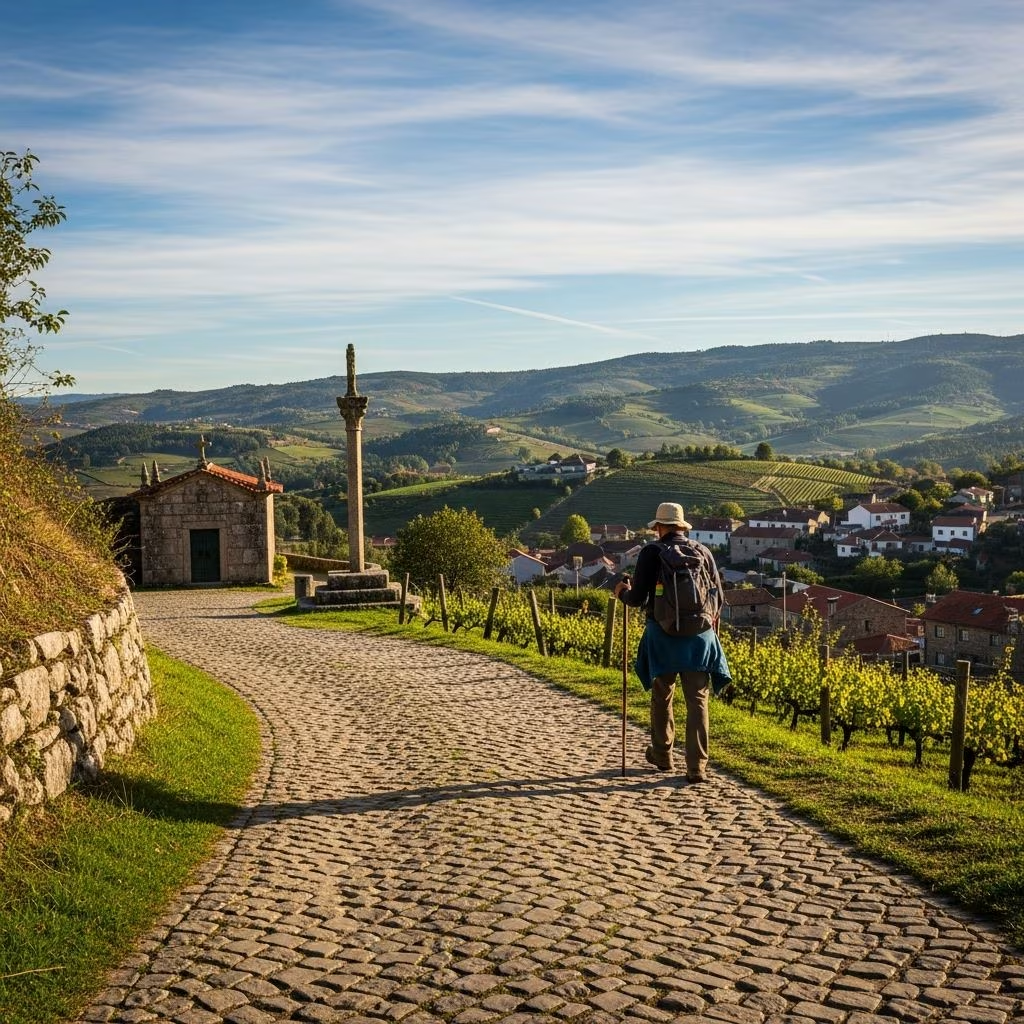
The journey follows well-established paths that wind through both inland and coastal regions. From Porto, pilgrims travel northward crossing five major rivers—the Ave, Cávado, Neiva, Lima, and Minho—before entering Spanish territory. The route then proceeds through Pontevedra en route to Santiago de Compostela. A coastal variant branches near the Miño River, hugging the Atlantic shoreline before reconnecting with the inland route at Redondela, allowing pilgrims to customize their experience based on preferences for mountain or coastal scenery.
One of the most compelling advantages of the Portuguese Way is its relatively modest pilgrim traffic compared to more famous routes like the Camino Francés. While the route maintains a robust community of modern pilgrims, travelers experience significantly fewer crowds, creating an ideal balance. Pilgrims still encounter the renowned sense of camaraderie and shared purpose that defines the Camino experience, but without the overwhelming congestion found on busier pathways. This balance allows individuals to engage authentically with fellow travelers, local communities, and their own spiritual journey simultaneously.
The Portuguese Way uniquely traverses two nations, providing travelers with distinct cultural, linguistic, and geographical experiences within a single pilgrimage. The route moves through Portuguese villages, towns, and countryside before crossing into Spanish territory, offering immersive exposure to different regional traditions, cuisines, and architectural styles. This cross-border dimension enriches the pilgrimage experience, transforming it into a cultural bridge between two Iberian nations with interconnected histories.
Unlike heavily urbanized routes or those dominated by international tourism infrastructure, the Portuguese Way passes through communities that have experienced population decline as younger residents migrate to major cities. By undertaking this pilgrimage, travelers directly support these villages through accommodation purchases, meal expenses, and local commerce. This economic contribution helps sustain rural communities and their traditional ways of life, making the pilgrimage inherently sustainable before sustainability became trendy. The route promotes what might be termed “slow travel”—a deliberate pace emphasizing observation, reflection, and genuine human interaction rather than rapid destination consumption.
The Portuguese Way draws its spiritual authority from deep Christian tradition and legend. According to tradition, Saint James the Apostle’s disciples transported his body by sea in a vessel guided by angels, eventually landing near Iria Flavia (modern-day Padrón, which lies on the Portuguese Way route). The apostle was subsequently buried in a field, remaining undiscovered until the 9th century when a hermit named Pelagius reportedly observed a celestial star indicating the burial location.
Following this discovery, King Alfonso II of Asturias traveled from Oviedo to confirm the remains’ authenticity and commissioned construction of a small church at the site around 830 AD. This king’s journey is historically recognized as the original Camino de Santiago, eventually formalized as the Camino Primitivo. The Catholic Church widely disseminated the discovery narrative through art and hymns, since most medieval populations could not read. The reliquary’s significance was amplified by medieval beliefs that venerating holy remains could facilitate miracles and spiritual salvation, and that undertaking pilgrimage could earn indulgences forgiving sins.
The Portuguese Way connects pilgrims to this legendary history—some modern travelers even opt to follow the supposed maritime route Saint James’s disciples took, beginning their journey from Portuguese coastal areas and traveling by boat before continuing overland to Santiago.
The Portuguese Way embodies sustainable pilgrimage principles through its fundamental structure and operation. Pilgrims traverse the entire distance on foot or by bicycle, eliminating motorized transportation and reducing environmental impact to minimal levels. This human-powered journey creates authentic engagement with landscapes, seasonal changes, and local communities in ways that cannot be replicated through vehicular travel.
The modern pilgrimage experience has evolved considerably from its purely religious origins. Contemporary pilgrims undertake the journey for diverse motivations: spiritual seeking, physical fitness challenges, personal reflection during major life transitions, or simple desire to decelerate and practice mindfulness. The Portuguese Way accommodates this diversity of purpose while maintaining its historical integrity. The sustainable methodology inherent to the route—foot-based travel, extended time in rural areas, economic support for small communities—aligns with contemporary values regarding responsible tourism and environmental consciousness.
The Portuguese Way is not monolithic but rather comprises multiple pathway options accommodating different preferences and time constraints:
The route supports pilgrim needs through established networks of hostels, guesthouses, and services. While infrastructure is less commercialized than on major routes, sufficient accommodation and dining options exist, particularly in larger towns and established stopping points. The relative lack of over-development means lower costs and more authentic local interactions compared to heavily touristed routes.
| Route | Distance | Popularity | Crowds | Starting Point |
|---|---|---|---|---|
| Portuguese Way | 260-600 km | Growing | Moderate | Porto/Lisbon |
| Camino Francés | 780 km | Highest | Very High | Saint-Jean |
| Camino Primitivo | 321 km | Moderate | Low-Moderate | Oviedo |
| Northern Way | 836 km | Moderate | Moderate | Irún |
The duration depends on the starting point and pace. The 260-kilometer Porto route typically requires 12-14 days of walking, while the 600-kilometer Lisbon route necessitates 25-30 days. Individual pace varies based on fitness level, daily mileage preferences, and rest days incorporated into the itinerary.
Spring (April-May) and fall (September-October) offer ideal conditions with moderate temperatures, manageable rainfall, and reasonable accommodation availability. Summer months attract more pilgrims and higher temperatures, while winter brings cold, wet conditions and reduced services in smaller towns.
The Portuguese Way accommodates varying fitness levels. The terrain progresses gradually from flat river valleys to rolling hills, allowing adequate acclimatization. Most reasonably healthy individuals can complete the journey with appropriate training and gradual daily mileage building.
Budget pilgrimages cost €30-50 daily when using affordable hostels and local food. Mid-range pilgrims spending €50-80 daily enjoy private rooms and better dining. Costs vary based on accommodation choices, dining preferences, and individual spending patterns.
No. While the route originates from Christian tradition, modern pilgrims encompass diverse backgrounds and motivations. The journey offers spiritual, physical, and personal benefits regardless of religious affiliation or lack thereof.
The Portuguese Way represents a growing trend toward alternative Camino routes as awareness spreads regarding options beyond the Camino Francés. Contemporary pilgrimage has become less exclusively religious and more inclusive of diverse seekers pursuing personal transformation, physical challenge, cultural immersion, and meaningful reflection. The Portuguese Way accommodates these contemporary motivations while maintaining historical authenticity and spiritual significance.
The route gained increasing recognition following literary works and cultural moments that elevated broader Camino awareness. The publication of Paulo Coelho’s 1988 novel “The Pilgrimage” and Pope John Paul II’s publicly documented Camino walk during the 1980s catalyzed international interest in pilgrimage traditions. The Portuguese Way benefits from this expanded interest while offering those seeking less-trameled experiences an ideal alternative.
The Portuguese Way distinguishes itself among pilgrimage options through its combination of historical significance, sustainable methodology, manageable pilgrim community, dual-country experience, and support for rural communities. For those drawn to pilgrimage but hesitant about crowded major routes, the Portuguese Way offers authentic spiritual journey, physical challenge, cultural immersion, and personal transformation. Whether undertaken for religious devotion, fitness goals, career transition reflection, or simple desire to slow down and reconnect with one’s inner life, the Portuguese Way delivers a distinctive Camino experience rooted in centuries of tradition while fully welcoming modern pilgrims of all backgrounds and motivations.
