

 Travel Essentials
 Travel Essentials

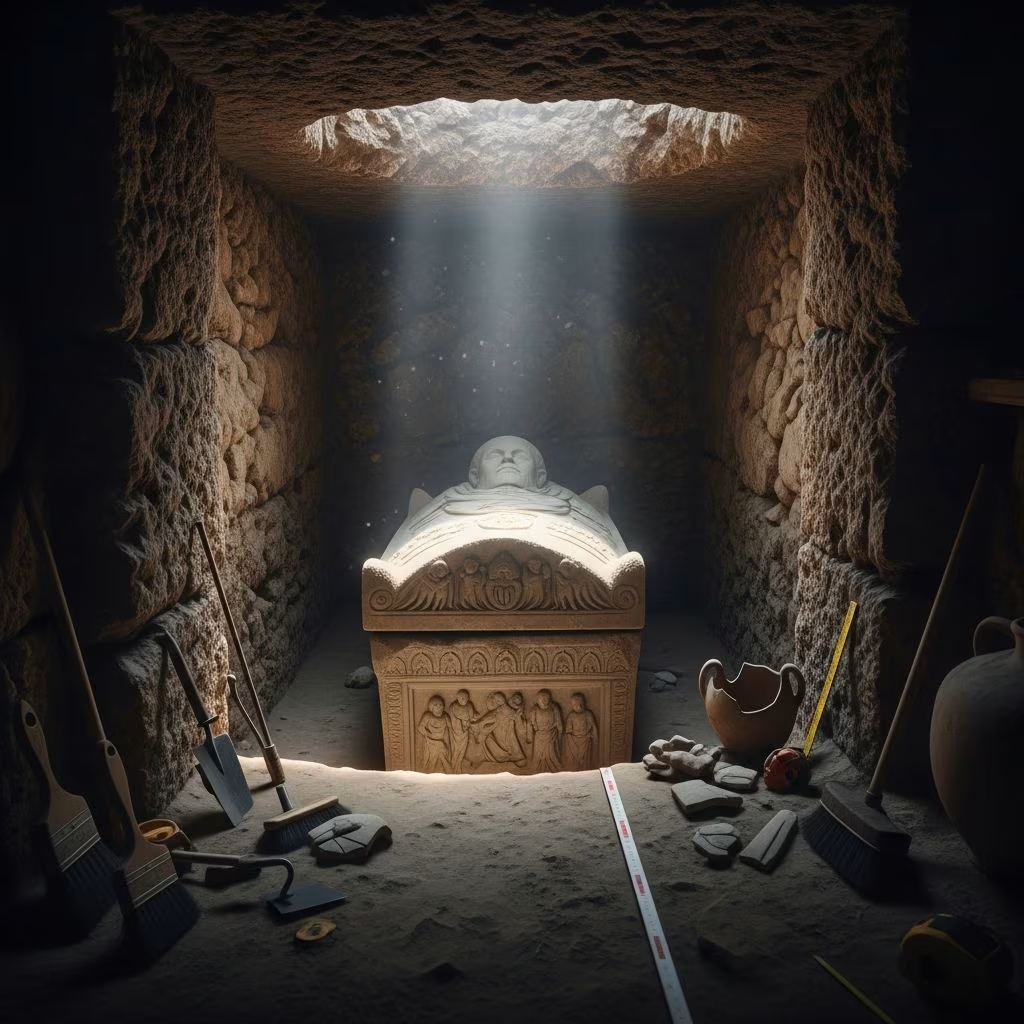
Archaeologists in Rome uncovered an ancient underground shrine and empty sarcophagus that may have honored Romulus, shedding new light on Rome's origins.
 Travel Essentials
Recent excavations in the heart of Rome’s ancient Forum have brought to light a remarkable underground structure: a temple and sarcophagus potentially dedicated to Romulus, the mythical founder of the city. Dating back to the 6th century B.C., this discovery sheds new light on early Roman beliefs and sacred sites.
Romulus stands as a cornerstone figure in Roman mythology, credited with establishing the city around 753 B.C. alongside his twin brother Remus. Abandoned as infants and nurtured by a she-wolf, the brothers grew to adulthood and selected the Palatine Hill as the site for their new settlement. Their partnership ended tragically when Romulus killed Remus during a dispute over the city’s boundaries, cementing Romulus’s role as Rome’s first king.
Ancient texts portray Romulus not just as a ruler but as a deified hero. After his mysterious disappearance during a storm on Capitoline Hill, Romans believed he ascended to godhood as Quirinus. This apotheosis fueled the creation of shrines honoring his legacy, blending myth with nascent civic religion.
The find occurred beneath the Curia Julia, the remnants of Rome’s Senate House, during investigations into early 20th-century digs by Giacomo Boni. Archaeologists from the Parco Archeologico del Colosseo revealed a hypogeum—a subterranean temple—complete with a circular votive altar and a tuff sarcophagus measuring 1.4 meters long.
Crafted from light volcanic tuff quarried from the nearby Capitoline Hill, the empty coffin suggests it symbolized Romulus’s spiritual presence rather than holding physical remains. The site’s preservation indicates its high reverence in antiquity, positioned under the Comitium, the ancient assembly area for public votes.
The Roman Forum served as the epicenter of public life, hosting political debates, trials, and religious rites. The Comitium, adjacent to this new find, was where citizens gathered for assemblies, making the tomb’s placement symbolically potent.
Nearby lies the Lapis Niger, a black marble-paved shrine unearthed in 1899, inscribed with warnings against profaning its sacred grounds. It contained archaic remains interpreted as those of a ‘holy king,’ possibly Romulus, slain by senators in legend. This clustering of sites underscores the Forum’s role in perpetuating founder myths.
| Sacred Site | Description | Connection to Romulus |
|---|---|---|
| Lapis Niger | Black stone shrine with inscriptions | Possible burial spot of murdered Romulus |
| New Hypogeum | Underground temple with altar and sarcophagus | Dedicated to Romulus’s deified presence |
| Comitium | Ancient assembly area | Overlaid the tomb, central to early governance |
Directed by Alfonsina Russo of the Colosseum Archaeological Park, the excavation builds on Boni’s efforts, which exposed the Lapis Niger. Advanced 3D laser scanning has captured the site’s intricacies, aiding future analysis. Further digs are slated post-April, probing deeper layers for artifacts or inscriptions.
Though no bones were found, the structure’s design and location align with ancient accounts of Romulus worship. Experts like Paolo Carafa emphasize that Romulus’s historical existence matters less than his symbolic role in marking Rome’s political genesis.
“Whether Romulus existed or not is not important. What matters is that this figure is considered by the ancients to mark the political birth of the city.” — Paolo Carafa, Archaeologist
Romulus’s story intertwines legend and history. Virgil’s Aeneid and Livy’s histories romanticize his deeds, from wolf-rearing to senatorial betrayal. The empty sarcophagus mirrors tales of his bodily ascension, prioritizing divine cult over mortal tomb.
This discovery validates literary references to a sepulcher in the Forum, revered through the Republic and Empire. It highlights how Romans engineered sacred narratives to legitimize their expanding dominion.
The hypogeum dates to the 6th century B.C., a formative era post-monarchy, during Rome’s transition to republic. Such shrines reinforced communal identity, linking citizens to divine origins amid Etruscan influences.
Comparatively, other founder cults—like Athens’ Theseus—served similar unifying functions. In Rome, Romulus’s veneration persisted, with temples to Quirinus enduring centuries.
While excavations continue, the Forum remains accessible via standard tickets to the Colosseum Archaeological Park. The Curia Julia area offers views of the dig context, though the hypogeum is underground and not yet open to the public.
Future openings could enhance tours, pairing the site with Lapis Niger visits for a full mythical circuit.
Alfonsina Russo notes the tomb’s importance stems from its preservation beneath monumental structures, signaling elite sanctity. BBC reports caution against overclaiming, absent scientific proof like DNA, yet affirm its cultural weight.
Scholars view it as evidence of 6th-century religious architecture, rare for pre-Republican Rome, potentially reshaping timelines of sacred space development.
Empty tombs pose verification hurdles; tuff’s commonality precludes unique identifiers. Inscriptions or offerings might clarify dedication, pending further digs. Meanwhile, the site’s alignment with texts like Plutarch’s Life of Romulus bolsters the hypothesis.
This unearthing revitalizes debates on Rome’s archaic phase, bridging mythic narratives with material culture. It invites reevaluation of Forum stratigraphy, possibly revealing more early temples.
For global audiences, it humanizes Rome’s grandeur, showing how legends anchored a superpower’s identity.
No bones confirm it, but location and features match ancient beliefs in his Forum sepulcher.
November, prior to February announcements, with scans completed.
Currently no; excavations ongoing. Monitor Colosseum Park updates.
Tuff from Capitoline Hill, 1.4m long.
Indirectly, as part of twin-founder myth, though focused on Romulus’s deification.
