

 Travel Essentials
 Travel Essentials

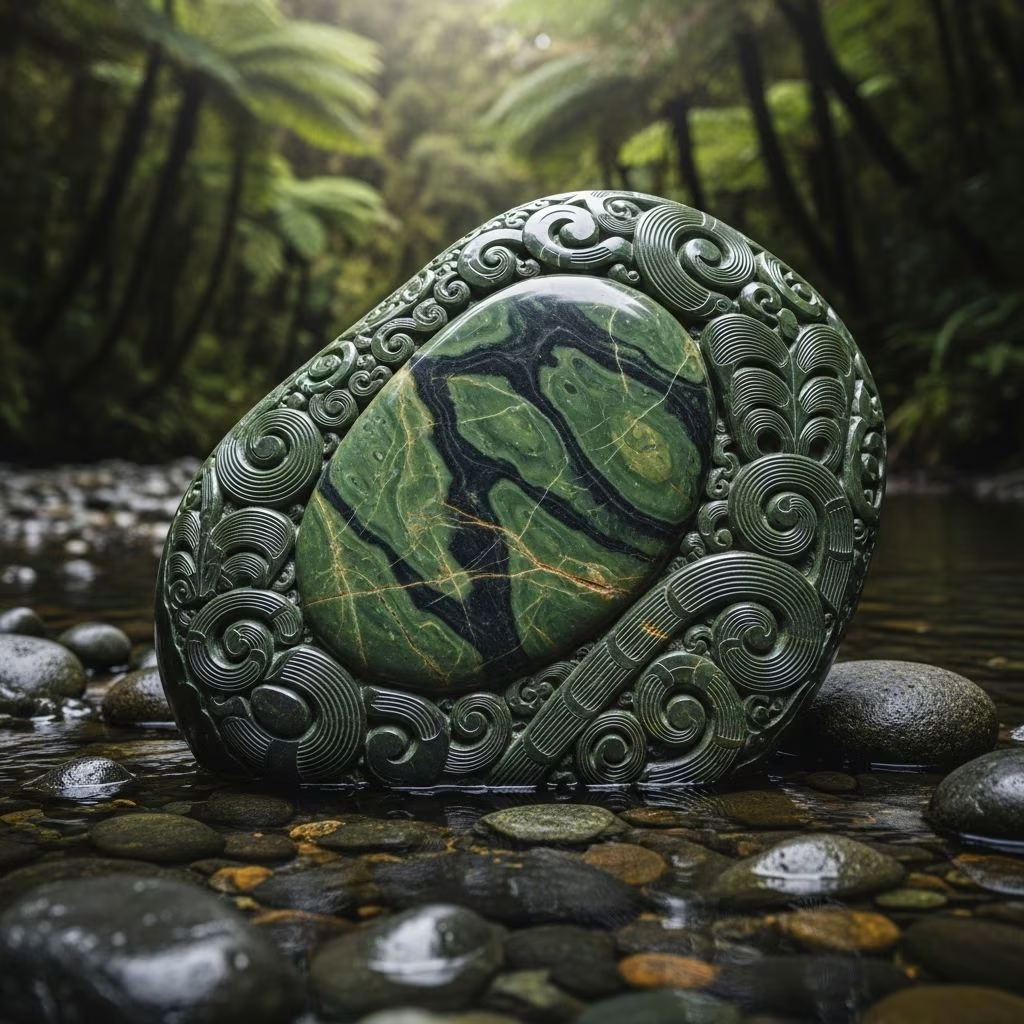
Explore the origins, varieties, symbolism, and guardianship of New Zealand greenstone (pounamu), a stone of immense spiritual power central to Māori identity and national pride.
 Travel Essentials
New Zealand’s greenstone, known as pounamu in Māori, holds a revered place in the nation’s cultural fabric. This durable, translucent stone, primarily nephrite jade, originates exclusively from the South Island and embodies deep spiritual, historical, and economic value for Māori people.
Pounamu forms through metamorphic processes in the rugged terrains of New Zealand’s South Island, particularly in regions like Westland and Fiordland. These areas, part of Te Wāhipounamu (‘the greenstone waters’), feature glacier-fed rivers that erode boulders of this precious material from ancient mountain sources.
The stone’s formation links to tectonic activity millions of years ago, where ultramafic rocks transformed under intense pressure and heat into tough varieties of jade. Nephrite, the dominant type, ranks high on the Mohs hardness scale, making it ideal for carving while resisting fracture.
Legend ties pounamu’s arrival to the demigod Ngahue, who transported it from Hawaiki to hide in southwestern rivers, where it continues to surface naturally. This mythology underscores its sacred status, portraying the stone as a gift from the Earth Mother, Papatūānuku.
Pounamu exhibits a spectrum of colors from deep green to rare translucent hues, each variety named after natural elements or locations, reflecting Māori’s intimate bond with the environment.
| Variety | Color Characteristics | Traditional Associations |
|---|---|---|
| Inanga | Pale, milky white-green | Resembles cooked eel (inanga), symbolizing purity |
| Kahurangi | Clear, brilliant green | Rarest and most valued, evoking sky or clear water |
| Kawakawa | Deep green with dark flecks | Named after kawakawa leaf, linked to healing |
| Tangiwai | Bowenite, weepy translucent | Resembles tears, associated with bowenite form |
These distinctions influence carving choices, with kahurangi prized for its clarity and kahurangi for high-status items. Authentic pounamu must hail from approved South Island sites to bear the official Ngāi Tahu certification.
Pre-colonial Māori harnessed pounamu’s toughness for practical and ceremonial purposes. Adzes (toki) fashioned from it cleared forests, while mere clubs served as elite weapons, their lethal edges polished to a sheen.
As a status symbol, pounamu signified chiefly authority; high-ranking individuals wore large pendants, denoting mana (prestige). Trade networks spanned Aotearoa, with the South Island dubbed Te Wai Pounamu due to its economic centrality—pounamu rivaled food in value, fueling intertribal exchanges.
Europeans arriving in the 19th century prized it similarly, but overexploitation prompted guardianship reforms.
To Māori, pounamu transcends material worth; it pulses with mauri (life force), bridging the physical and spiritual realms. Viewed as a taonga (treasure), it connects wearers to tūpuna (ancestors) and whenua (land).
Karakia (prayers) bless carvings, infusing them with protective energies. Gifting pounamu seals bonds, as in peace treaties symbolized by a ‘door of greenstone’—unbreakable alliances. Its vitality demands respect; lost pieces are mourned, retrieved ones ritually cleansed.
Each motif draws from nature and whakapapa (genealogy), personalizing the taonga to the wearer’s story.
In 1997, the Ngāi Tahu Claims Settlement restored pounamu rights to Ngāi Tahu iwi, who now oversee extraction as kaitiaki (stewards). Only hand-gathered river boulders qualify as authentic, with quotas preserving riverscapes.
Ngāi Tahu Pounamu verifies carvings from licensed sources, combating fakes from overseas jade or serpentine. Artisans employ traditional techniques alongside modern tools, blending heritage with innovation.
Travelers encounter pounamu ubiquitously—from Hokitika’s carvers to Queenstown galleries. West Coast trails like the Greenstone Track offer immersion amid sourcing rivers.
Respect protocols: Seek Ngāi Tahu-stamped pieces; understand gifting etiquette—recipients polish with skin oils to activate mauri. Museums like Te Papa showcase heirlooms, illuminating its narrative.
Folk traditions attribute pounamu with warding illness and fostering wellbeing, worn close to the heart. Globally, it captivates as sustainable jewelry, its allure amplified by Māori storytelling.
Incorporate visits to carving workshops for live demonstrations, deepening appreciation beyond souvenirs.
Pounamu refers specifically to nephrite and bowenite from New Zealand’s South Island, while jade encompasses nephrite and jadeite worldwide. New Zealand jade emphasizes cultural context.
No, collection is illegal without Ngāi Tahu authorization to protect resources and cultural integrity. Purchase verified carvings instead.
Wear it often to build mauri; cleanse with water, avoid harsh chemicals. Store wrapped in cloth.
Its exceptional clarity and rarity command premium prices, reserved historically for elite items.
Key sites:
Respect tikanga (customs) for meaningful encounters.
