

 Travel Essentials
 Travel Essentials

Explore Prambanan Temple, Indonesia's largest Hindu temple compound and UNESCO World Heritage Site, featuring 240 structures dedicated to the Hindu trinity.
 Travel Essentials
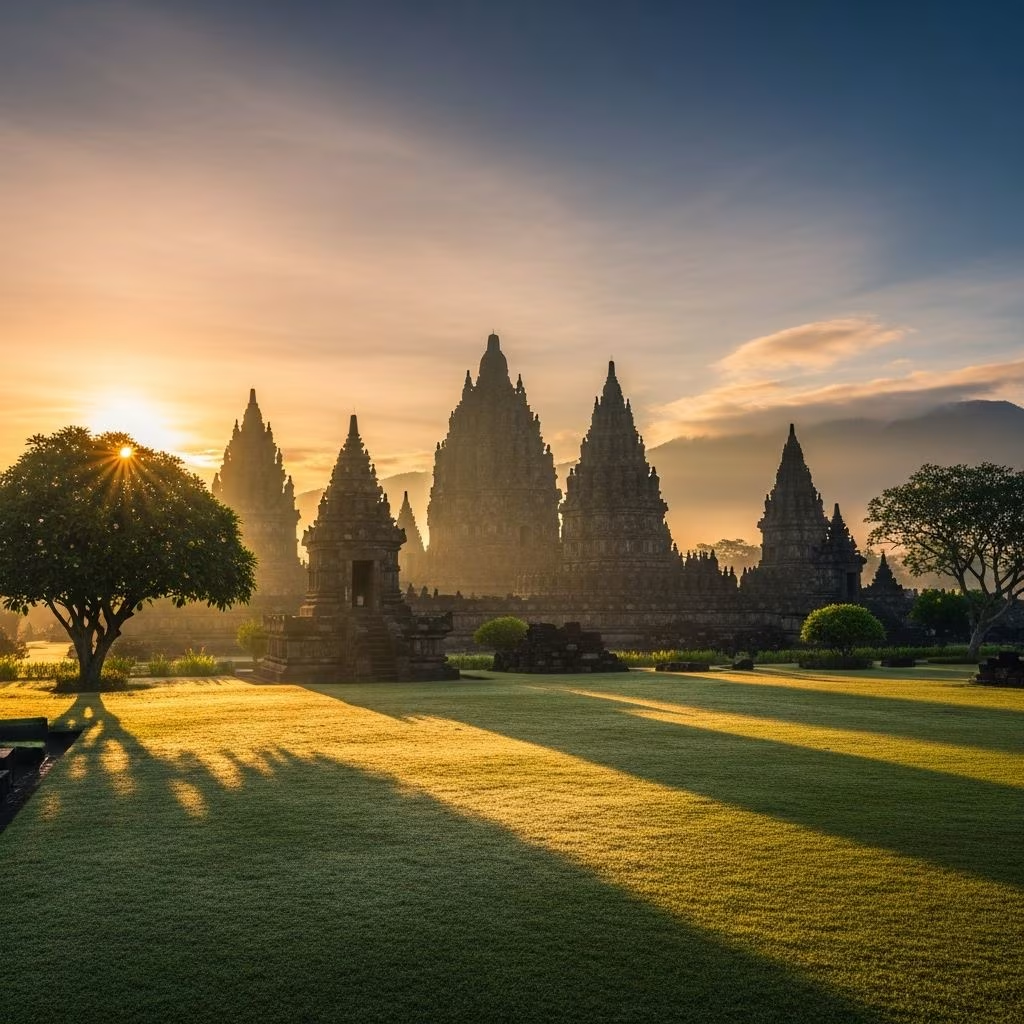
Rising majestically from the plains of Java, Prambanan Temple stands as Indonesia’s most impressive Hindu religious structure and a testament to centuries of architectural excellence. Located in Yogyakarta in southern Java, this magnificent compound represents not merely a place of worship but an extraordinary achievement in classical Hindu-Javanese civilization. The temple’s distinctive silhouette, characterized by its soaring central tower and intricate stone carvings, attracts pilgrims and travelers from around the globe, making it one of Southeast Asia’s most visited cultural landmarks.
What distinguishes Prambanan from other religious structures throughout Asia is its sheer magnitude and comprehensive design. The temple compound originally encompassed 240 individual temple structures, each contributing to a unified spiritual and architectural vision. The most prominent feature is the central sanctuary tower, which soars to a height of 47 meters (154 feet), commanding attention and reverence from visitors approaching the site. This towering structure represents the apex of Hindu temple architecture in medieval Java and remains the largest Hindu temple site in Indonesia.
The temple’s UNESCO recognition as a World Heritage Site acknowledges its status as the second-largest Hindu temple complex in Southeast Asia, surpassed only by the renowned Angkor Wat in Cambodia. The architectural design reflects the fundamental principles of Hindu cosmology, with the complex arranged in concentric patterns representing the hierarchical universe and divine realms.
Historical records indicate that construction of Prambanan commenced around the middle of the 9th century, specifically around 850 AD. Rakai Pikatan, a ruler of the Sanjaya dynasty, initiated the temple’s construction as the royal shrine of the Medang Mataram kingdom. This royal patronage was crucial in establishing the temple’s significance as the primary religious center for Hindu worship in Central Java during its golden age.
Following Rakai Pikatan’s initial vision, subsequent rulers expanded and refined the complex. His successor, King Lokapala, formally inaugurated a major temple structure known as the Shivagrha (the House of Shiva) in 856 AD, as documented in the Shivagrha inscription discovered at the site. Later rulers, including Dyah Balitung Maha Sambu, continued the development of the temple compound, adding structures and embellishments that enhanced the complex’s spiritual and aesthetic qualities.
At the spiritual heart of Prambanan lies a profound theological concept: the veneration of the Trimurti, the Hindu trinity representing the three fundamental aspects of divine power. The main sanctuaries within the complex are dedicated to Shiva (the Destroyer and Transformer), Brahma (the Creator), and Vishnu (the Preserver). Each deity occupies a position of honor within the complex, with elaborate temples constructed specifically to honor their respective divine functions.
Complementing these principal temples are six smaller sanctuaries dedicated to the sacred animals associated with each deity. These vahana temples honor:
The repetition of these spiritual elements throughout the compound reinforces the fundamental Hindu principles and creates a landscape imbued with religious symbolism.
Prambanan exemplifies the distinctive characteristics of Hindu temple architecture adapted to the Javanese context. The temples showcase tall, pointed architecture rising in pyramid-like formations, a hallmark of classical Hindu temple design. The structures are decorated with intricate stone reliefs that narrate episodes from the Ramayana, one of Hinduism’s most sacred epics.
The complex demonstrates an advanced understanding of structural engineering and stone-building technology that was remarkable for the 8th and 9th centuries. The arrangement of over 500 individual structures within the Prambanan Archaeological Park (which includes associated temples such as Sewu, Bubrah, and Lumbung) reflects sophisticated urban and religious planning. These temples are organized in three concentric zones, each representing different levels of spiritual access and importance within the Hindu cosmological framework.
The temple carries multiple names reflecting different linguistic traditions and historical contexts. In Indonesian, it is known as Candi Prambanan, while in Javanese it is called Rara Jonggrang, which translates to “the Temple of the Slender Virgin.” The etymology of “Prambanan” remains subject to scholarly debate.
Some historians propose that the name derives from Para Brahman, a Hindu theological term meaning “the God Almighty,” suggesting the temple’s primary spiritual focus. Alternative interpretations suggest the name references the numerous Brahmin priests who resided within the temple compound during its periods of greatest vitality and influence. The local designation as the Temple of the Slender Virgin connects to Javanese legend and folklore surrounding the site’s legendary origins.
During its golden age following its completion in the 9th century, Prambanan functioned as the royal shrine and the preeminent center of Hindu religious practice throughout Java. The temple attracted numerous Brahmin scholars and priests who established communities within the compound’s outer zones, creating a vibrant intellectual and spiritual center that influenced Hindu practice across the region.
However, the temple’s prominence was not permanent. Less than a century after its inauguration, significant changes disrupted the region’s stability. The massive eruption of Mount Merapi in the 10th century prompted the royal court to relocate from Central Java to East Java. This geographical displacement, orchestrated by Mpu Sindok, fundamentally altered the political and religious landscape of Java, leading to Prambanan’s gradual abandonment and the loss of institutional support for its maintenance.
As the centuries progressed, the temple fell into disrepair and was largely forgotten by the surrounding population, its religious significance diminished as Buddhist and Islamic traditions gained prominence in Java.
The temple’s architectural integrity suffered catastrophically during a major earthquake in the 16th century. This seismic event caused extensive collapse of the temple structures, leaving the compound in ruins for centuries. The damage was so severe that many of the original 240 structures were reduced to rubble, and the site remained largely untouched for prolonged periods.
The long hiatus between the temple’s destruction and modern restoration efforts meant that substantial portions of the original complex were lost to time, weathering, and natural decay. This rupture in the site’s physical continuity separated the medieval religious complex from the restored monument visible to contemporary visitors.
Recognition of Prambanan’s historical and cultural significance led to its designation as a UNESCO World Heritage Site, acknowledging its status as a masterpiece of classical Indonesian civilization. This international recognition has facilitated ongoing restoration and preservation efforts, allowing modern visitors to experience a reconstructed version of this ancient sanctuary.
The UNESCO designation emphasizes that Prambanan represents “the grandiose culture of Siva art as a masterpiece of the classical period in Indonesia.” The temple complexes embody not merely religious devotion but also demonstrate “high levels of stone building technology and architecture from the 8th century AD in Java,” providing archaeological evidence of sophisticated construction techniques employed by medieval Javanese civilizations.
Beyond its architectural and spiritual dimensions, Prambanan serves as a remarkable testament to religious pluralism and peaceful coexistence. The Prambanan Archaeological Park, encompassing over 500 temples collectively, represents a period when Hindu, Buddhist, and indigenous Javanese spiritual traditions coexisted and influenced one another. This syncretism is visible in the architectural styles, sculptural programs, and religious practices evident throughout the compound.
The presence of multiple temple complexes dedicated to different spiritual traditions within the same geographical area suggests a sophisticated society where religious identity was not necessarily exclusive or antagonistic. This pluralistic approach to spirituality, preserved in stone and architectural forms, offers valuable insights into pre-Islamic Javanese civilization.
Located approximately 15 kilometers east of Yogyakarta, Prambanan is readily accessible to international and domestic visitors. The temple’s status as Indonesia’s largest Hindu temple complex and a major UNESCO World Heritage Site ensures that it receives substantial visitor traffic throughout the year. The site includes visitor facilities and interpretive resources designed to enhance understanding of the temple’s historical, architectural, and spiritual significance.
Modern restoration work has made substantial portions of the temple accessible for exploration, though visitors should be aware that significant sections remain under restoration or are inaccessible due to ongoing preservation efforts. The site represents a fusion of ancient ruins and contemporary reconstruction, allowing visitors to appreciate both the temple’s original grandeur and the challenges involved in preserving ancient monuments.
Prambanan’s significance extends beyond historical interest or tourist attraction. The temple remains spiritually meaningful to Hindu communities throughout Indonesia and beyond, who continue to recognize its sacred importance despite its weathered state and partially reconstructed nature. The site serves as a powerful reminder of Java’s pre-Islamic Hindu-Buddhist heritage and the sophisticated civilizations that flourished in the archipelago centuries before European contact.
As both an archaeological monument and a living cultural landmark, Prambanan embodies the complexity of heritage preservation in the contemporary world. The temple demonstrates how ancient structures can be simultaneously recognized as historical artifacts worthy of scientific study and restoration, while also maintaining spiritual significance for descendant communities and pilgrims who recognize their cultural identity within its stones and sacred spaces.
