


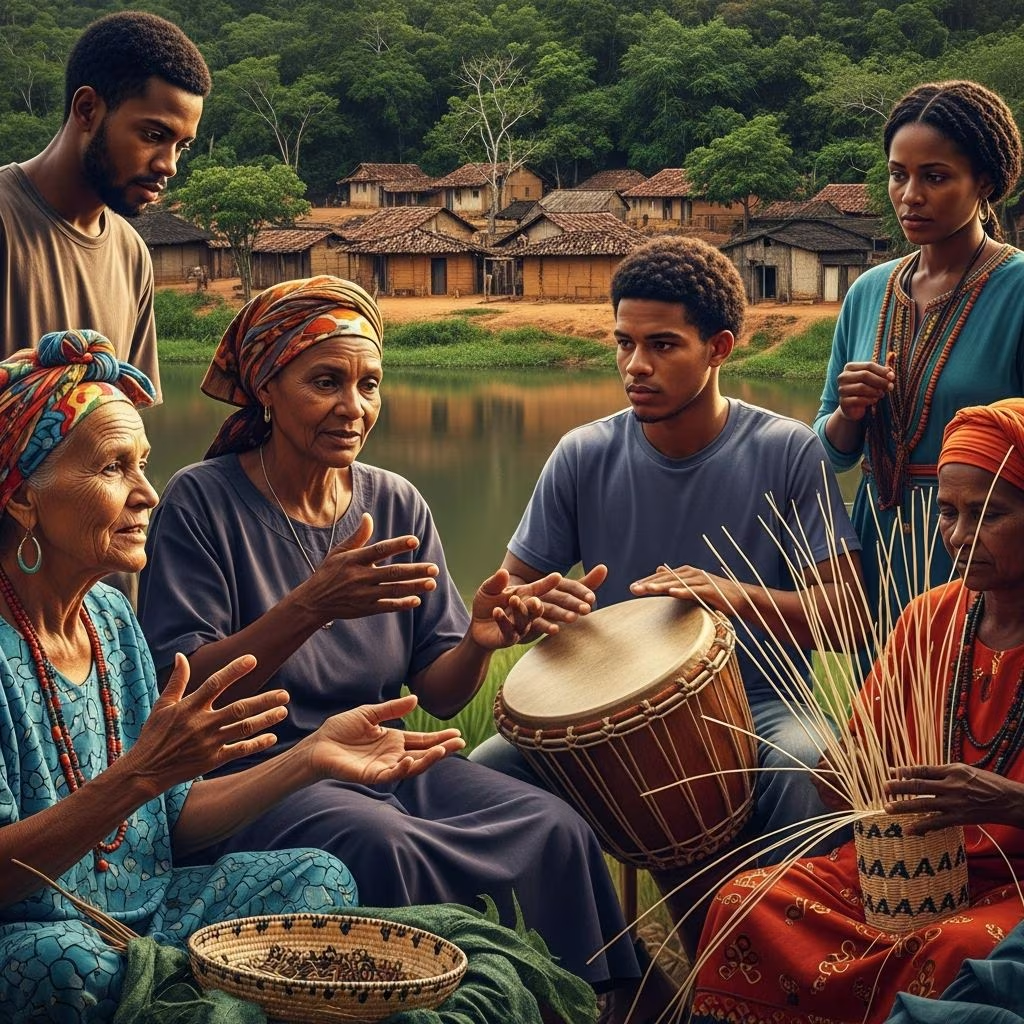
Quilombos represent far more than historical curiosities in Brazil’s complex narrative—they embody centuries of resilience, cultural preservation, and ongoing struggles for recognition and justice. These communities, rooted in African traditions and shaped by the brutal reality of slavery, continue to thrive as living repositories of Afro-Brazilian identity. Understanding quilombos requires examining their multifaceted origins, their transformation over time, and their contemporary significance in a nation still grappling with the legacy of over 350 years of enslavement.
Origins and Formation During the Era of Enslavement
The emergence of quilombo communities cannot be separated from Brazil’s tragic history as the primary destination for the transatlantic slave trade. Beginning in the early-to-mid 1500s and continuing until 1888, Brazil received an estimated 4.9 million enslaved Africans—roughly 46 percent of all Africans forced into the Americas. This staggering volume of human trafficking created conditions that sparked resistance and fostered the formation of autonomous communities.
The term “quilombo” itself originates from Central African languages, deriving from words meaning “encampments” or “villages.” In earlier colonial texts dating from the mid-16th century, such communities were referred to as “mocambos,” terminology that underscores the African linguistic and cultural foundations of these settlements. These were not haphazard refuges but deliberately constructed societies built according to African organizational principles.
Quilombos formed through multiple pathways. The most commonly understood mechanism involved enslaved individuals escaping plantations and establishing remote settlements in forests, mountainous terrain, and other geographically isolated regions where colonial authorities struggled to maintain control. However, quilombo formation was far more complex than simple flight. Communities also emerged through the donation of land to freed individuals, inheritance of property, and the occupation of territories by Black families during the final decades of slavery and the immediate post-abolition period. Some quilombos arose when enslaved people were simply abandoned by their enslavers, left to fend for themselves on marginal lands.
Geographic Spread and Regional Variations
Rather than remaining confined to a single region, quilombos proliferated across Brazil’s diverse landscapes. The most historically prominent quilombo, Palmares, flourished across parts of what are now Alagoas and Pernambuco from 1575 to 1743, led by renowned leaders including Ganga-Zumba and Zumbi. This massive settlement demonstrated the scale and organizational capacity these communities could achieve.
Beyond Palmares, quilombo settlements appeared throughout the Amazon basin, in the northeastern states of Bahia, Sergipe, Rio Grande do Norte, and Piauí, and in interior regions including Goiás, Mato Grosso, and Minas Gerais. During the 19th century, particularly in the decades immediately preceding abolition in 1888, quilombo communities multiplied dramatically, especially in São Paulo, Rio de Janeiro, and Rio Grande do Sul.
Urban quilombos also developed in coastal cities. Salvador, Bahia, witnessed numerous small quilombos on its forested and hilly outskirts during the early 19th century, serving as sanctuaries for urban enslaved populations involved in resistance conspiracies and insurrections. In the south, fugitive communities settled in river valleys near Rio de Janeiro and engaged in wage labor for cane farmers or collected and sold wood in the imperial capital.
Economic Systems and Subsistence Practices
Quilombo communities developed sophisticated agricultural and economic systems that contradicted colonial narratives portraying them as lawless bands. Archaeological and historical evidence reveals that complex smallholder farming experiments emerged from quilombo settlements themselves. These communities practiced diversified agriculture, producing food for their own consumption while occasionally generating surplus for trade.
The economic independence these communities achieved through farming and artisanal production became a critical factor in their sustainability and longevity. By producing their own food and engaging in selective trade, quilombos reduced dependence on stolen goods or raiding—practices that might have invited immediate military reprisals. Instead, many communities functioned as relatively stable settlements with clear territorial boundaries and established social structures.
Interactions with Indigenous Peoples
A significant and often overlooked dimension of quilombo history involves their relationships with indigenous populations. As quilombo communities moved into Brazil’s interior, they encountered indigenous groups, resulting in interactions that ranged from peaceful coexistence to violent conflict. Archaeological findings at the quilombo of Carlota in Mato Grosso, attacked in 1795, revealed communities composed of both Indians and mixed-race descendants of Blacks and Indians living together.
Colonial authorities deployed indigenous battalions to combat quilombo settlements, successfully dismantling communities such as Buraco do Tatu in 1764 and Oitizeiro in 1806, both located near plantation areas in Bahia. These encounters, while sometimes resulting in conflict, also created opportunities for cultural synthesis and shared resistance against colonial oppression.
Evolution of Quilombo Identity and Definition
The meaning and legal definition of quilombos have undergone significant transformation, particularly following Brazil’s democratic transition. Scholars and researchers, working alongside community leaders and social movements, have advocated for expanded definitions that move beyond the narrow historical conception of quilombos as escape communities.
Contemporary quilombo identity incorporates multiple dimensions including memory, ethnicity, territorial connection, and citizenship rights. This reimagining reflects the lived reality of communities that may not have originated through dramatic escapes but that share deep African ancestral connections, communal land management practices, and commitment to preserving Afro-Brazilian cultural traditions. The redefinition also acknowledges quilombos throughout the Americas, including maroons in the Caribbean, cumbes in Venezuela, palenques and cimarrones in Colombia and other regions, recognizing these communities as expressions of a broader diaspora experience.
Legal Recognition and Contemporary Status
The Brazilian government formally acknowledged quilombos as legitimate communities through constitutional recognition in 1988, marking a watershed moment in their legal status. However, official recognition requires communities to navigate a rigorous and challenging process to secure both the quilombo designation and formal land title. This bureaucratic pathway reflects ongoing tensions between state recognition and grassroots community autonomy.
Current estimates suggest that approximately 6,000 quilombo communities exist throughout Brazil, potentially encompassing as many as three million people by the middle of the 21st century. Despite this substantial population, quilombos remain marginalized within national consciousness and policy frameworks.
Land Struggles and Contemporary Activism
Access to and control of land constitutes the central battleground for contemporary quilombos. The struggle for secure land tenure involves ongoing political mobilization, governmental intervention, participation of academic researchers and anthropologists, parliamentary advocacy, and most importantly, direct community organizing. These campaigns intersect with broader conversations regarding racial inequality, reparations for centuries of enslavement, public policy formation, and the expansion of citizenship rights for Afro-Brazilian populations.
Cultural Preservation and Spiritual Traditions
Quilombos function as guardians of Afro-Brazilian cultural heritage with particular significance for religious and artistic expression. In Rio de Janeiro’s port district, where more than 1.5 million captured Africans arrived after surviving the Atlantic crossing, communities of liberated Blacks established centers for practicing African religions and maintaining spiritual traditions. The rhythmic accompaniment of drums during religious ceremonies directly contributed to the emergence of samba, one of Brazil’s most recognizable cultural forms, born from the synthesis of African spiritual practice and Brazilian creativity.
These spiritual and artistic traditions represent more than entertainment or cultural curiosity—they constitute acts of cultural resistance, mechanisms through which communities maintain connections to ancestral heritage while adapting to Brazilian circumstances.
Visiting and Engaging with Quilombo Communities
Many quilombo communities, particularly those organized in urban areas or proximate to travel infrastructure, welcome respectful visitors genuinely interested in their history and activism. Community leaders actively facilitate engagement with outsiders, recognizing opportunities to share their narratives and build solidarity networks. Typical visits incorporate hiking excursions, guided historical tours, and participatory cultural activities including traditional music and dance performances.
Such encounters require visitors to approach quilombos with appropriate respect and genuine intellectual curiosity rather than voyeuristic fascination. Authentic engagement means supporting community-led initiatives and understanding quilombos as living, evolving communities rather than static historical artifacts.
Quilombos as Symbols of Resistance
Beyond their historical significance, quilombos embody ongoing resistance against multiple forms of oppression including cultural erasure, environmental destruction, and persistent racism. Contemporary quilombos draw their strength from these historical predecessors while engaging with current struggles for social justice, land rights, and recognition of Afro-Brazilian contributions to national culture and society.
The resilience demonstrated by quilombo communities throughout centuries of adversity—from plantation slavery through post-abolition marginalization to contemporary land disputes—reflects a determination to survive, thrive, and maintain cultural integrity despite systematic efforts to erase their presence and significance from historical memory.
Understanding Quilombos in Broader Context
Quilombos cannot be understood solely through individual community histories; they represent a collective phenomenon shaped by Brazil’s central role in the transatlantic slave trade and the distinctive character of enslavement in the Portuguese-speaking world. The communities that emerged demonstrate the agency, creativity, and organizational capacity of African and Afro-descended peoples navigating impossible circumstances.
Today’s quilombos carry forward legacies of resistance while articulating contemporary demands for recognition, reparation, and rights. They serve as repositories of African-rooted knowledge, artistic expression, spiritual practice, and historical memory, offering Brazil and the world crucial lessons about cultural survival, community solidarity, and the persistence of dignity in the face of dehumanizing systems.
References
- Brazil’s quilombos: the heart of Afro-Brazilian history — Lonely Planet. Retrieved April 2026. https://www.lonelyplanet.com/articles/brazils-quilombos-the-heart-of-afro-brazilian-history
- Quilombos, hotbeds of Afro-Brazilian resistance — UNESCO Courier. Retrieved April 2026. https://courier.unesco.org/en/articles/quilombos-hotbeds-afro-brazilian-resistance
- Genetic Ancestry Reveals Historical Diversity of Formation Across Brazilian Quilombo Communities — National Center for Biotechnology Information (NCBI). Retrieved April 2026. https://pmc.ncbi.nlm.nih.gov/articles/PMC12828477/
- They won’t burn our ancestry: Contextualizing Quilombos in Brazil — University of Pennsylvania Scholarly Commons. Retrieved April 2026. https://dia.upenn.edu/en/content/RochaG001/
- Quilombo: Brazilian Maroons during slavery — Cultural Survival Quarterly. Retrieved April 2026. https://www.culturalsurvival.org/publications/cultural-survival-quarterly/quilombo-brazilian-maroons-during-slavery

