

 Travel Essentials
 Travel Essentials

Discover how raicilla and tequila differ in history, geography, production, flavor, and legal status—from industrial tequila to artisanal raicilla.
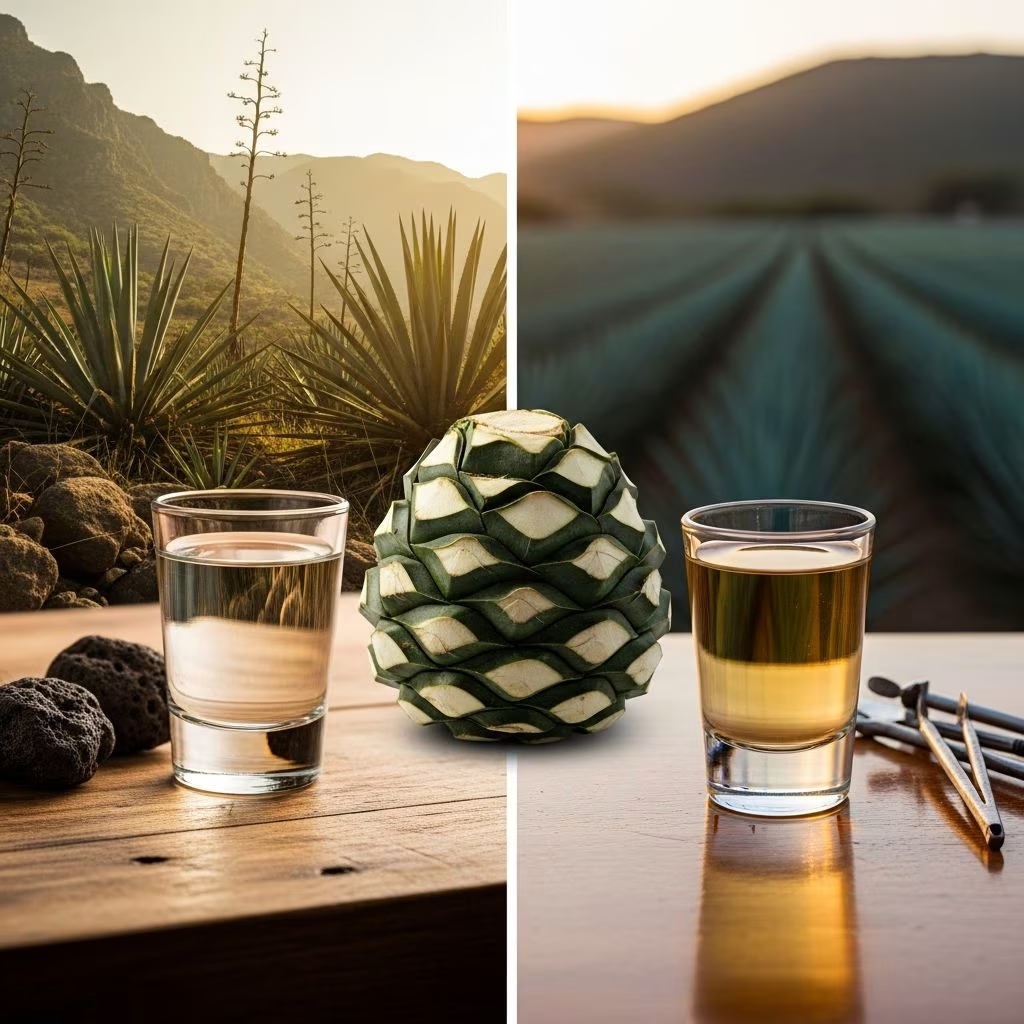 Travel Essentials
Mexico’s most celebrated agave-based spirits represent two distinct paths in the country’s distilled heritage. While tequila has achieved worldwide recognition and industrial scale, raicilla remains a carefully guarded tradition rooted in coastal and mountainous regions of Jalisco. Understanding the differences between these two spirits reveals not just variations in production technique, but fundamentally different philosophies about how agave should be transformed into something potent and flavorful.
The story of both tequila and raicilla begins in the 16th and 17th centuries when Spanish colonizers arrived in Mexico with knowledge of distillation technology. What made this particularly significant was the influence of Filipino traders and settlers who traveled the Spanish trade routes. These immigrants brought expertise in creating portable stills, originally designed to distill coconut sap into brandy, which became the foundation for early agave spirit production.
Local Mexican communities adapted this technology to ferment and distill agave plants, creating what early colonists called vino de mezcal. This early spirit was produced across various regions of Mexico, but production near the town of Tequila in Jalisco eventually became distinct and recognizable by the 1600s. By the 1800s, the lengthy name vino de mezcal de Tequila shortened simply to tequila, marking the beginning of its journey toward commercial prominence.
Raicilla followed a markedly different trajectory. Rather than gaining official recognition and commercial backing, raicilla production remained underground and regional. Producers faced severe taxation and legal restrictions after Spanish colonization, forcing them to disguise their operations and give their spirit a deceptive name. The term raicilla itself—meaning little root—originated as a cover story used by mountain and coastal distillers who claimed they were producing spirits from agave roots rather than the piña (heart), which was the taxed component. This outlaw heritage would characterize raicilla production for approximately 300 to 400 years.
One of the most fundamental differences between raicilla and tequila lies in their geographic boundaries and the importance placed on terroir. Tequila production is concentrated in and around the Tequila region of Jalisco, though it can also be produced in specified areas of other Mexican states including Guanajuato, Michoacán, Nayarit, and Tamaulipas.
Raicilla’s production zones are far more limited and intentionally localized. According to the official Denominación de Origen granted in 2019, raicilla can only be produced in 16 municipalities in Jalisco and one municipality in Nayarit. More significantly, raicilla production divides into two distinct terroirs with markedly different characteristics:
These two regions produce noticeably different spirits despite using similar base ingredients and traditional methods. Raicilla de la costa tends toward brighter, more mineral characteristics influenced by coastal soil and water, while raicilla de la sierra develops earthier, smokier profiles shaped by mountain terroir.
The most striking differences between tequila and raicilla emerge in how producers transform raw agave into finished spirit. Tequila’s industrialization began in earnest during the late 19th and 20th centuries, replacing traditional methods with modern technology.
Tequila: Modern tequila production typically employs massive stainless steel autoclaves or diffusers that rapidly break down agave fibers using steam and pressure. This process takes hours rather than days, dramatically increasing production efficiency. Some producers still use traditional brick ovens, but the trend toward industrial cooking methods has accelerated over the past century.
Raicilla: Both coastal and mountain raicilla producers maintain ancient cooking methods that have barely changed in 400 years. In La Costa, agaves are placed in underground pits lined with volcanic stones, where a large fire burns at the bottom. When coals are ready, raicilleros add stones and agave fibers, then fill the pit with piñas. They cover everything with tarps or reed mats and layer earth on top. This process, known locally as el volcán because steam erupts like a small volcano when water hits the stones, typically lasts three days, though some producers extend cooking longer.
In La Sierra, distillers use direct-fire copper stills heated by open flames, maintaining manual techniques passed down through generations.
Tequila: Juice extracted from cooked agave is placed into large fermentation tanks made of stainless steel. Commercial yeasts are introduced to ensure predictable fermentation that typically lasts three to seven days. This controlled approach ensures consistency across batches and supports large-scale production demands. Temperature regulation and monitoring are central to modern tequila production.
Raicilla: Fermentation in raicilla production relies on wild yeasts naturally present in the local environment. The agave juice ferments in wooden barrels, clay pots, leather vessels, or even holes made directly in stone or tree trunks. This process, which can extend several weeks, results in distinctive character variations from batch to batch. Each producer’s fermentation is guided by experience and instinct rather than precise temperature gauges or timers, making every raicilla batch subtly unique.
Tequila: Industrial distillation uses continuous stills and modern copper stills, producing high volumes efficiently. The spirit is typically distilled once or twice depending on the producer’s preferences and quality standards.
Raicilla: Traditional raicilla production employs clay pot stills directly heated with firewood. Still heads are made from clay or wood rather than copper, and the still must include agave fibers in the process. Coastal raicilla is always distilled twice, which concentrates flavors and removes undesirable volatiles. These methods, while labor-intensive, create spirits with complex flavor dimensions.
Understanding how each spirit is officially categorized reveals differing philosophies about quality and production standards.
Tequila divides primarily into two categories: 100% agave (made exclusively from blue agave) and mixto (made from at least 51% blue agave with added sugars). Within these categories, age designations include blanco (unaged), reposado (aged 2-12 months in wood), añejo (aged 1-3 years), and extra añejo (aged more than 3 years). These classifications emphasize the importance of aging and the blue agave varietal.
Raicilla employs a more process-oriented classification system focused on production methodology rather than marketing appeal:
Raicilla is further divided into aging categories: young/white/silver (no post-distillation aging), matured in glass (more than 12 months), reposado or gold (2-12 months in wood), aged (more than 12 months in wood), and variations with added ingredients or additional flavored distillations.
The production differences between these spirits create distinct sensory experiences for drinkers.
| Characteristic | Tequila | Raicilla |
|---|---|---|
| Base Ingredient | Blue agave (regulated species) | Various wild and cultivated agave species |
| Primary Flavor Notes | Crisp, citrus, herbaceous, sometimes fruity | Smoky, earthy, mineral, with regional variation |
| Smoking Character | Minimal to none | Pronounced smoky notes from pit cooking |
| Regional Taste Variation | Relatively consistent across brands | Significant differences between coastal and mountain versions |
| Production Influence | Reflects agave quality and aging primarily | Reflects terroir, cooking method, wild yeasts, and distiller expertise |
Tequila’s flavor profile typically emphasizes the natural characteristics of blue agave: crisp, clean, sometimes with citrus or herbal notes. Aging in oak adds vanilla and spice elements to reposado and añejo versions. The spirit is designed for consistency and approachability.
Raicilla’s flavor emerges from the interplay of multiple factors. The underground pit cooking imparts deep smoky and earthy characteristics that distinguish it from tequila’s cleaner profile. Different agave species contribute unique flavor compounds. Wild yeasts during fermentation create complexity that cannot be replicated through controlled fermentation. Regional variations mean that raicilla de la costa may display bright mineral qualities while raicilla de la sierra showcases deeper, more profound earthiness.
The economic and commercial trajectories of these spirits differ dramatically. Tequila represents a multibillion-liter global industry exported to virtually every country. Major producers operate industrial facilities producing hundreds of thousands of bottles annually. Investment capital, marketing budgets, and distribution networks have transformed tequila into one of Mexico’s most recognizable cultural exports.
Raicilla’s annual production remains approximately 600,000 liters, distributed across roughly 200 producers, many of whom operate family-scale operations. The spirit remained illegal for centuries, existed without official recognition until 2019, and only recently began gaining international attention. This limited production and recent legitimization mean raicilla remains primarily available in Mexico, with limited international distribution.
Both spirits depend on agave plants, but cultivation practices differ significantly. Blue agave for tequila production takes 7 to 10 years to mature and is highly regulated to ensure quality and authenticity. Cultivation is concentrated, with producers managing large plantations of identical plants.
Raicilla uses multiple agave species that grow wild or semi-wild in Jalisco and Nayarit regions. These plants are adapted to local conditions and selected based on producer preferences and regional traditions. The diversity of agave species contributes to raicilla’s variable flavor profile compared to tequila’s more standardized approach.
A significant turning point came in 2019 when raicilla received official Denominación de Origen recognition from Mexican authorities. This designation secured raicilla’s legal status and protected its production specifications, ending centuries of prohibition and illegality. Official recognition required establishing production standards while preserving ancestral methods, creating a system where traditional production is literally enshrined in law.
This legal status alongside mezcal, sotol, and bacanora elevates raicilla on the global stage, though international awareness remains limited compared to tequila’s universal recognition. The challenge for raicilla producers involves growing international markets while protecting the small-scale, artisanal nature that defines the spirit.
Raicilla is technically a regional mezcal from Jalisco, though it employs distinct production methods and comes with protected geographic designation. The term mezcal refers broadly to agave spirits made across Mexico, while raicilla specifically refers to spirits produced in designated Jalisco and Nayarit regions using approved methods.
Tequila tends toward a cleaner, smoother palate due to controlled fermentation and industrial distillation. Raicilla’s character is more rustic and complex, with pronounced smoky notes that may feel more intense initially but reveal layers upon exploration. Smoothness preference depends on individual palate preferences.
No. By definition and legal regulation, tequila must be made from blue agave (Agave tequilana). This standardization is central to tequila’s protected designation of origin. Mixto tequilas contain at least 51% blue agave but can contain other sugars.
Raicilla production requires approximately 10 kilograms of agave to produce one liter of finished spirit. Tequila production varies based on agave quality and processing efficiency but operates at comparable ratios.
Raicilla remained illegal for centuries and only recently gained official recognition in 2019. Production remained small-scale and regional, without international marketing or distribution infrastructure. Tequila’s industrial development and deliberate global marketing efforts over more than a century created vast differences in market penetration and brand recognition.
