

 Travel Essentials
 Travel Essentials

Explore how a Reddit user's post revealed a rare Cedid Atlas in Norway's National Library, boosting known copies from 14 to 15 and highlighting digital crowdsourcing in historical finds.
 Travel Essentials
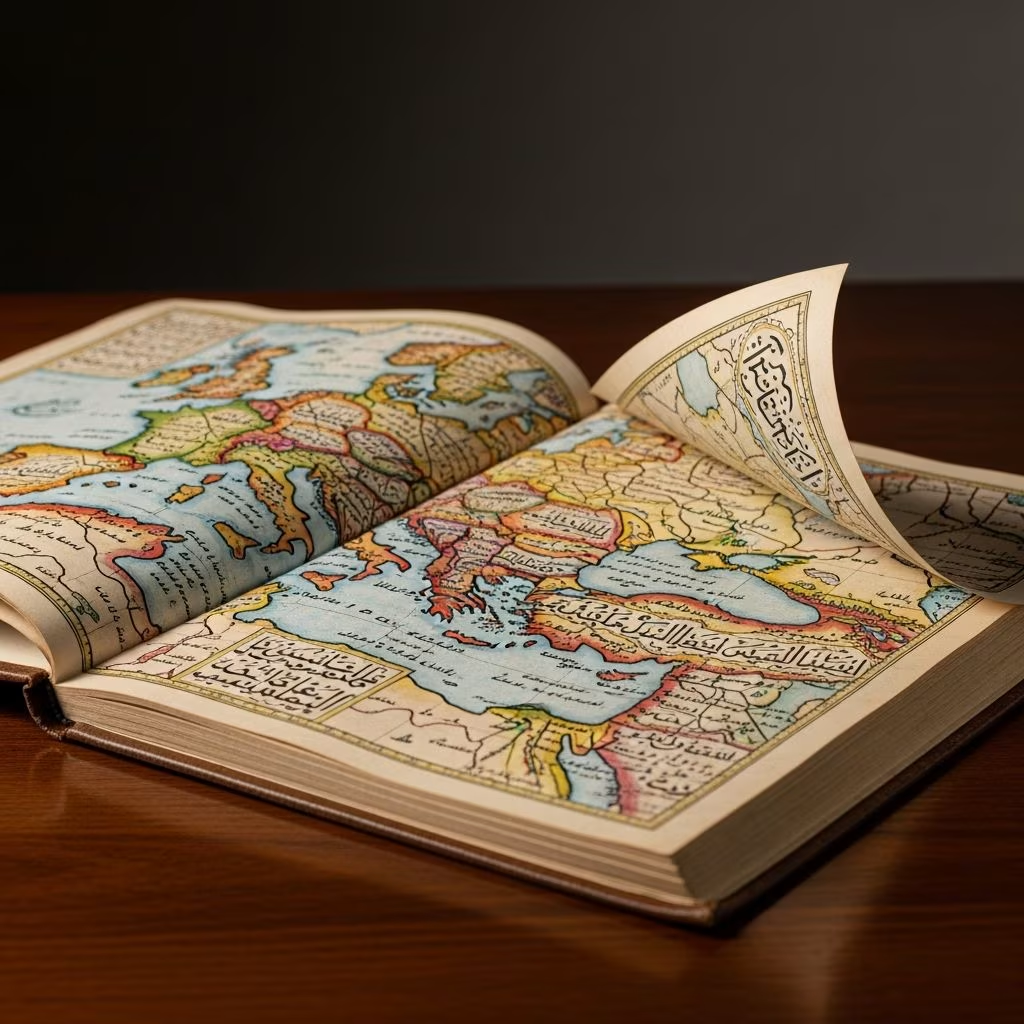
In an era where social media often buzzes with memes and viral videos, one unassuming post on Reddit sparked a chain of events leading to a monumental historical discovery. Tucked away in the National Library of Norway, a forgotten treasure from the Ottoman Empire—a meticulously printed atlas from 1803—emerged from obscurity thanks to the keen eyes of online enthusiasts. This find not only expanded the known inventory of one of the world’s rarest cartographic works but also underscored the transformative role of digital platforms in cultural heritage preservation.
The story begins in late 2023 when Øivind Solhaug, a reference librarian at the National Library of Norway in Oslo, stumbled upon an intriguing volume during routine cataloging. The book, bound in worn leather and filled with vibrant maps, caught his attention due to its exotic script and detailed illustrations. Unsure of its exact significance but eager to learn more, Solhaug scanned a few pages and shared them on Reddit’s r/HelpMeFind subreddit, hoping the community might identify it. Little did he know, this ‘karma-seeking’ act, as some dubbed it, would unravel a historical mystery.
Within days, responses flooded in. A fellow Redditor recognized similarities between Solhaug’s scans and maps from the Library of Congress’s digital collection. Cross-referencing revealed that the Norwegian copy matched the Cedid Atlas Tercümesi, a groundbreaking publication from the Ottoman Empire. Printed in Istanbul just as the empire navigated modernization, this atlas represented a pivotal shift from hand-drawn manuscripts to mechanized printing in Islamic cartography.
Commissioned during the reign of Sultan Selim III, the Cedid Atlas was produced in 1803 by cartographer Mahmud Raif Efendi. It was one of the earliest printed atlases in the Ottoman world, with only around 50 copies ever made. Prior to this, maps were laboriously hand-illustrated, limiting their dissemination. The atlas drew from European sources, including William Faden’s General Atlas, but was adapted with Ottoman perspectives, featuring 42 maps covering Europe, Asia, Africa, and the Americas.
This publication emerged amid the Nizam-ı Cedid (New Order) reforms, aimed at modernizing the military and administration. By incorporating printed maps, the Ottomans sought to enhance geographical knowledge for strategic purposes. The book’s rarity stems from its limited print run and the tumultuous history of the empire, which led to many copies being lost, destroyed, or forgotten.
How did this Ottoman gem end up in Norway? Records indicate the library acquired it in the 1960s from a private donor: a textile importer from Oslo named Eirik Sundt. In the 1930s, Sundt traveled extensively through the Balkans, a region under Ottoman influence for centuries. It is believed he purchased the atlas during one of these trips, perhaps in a market or from a local collector, and brought it back to Norway.
For over 60 years, it languished in the library’s stacks, misidentified or overlooked amid thousands of volumes. Modern curators were unaware of its presence until Solhaug’s discovery. This path—from imperial Istanbul, through Balkan trade routes, to a Scandinavian library—mirrors the interconnected histories of Europe and the Middle East.
Solhaug’s post garnered quick attention. Comparisons with the Library of Congress copy confirmed the match. His supervisor, book historian Gunnar Sætra, verified the details: the paper quality, binding, and specific map variations aligned perfectly. Previously, scholars knew of only 14 surviving copies worldwide, scattered in institutions from Istanbul to Vienna. The Norwegian find elevated that number to 15, a small but significant addition to global heritage.
| Known Copies Before Discovery | Location | Status |
|---|---|---|
| 1-5 | Istanbul (Various libraries) | Primary Ottoman holdings |
| 6-10 | Europe (Vienna, Paris, etc.) | Acquired via diplomacy/war |
| 11-14 | USA (Library of Congress) | Digitized and studied |
| 15 | Norway (National Library) | Newly identified |
This episode exemplifies how online communities democratize expertise. Reddit’s global user base—millions strong—pooled knowledge from historians, librarians, and enthusiasts. Similar stories abound: lost languages identified via Twitter, ancient artifacts crowdsourced on forums. For rare books, platforms like Reddit and Flickr Commons enable rapid verification that once took years.
Norway’s National Library has since digitized the atlas, making it accessible worldwide. This aligns with global trends in open-access archives, ensuring such treasures endure beyond physical walls.
Discoveries like this fuel excitement in bibliophilia. Rare atlases, especially from non-Western traditions, offer insights into historical worldviews. The Cedid Atlas, for instance, depicts Europe from an Eastern lens, with Istanbul at the center, challenging Eurocentric narratives.
Institutions worldwide are now auditing collections with fresh eyes, spurred by digital tools. AI-assisted image recognition and blockchain provenance tracking promise to uncover more hidden gems.
Despite progress, obstacles remain. Many Ottoman works suffer from degradation, political sensitivities, or lack of funding. Wars and displacements have scattered collections. Collaborative efforts, like those between Turkish and European libraries, are vital.
The Norwegian discovery teaches us that history hides in plain sight. Everyday actions—like a librarian’s post—can yield extraordinary results. It celebrates curiosity, collaboration, and technology’s role in bridging past and present.
The Cedid Atlas Tercümesi is a 1803 printed atlas from the Ottoman Empire, one of the first of its kind, with 42 maps adapted from European sources.
Librarian Øivind Solhaug posted scans on Reddit, where users identified it as matching a known rare copy.
15 known copies worldwide after this find; originally about 50 printed.
It marks a shift to printed cartography in the Ottoman world during modernization reforms.
Digitized versions are available via Norway’s National Library and similar institutions.
