

 Travel Essentials
 Travel Essentials

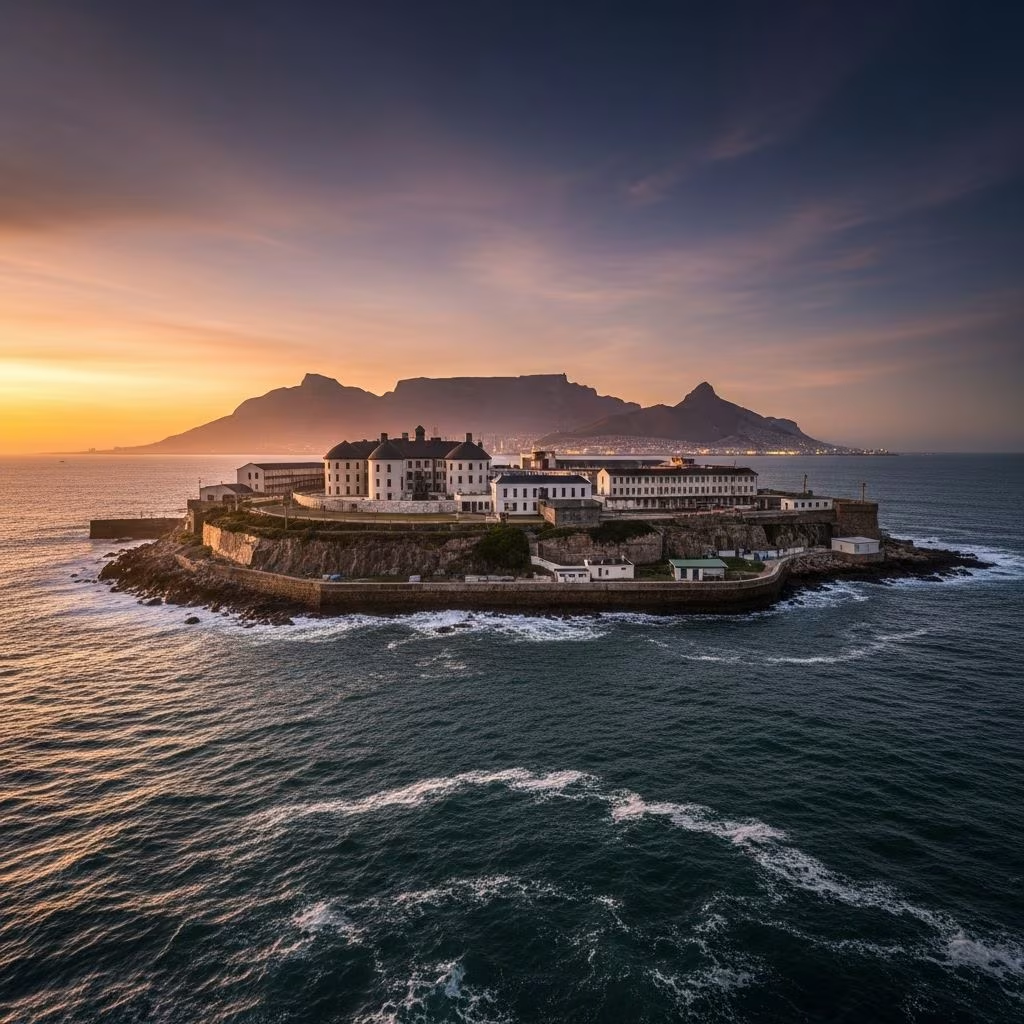
Explore Robben Island’s history as a prison of resistance, where Mandela and other activists endured hardship and helped shape South Africa’s freedom.
 Travel Essentials
Robben Island stands as a stark reminder of South Africa’s turbulent past, a place where isolation met unbreakable human spirit. Located in Table Bay just off Cape Town’s coast, this small rocky outcrop served multiple roles over centuries, but it is most infamous as the maximum-security prison that held Nelson Mandela and thousands of political activists during apartheid.
The history of Robben Island stretches back to the 17th century when European powers first utilized it. Dutch settlers initially used the island as a refreshment station for ships, but soon transformed it into a penal colony for exiles and criminals. By the 19th century, under British rule, it housed lepers, the mentally ill, and political dissidents, reflecting societal prejudices of the era.
Fortifications built during World War II underscored its strategic military value, but the mid-20th century marked its darkest chapter. From 1961, the apartheid regime designated it a high-security facility for political prisoners, aiming to silence opposition voices through geographic and psychological isolation.
Apartheid, the institutionalized system of racial segregation enforced from 1948 to 1994, turned Robben Island into a fortress against dissent. Black South Africans viewed it as the ultimate symbol of white minority rule’s brutality. Political prisoners, convicted for challenging the regime, faced maximum security conditions designed to break their resolve.
The island’s limestone quarries became sites of grueling labor, where inmates toiled under the scorching sun, crushing rocks that damaged their eyes and lungs. This punitive work was meant to humiliate and exhaust, yet it fostered solidarity among captives.
| Prisoner Category | Treatment Details | Duration |
|---|---|---|
| Political Prisoners | Hard quarry labor, isolation cells, limited family contact | 1961-1991 |
| Criminal Prisoners | Medium security post-1991 | Until 1996 |
| Black vs. Others | Inferior food rations for Black inmates | Throughout apartheid |
Nelson Mandela’s arrival on Robben Island in 1964 following the Rivonia Trial epitomized the prison’s role in apartheid’s machinery. Sentenced to life imprisonment for sabotage charges, he spent 18 of his 27 total years there, from 1964 to 1982. Housed in Section B’s single cells, Mandela and fellow African National Congress (ANC) leaders like Walter Sisulu endured solitary confinement to prevent plotting.
Despite hardships, Mandela maintained dignity, studying through smuggled books and leading informal education sessions dubbed the ‘Robben Island University.’ His cell, with its mat-thin bedding and bucket sanitation, became iconic.
“No one truly knows a nation until one has been inside its jails.” – Inspired by reflections on prison life.
Life on Robben Island was regimented cruelty. Prisoners rose at 5:30 AM to empty waste buckets before quarry labor. Meals were racially tiered: Black inmates received thin porridge and vegetables, while whites got meat— a microcosm of apartheid inequality.
Communication with the outside was severely restricted: one half-hour family visit and two letters annually. Physical abuse was common in early years (1962-1966), with no recreation allowed initially. Yet, inmates organized secret study groups, sports, and cultural activities, turning oppression into resistance.
Beyond Mandela, Robben Island confined over 3,000 political prisoners, including future presidents Kgalema Motlanthe and Jacob Zuma. Figures like Ahmed Kathrada and Raymond Mhlaba formed the core of ANC leadership. Their collective endurance eroded apartheid from within.
Guards, often former prisoners themselves in today’s tours, recount how inmates’ debates educated wardens, sowing seeds of change. This intellectual resistance contrasted the regime’s brute force.
The prison’s political wing shut in 1991 amid global pressure and internal unrest, with the last criminals leaving in 1996. Mandela’s release in 1990 from mainland prison signaled the end. In 1997, it became a national monument; UNESCO inscribed it as a World Heritage Site in 1999 for symbolizing democracy’s triumph.
The Robben Island Museum now preserves cells, quarries, and artifacts. Annual reunions, like the 1995 gathering of 1,200 ex-prisoners, highlight reconstruction.
A trip to Robben Island is a 3.5-hour ferry journey from Cape Town’s V&A Waterfront. Tours, led by ex-inmates or guards, cover the prison complex, lime quarry (Mandela’s reflective spot), and church. Book months ahead, especially peak season (October-March).
The experience humbles visitors, bridging past pains with present reconciliation. It’s not mere tourism but a pilgrimage to South Africa’s soul.
Robben Island transcends its prison history, embodying human capacity for forgiveness. Mandela’s post-release leadership in the Truth and Reconciliation Commission echoed island lessons. Today, it educates global audiences on fighting injustice.
Challenges persist: maintenance funding and weather disruptions affect access. Yet, its message endures—oppression crumbles before unified resolve.
Mandela served 18 years there, from 1964 to 1982.
No, it closed fully in 1996 and is now a museum.
Yes, via guided tours from Cape Town; advance booking essential.
For representing the struggle against apartheid and victory of democracy.
Hard labor, poor food, isolation, but secret education thrived.
