

 Travel Essentials
 Travel Essentials

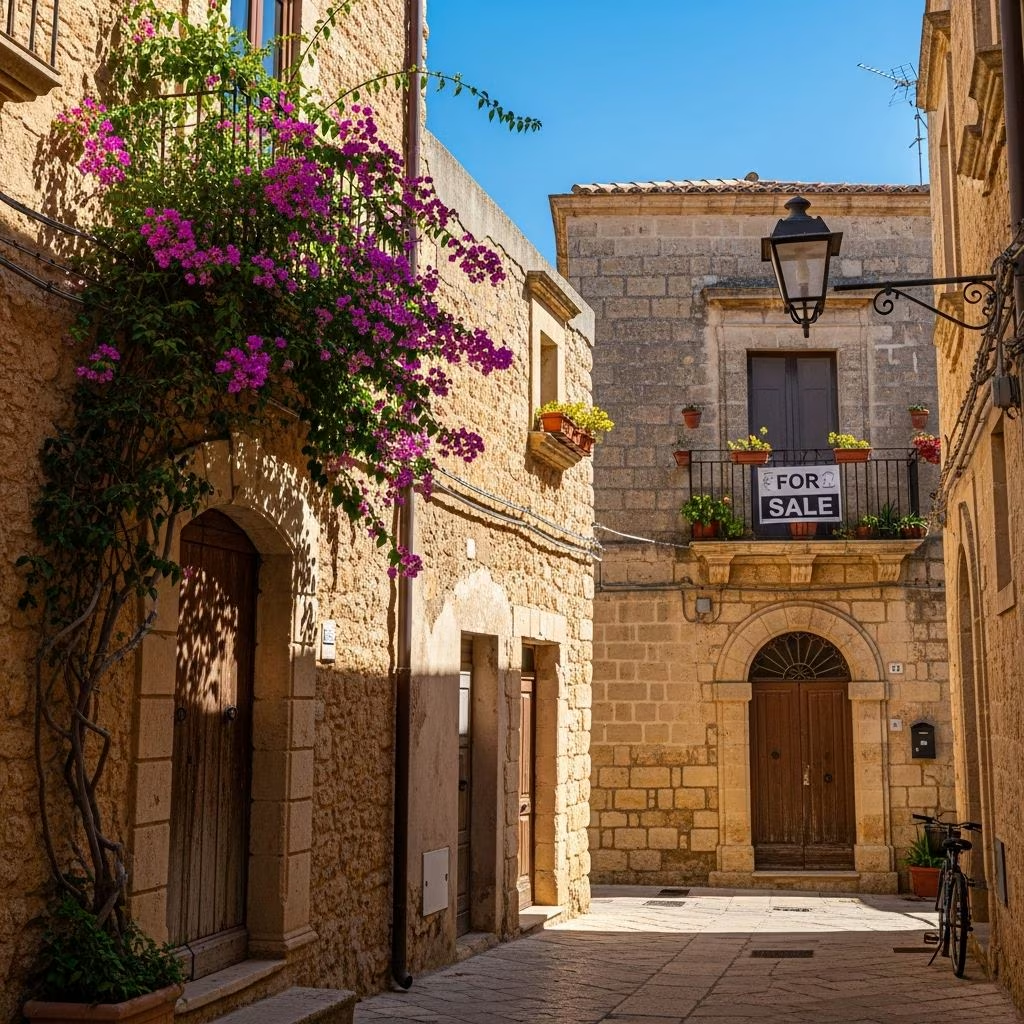
Salemi’s €1 home program turns abandoned Sicilian buildings into a community revival project, drawing buyers with renovation incentives and global interest.
 Travel Essentials
In the decades following a devastating 1968 earthquake that left portions of Sicily in ruins, the town of Salemi faced an ongoing struggle with population loss and urban decay. The catastrophe, combined with economic challenges affecting rural Sicily, prompted residents and local leaders to seek innovative solutions for community recovery. This challenging backdrop became the catalyst for one of Italy’s most distinctive and pioneering urban regeneration initiatives.
The concept emerged in 2008 when then-mayor Vittorio Sgarbi, an art critic and television personality, consulted with advisors about methods to reverse the town’s declining fortunes. Drawing inspiration from successful international models, the decision was made to transform Salemi’s most deteriorated structures—abandoned buildings that dotted the historic center—into economic assets. By pricing these properties at just €1, the municipality created an unprecedented opportunity that would eventually inspire similar programs throughout Italy and capture international attention.
Salemi’s approach to the €1 house initiative operates distinctly from comparable programs in other Italian municipalities. Rather than facilitating transactions between private sellers and buyers through municipal oversight, Salemi conducts direct sales from the municipal government itself. This arrangement essentially transforms each purchase into a competitive auction where €1 represents the minimum starting bid, allowing the town to retain greater control over property disposition and buyer selection.
Prospective purchasers seeking to acquire one of these historical properties must navigate a structured application process. The initial step requires submission of a comprehensive renovation blueprint detailing specific plans for restoring the building. This requirement ensures that buyers possess genuine intentions and realistic visions for property rehabilitation rather than seeking purely speculative investments. Additionally, interested parties must provide a deposit of €3,000, demonstrating financial commitment and capacity to undertake substantial renovation work.
The initial cohort of available properties consists of approximately a dozen homes offered through the auction mechanism. Interested buyers can review photographic documentation of the available structures before submitting their formal online applications indicating their preferred properties. This transparent process has attracted attention from both Italian citizens and international purchasers seeking affordable entry points into property ownership in Italy’s culturally rich regions.
Purchasing a €1 home represents merely the first commitment in a longer-term renovation and restoration undertaking. Buyers must demonstrate dedication to their projects within defined timeframes to ensure program integrity and community benefit. Different sources reference varying completion deadlines, with some indicating a three-month commencement requirement and others specifying a three-year overall renovation window. These timelines establish clear expectations while providing purchasers with reasonable periods to secure financing, hire contractors, and manage construction logistics.
The renovation obligation serves multiple purposes beyond simple property restoration. By requiring substantive investment and improvement of long-neglected structures, the program ensures that buildings are genuinely brought back into functional use rather than remaining vacant monuments to urban decline. This approach transforms the initiative from a mere real estate redistribution scheme into a genuine community revitalization effort with measurable improvements to the town’s physical infrastructure and economic vitality.
While standard renovations are mandatory, Salemi recognizes that certain types of property conversions generate particularly significant community benefits. Those who repurpose their €1 homes into commercial enterprises specifically designed to stimulate local economic activity qualify for substantial tax credits and financial incentives. Eligible business conversions include hospitality ventures such as bed-and-breakfast accommodations, cultural enterprises like art galleries, and food service operations including restaurants and cafes.
This incentive structure acknowledges that tourism and cultural attractions represent critical revenue sources for small Sicilian communities. By encouraging the transformation of abandoned residences into visitor-oriented businesses, the municipality simultaneously creates employment opportunities, generates tax revenue, and enhances the town’s appeal to potential tourists. The strategy recognizes that business-oriented renovations often require more substantial investments than residential restoration, justifying the additional financial support through tax reduction mechanisms.
The program gained international recognition when prominent British television personalities undertook a high-profile renovation project within Salemi. As part of a BBC television series titled “Alan & Amanda’s Italian Job,” celebrities collaborated on transforming one of the €1 properties into an elegant residence known as Casa Alamanda. This television production showcased the feasibility of successful renovations while demonstrating the aesthetic potential of Salemi’s historic structures when subjected to professional restoration and design thoughtfully adapted to contemporary living standards.
Following successful renovation, the television personalities subsequently placed their restored property back on the real estate market, creating a demonstration project that illustrated both the process and the potential return on investment. Such high-visibility success stories significantly expanded program awareness among international property buyers and investors, transforming Salemi from a relatively obscure Sicilian village into a recognized destination for those seeking affordable European real estate investment opportunities.
Despite the program’s conceptual appeal and early promotional efforts, implementation has encountered substantial practical obstacles that have sometimes stalled progress. One recurring challenge involves inadequate municipal infrastructure, particularly in communities where foundational systems require upgrade or expansion. In some cases, the absence of properly functioning sewage systems or other essential utilities complicates renovation efforts and increases project costs beyond buyer expectations. These infrastructural deficiencies, inherited from decades of urban neglect, require municipal investment and coordination that sometimes exceeds local government capacity or financial resources.
Additional complications have emerged from property title complexities, bureaucratic procedures, and the necessity of conducting thorough structural and environmental assessments before renovation can commence. International buyers, in particular, navigate language barriers and unfamiliarity with Italian legal and administrative processes, necessitating professional guidance that adds expense to acquisition and renovation undertakings. These practical realities moderate the program’s initial appeal despite the dramatically low property prices.
Following Salemi’s pioneering efforts in 2008, other struggling Italian municipalities recognized the potential of the €1 house model and incorporated similar initiatives into their urban recovery strategies. The concept spread across southern Italy and into other economically challenged regions where population decline, aging populations, and abandoned structures threatened community viability. Sambuca di Sicilia, another Sicilian municipality, launched its own €1 property program, expanding the scope of this innovative regeneration approach across Sicily and beyond.
The widespread adoption reflects growing recognition that traditional economic development strategies may prove insufficient for revitalizing small towns facing structural economic challenges. By reducing artificial barriers to property acquisition and requiring substantive investment in community improvements, these programs create pathways for individuals seeking alternative lifestyles, remote workers, investors, and entrepreneurs to establish themselves in culturally significant yet economically challenged communities. This population rebalancing generates tax revenue, creates employment, and potentially establishes new service sectors supporting year-round residents and seasonal visitors.
The €1 house initiatives have attracted unprecedented international attention, transforming small Sicilian villages into destinations for property seekers, entrepreneurs, and lifestyle migrants from across Europe and beyond. This global awareness reflects broader demographic and economic trends including remote work proliferation, lifestyle prioritization over urban concentration, and growing interest in authentic cultural experiences and historical preservation. International participants bring capital investment, diverse skill sets, and renewed commercial perspectives to communities that traditional employment structures have historically neglected.
Media coverage from prestigious international outlets, including British television productions and travel publications, has accelerated awareness and expanded the geographic scope of interested purchasers. These representations position Salemi and comparable communities not as economically marginalized backwaters requiring pity but as distinctive destinations offering genuine value propositions to those prioritizing cultural authenticity, architectural heritage, and community revitalization over conventional urban amenities.
At its foundation, Salemi’s €1 house initiative represents a comprehensive community revitalization strategy that extends significantly beyond simple property transactions. The program fundamentally aims to reverse population decline, restore economic vitality, preserve architectural and cultural heritage, and reconstruct social cohesion within communities fractured by decades of emigration and economic stagnation. By pricing properties at nominal amounts, the municipality removes financial obstacles that might otherwise prevent individuals from establishing roots in the community while simultaneously requiring substantive commitment through renovation obligations and business development incentives.
The strategy acknowledges that abandoned buildings represent not merely failed investments or physical deterioration but symbols of diminished community confidence and vitality. Transforming these structures into occupied, maintained, and productive properties reverses symbolic meanings while simultaneously improving tangible community conditions. Residents who relocate to Salemi through this program establish households, patronize existing businesses, engage with local culture, and potentially establish new enterprises that generate employment and attract additional economic activity.
For individuals genuinely interested in participating in this initiative, several practical considerations warrant careful evaluation before committing resources. Financial planning must account not only for the nominal €1 purchase price but for the €3,000 deposit requirement, comprehensive renovation costs, and potential municipal fees or administrative expenses. Property-specific factors including structural condition, required infrastructure improvements, and accessibility to essential services should receive thorough professional assessment before commitment.
Prospective buyers should similarly evaluate personal readiness for extended renovation timelines, potential complications arising from Italian bureaucratic procedures, and realistic assessment of market conditions for either residential occupancy or commercial operations within small Sicilian communities. Language proficiency, cultural adaptability, and genuine enthusiasm for community engagement distinguish successful acquisitions from problematic investments undertaken primarily from speculative motives.
As the €1 house initiative matures, questions naturally arise regarding program sustainability, long-term community impacts, and whether the strategy can realistically reverse decades of population decline and economic deterioration. The most optimistic scenarios envision these programs as catalysts attracting sufficient new residents and commercial activity to establish positive economic momentum, enhance school enrollments, support expanded service sectors, and restore community confidence. More cautious assessments acknowledge that while individual success stories validate program feasibility, broader demographic and economic forces may ultimately limit the scale of impact achievable through property pricing innovations alone.
Successful program evolution likely requires complementary strategies addressing infrastructure development, employment opportunity expansion, educational institution vitality, and cultural tourism development. Communities adopting the €1 house model while neglecting these complementary investments may experience temporary activity bursts followed by regression. Conversely, municipalities integrating property accessibility initiatives with broader community development strategies position themselves to achieve more substantial and durable revitalization outcomes.
