

 Travel Essentials
 Travel Essentials

Explore Harlem’s Schomburg Center, a world-class archive preserving Black history, culture, and creativity with more than 11 million items.
 Travel Essentials
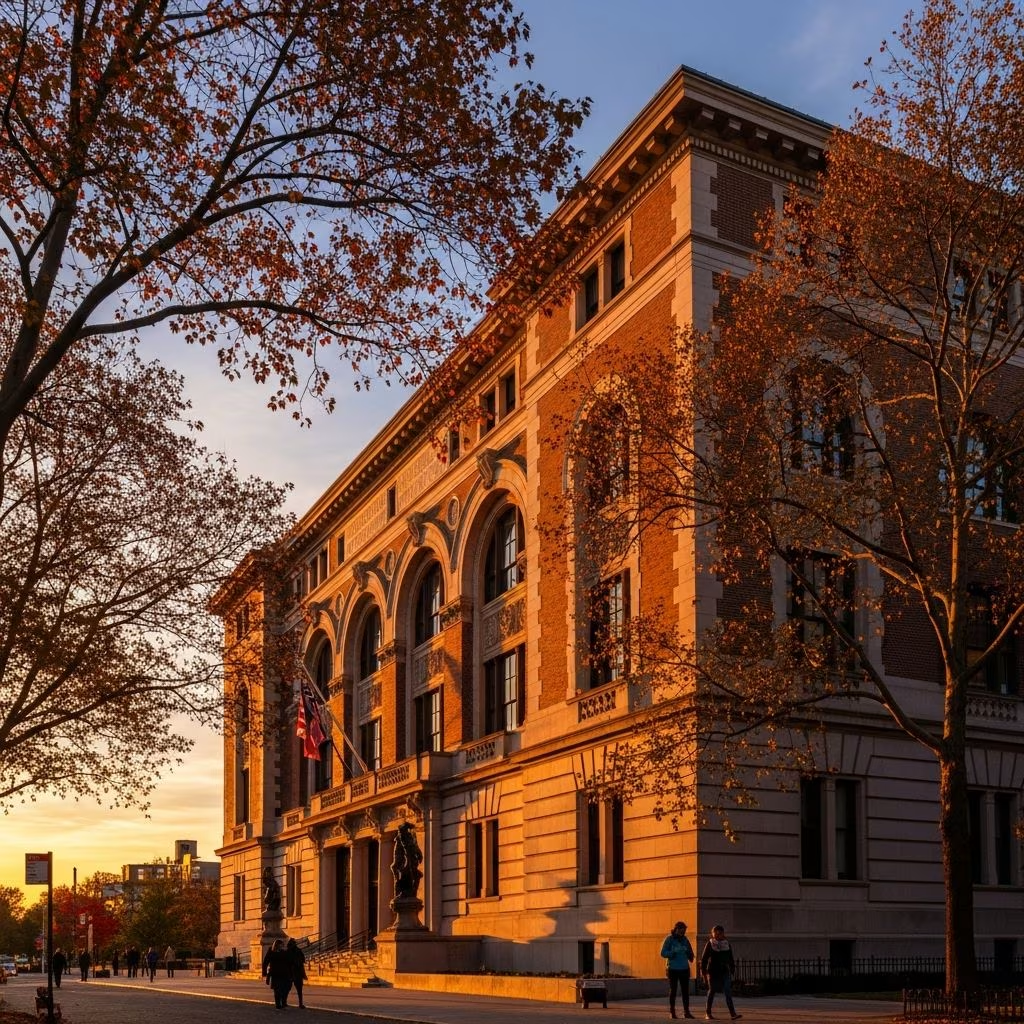
The Schomburg Center for Research in Black Culture stands as a monumental repository in Harlem, safeguarding the stories, artifacts, and legacies of African peoples worldwide. Housed within The New York Public Library system, this institution boasts more than 11 million items, ranging from ancient manuscripts to contemporary digital records, making it an indispensable resource for scholars, artists, and the public alike.
The roots of the Schomburg Center trace back to the early 20th century, amid the vibrant Harlem Renaissance. In 1925, it began as the Division of Negro Literature, History, and Prints at the 135th Street Branch Library. This branch quickly became a hub for African Americans arriving during the Great Migration, fostering intellectual and cultural exchange.
A pivotal moment came in 1926 when collector Arturo Alfonso Schomburg sold his extensive private collection to the library for $10,000, funded by a Carnegie Corporation grant. This acquisition, equivalent to over $140,000 today, formed the core of what would evolve into the Schomburg Center. Schomburg, driven by a childhood challenge to prove Black achievements, curated materials proving the depth of African contributions globally.
Born in Puerto Rico in 1874, Arturo Alfonso Schomburg dedicated his life to amassing evidence of Black excellence. His collection included rare books, prints, manuscripts, and ephemera from Africa, the Americas, and beyond. As curator from 1926 to 1930, and later at Fisk University, he ensured these treasures remained accessible in Harlem.
Schomburg’s philosophy—that Black history was not absent but overlooked—propelled his work. His efforts transformed a modest library branch into a national beacon, influencing generations of researchers and activists.
By the 1970s, the center outgrew its original space. In 1973, a new site on Lenox Avenue was selected for its ties to the Harlem Renaissance. The 135th Street building earned National Register of Historic Places status in 1978, with formal listing in 1979.
Today, the Schomburg Center thrives with acquisitions like James Baldwin’s personal archives and a rediscovered chapter from Malcolm X’s autobiography. These additions underscore its role in uncovering hidden narratives.
| Milestone | Year | Significance |
|---|---|---|
| Carnegie Grant Acquisition | 1926 | Foundation of core collection |
| New Building Purchase | 1973 | Expansion for growing archives |
| Historic Designation | 1978-1979 | Preservation recognition |
| Baldwin Archives | Recent | Modern literary addition |
The Schomburg’s holdings span 11 million items across multiple formats. Manuscripts Division features letters from luminaries like Frederick Douglass; Photographs and Prints document visual histories; Rare Books include first editions by Black authors; Moving Images and Recorded Sound preserve performances and speeches.
These non-circulating materials offer free public access, supporting research on slavery, civil rights, arts, and diaspora migrations. Digital initiatives make portions available online, broadening global reach.
Beyond archives, the Schomburg Center pulses with life through exhibitions, lectures, performances, and workshops. It hosts events illuminating Black history, from panel discussions on contemporary issues to film screenings of diaspora cinema.
Its role in controversies, like the 1969 ‘Harlem on My Mind’ exhibit files, highlights its engagement with social debates. These records, including correspondence with Met Museum directors, reveal the center’s influence on public discourse.
In Harlem, the center remains a cultural anchor, drawing visitors to explore exhibits on figures like Malcolm X or Zora Neale Hurston. Programs often feature live jazz, poetry slams, and youth education, blending preservation with celebration.
Located at 515 Malcolm X Boulevard, the center welcomes researchers and tourists. Open weekdays and select weekends, it offers free entry to reading rooms (ID required for materials). Guided tours and virtual options enhance accessibility.
Plan ahead: High-demand items require appointments. Nearby Harlem spots like the Apollo Theater complement a visit, immersing you in the neighborhood’s legacy.
The Schomburg embraces technology with digitized collections on NYPL’s website. Projects like In the Life Archive preserve LGBTQ+ Black histories, ensuring relevance in the digital age.
Future plans include expanded digitization and partnerships for global outreach, solidifying its status as a leading institution for Black studies.
It holds one of the world’s largest collections on African diaspora experiences, with over 11 million items focused exclusively on Black history and culture.
Yes, materials are non-circulating but available free in reading rooms; many digitized items are online.
A Puerto Rican collector who amassed proof of Black achievements worldwide, serving as the center’s first curator.
Absolutely—it hosts rotating exhibits, performances, and scholarly events year-round.
Subway: 2/3 to 135th St; bus lines along Malcolm X Blvd. Ample street parking nearby.
The Schomburg Center not only preserves the past but inspires future narratives of resilience and creativity. Whether diving into rare documents or attending a lively event, it offers profound insights into Black excellence.
