

 Travel Essentials
 Travel Essentials

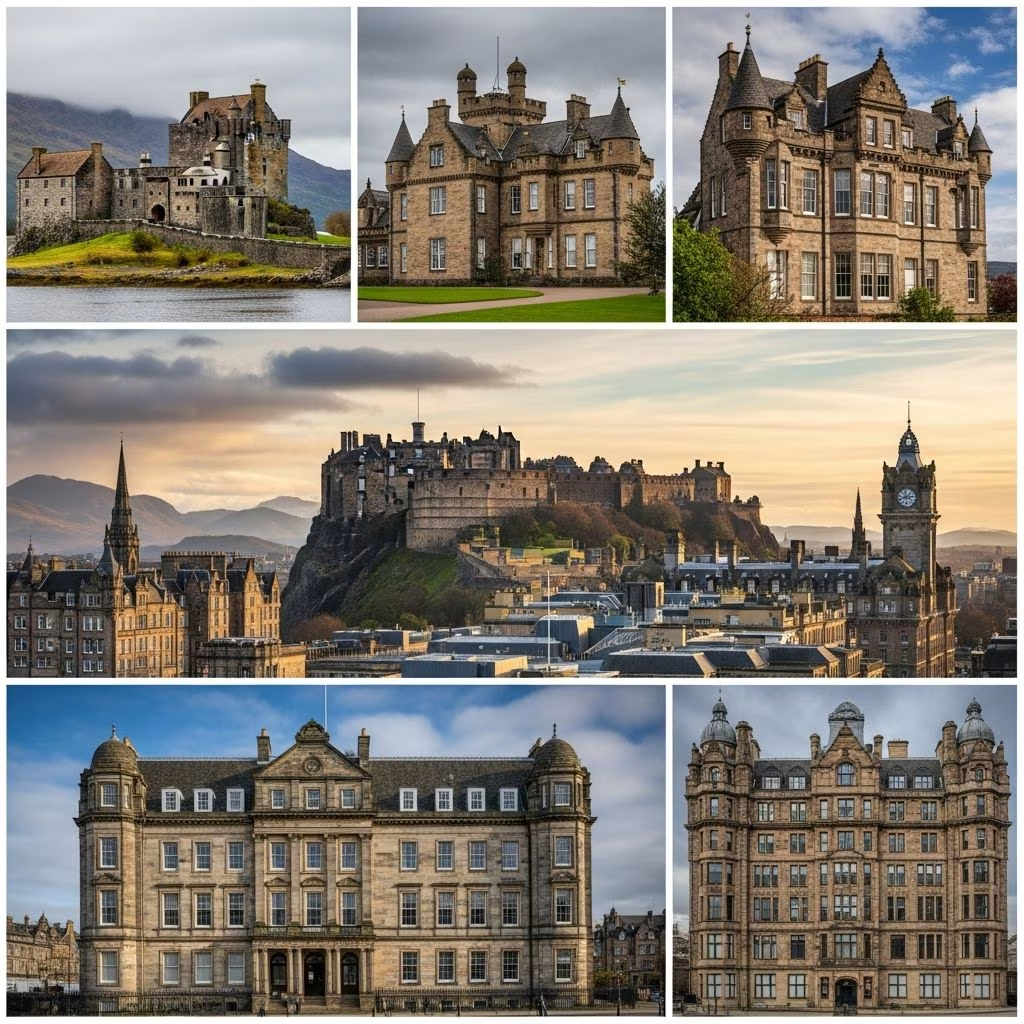
Discover the diverse architectural styles that define Scotland, from prehistoric Skara Brae to contemporary designs reflecting the nation's cultural identity.
 Travel Essentials
Scotland’s built environment tells a compelling story of cultural evolution, artistic innovation, and technical achievement. From the windswept shores of Orkney to the bustling streets of Edinburgh and Glasgow, the nation’s architecture reflects centuries of adaptation, creativity, and resilience. Understanding Scottish architectural traditions provides insight into how geography, history, and society have shaped the spaces where Scots have lived, worked, and gathered.
The architectural legacy of Scotland extends back remarkably far into human history. The earliest surviving houses in Scotland date back approximately 9,500 years, while the first organized villages emerged around 6,000 years ago. Skara Brae, located on the Mainland of Orkney, stands as the earliest preserved example of a Neolithic settlement in Europe. This extraordinary site demonstrates that our ancestors possessed sophisticated understanding of spatial organization and construction methods, creating stone dwellings designed to withstand harsh climatic conditions.
These ancient settlements reveal fundamental principles that would influence Scottish building practices for millennia: practical design adapted to local environments, use of available materials, and consideration for community needs. The transition from isolated structures to organized villages marked a significant conceptual shift in how Scottish communities approached settlement planning and communal living.
Scottish architecture underwent significant transformation during the Renaissance, which manifested in two distinct phases. During the early fifteenth century, architects began selectively incorporating Romanesque forms into church design. This initial phase evolved into more comprehensive Renaissance influence by the late fifteenth century, particularly evident in ambitious palace construction projects.
The interplay between traditional Scottish building methods and continental European influences created a distinctive hybrid approach. Architects and builders synthesized imported aesthetic principles with established local practices, resulting in structures that honored both traditions. This period established foundations for what would eventually become recognized as distinctly Scottish architectural character.
Among Scotland’s most recognizable architectural contributions stands the Scots Baronial style, which emerged as a formalized architectural movement during the mid-nineteenth century. This style grew from a broader Gothic revival movement that swept through Britain and Europe, but Scottish architects adapted it to create something uniquely national. The Gothic revival tapped into renewed interest in medieval architecture and represented a conscious return to traditional stonemasonry skills that industrialization had threatened to displace.
Influential architects including David Bryce and William Burn championed Scots Baronial, incorporating medieval inspiration into their architectural visions while employing contemporary construction techniques. Their work established visual and conceptual frameworks that subsequent generations of Scottish architects would reference and develop.
The most easily identifiable feature of Scots Baronial architecture is the witches’ hat tower, a distinctive element consisting of a conical roof structure positioned above a corner turret. These towers create striking visual impact while serving practical purposes related to defensive design principles inherited from Scotland’s medieval fortifications.
Bartizans represent a variation on this theme—tower structures that don’t extend fully to ground level but instead cantilever outward from upper portions of buildings. These architectural elements serve both functional and aesthetic purposes, providing observation points while adding visual complexity and romanticism to facades. The Castle Hill School building in Edinburgh, now converted into a Scotch whisky visitor attraction, exemplifies how Scots Baronial features remain visible in the contemporary urban landscape.
The twentieth century brought new architectural movements that challenged traditional approaches while introducing international design philosophies. Art Deco emerged as a significant influence during the 1930s, representing optimism about technological progress and industrial advancement. Scotland embraced this movement, with architects creating striking public and commercial buildings that announced modernity through geometric forms and streamlined aesthetics.
St Andrews House in Edinburgh’s Regent Road stands as a principal example of Scottish Art Deco achievement. Completed in 1939 by architect Thomas S. Tait of John Burnet, Tait & Lorne Architects, this building served as the most important public construction project in Scotland during the 1930s. The structure housed offices for Scotland’s government leadership, including the First Minister and Deputy First Minister, giving it significant institutional importance. Tait’s design demonstrated how classical architectural principles could be translated into contemporary Art Deco language, creating a building that appeared both modern and rooted in Scottish tradition.
Thomas S. Tait’s broader architectural career extended far beyond St Andrews House, with numerous modern buildings designed in Art Deco style across multiple continents. His work influenced Scottish architectural practice while contributing to international modernist discourse.
Glasgow witnessed its own Art Deco flourishing with structures like the Luma Tower, designed by Cornelius Armour in 1938. Originally constructed as a factory for the British Luma Co-operative Electric Lamp Society and later operated by bulb manufacturer Osram, the Luma Tower represented industrial-age optimism. During World War II, it served as a defensive lookout post, a reminder that even commercial buildings participated in national war efforts. By the 1990s, the structure faced potential demolition before preservation efforts successfully converted it into residential apartments, demonstrating how adaptive reuse can extend building lifecycles while maintaining historical character.
The 1938 Empire Exhibition Buildings in Glasgow showcase another important Art Deco initiative, while the Rothesay Pavilion, designed by James Carrick in 1938, extends this movement beyond Scotland’s major urban centers. Nardini Café in Largs represents how Art Deco influenced commercial establishments, bringing metropolitan sophistication to smaller towns.
Modern Scotland continues to generate innovative architectural responses to contemporary needs while grappling with heritage preservation obligations. The Scottish Parliament Building in Edinburgh, designed by renowned architect Enric Miralles and opened in 2004, represents twenty-first century Scottish architectural ambition. Miralles’s design deliberately recalls upturned fishing boats, creating metaphorical connection between political institutions and maritime heritage that defines Scottish national identity.
This building demonstrates how contemporary architecture can engage with cultural symbolism while employing cutting-edge construction methods and sustainable design principles. Rather than retreating into historical pastiche, Miralles created something simultaneously modern and distinctly Scottish, establishing precedent for how new construction can respectfully dialogue with architectural tradition.
Scotland has increasingly prioritized preserving its architectural heritage, recognizing that buildings constitute irreplaceable cultural records. Preservation initiatives extend beyond grand civic structures to encompass vernacular buildings, early industrial sites, and residential tenements that might otherwise face demolition.
Many Scottish tenements, particularly in Edinburgh and Glasgow, have undergone extensive renovation projects that restore original sandstone facades and upgrade internal systems to contemporary standards. These structures had accumulated decades of urban pollution that blackened their surfaces, obscuring the pink and honeyed stone beneath. Careful cleaning and restoration now reveal the original aesthetic intention, while mechanical and electrical upgrades make buildings suitable for modern occupation.
Scottish architectural heritage encompasses diverse building types reflecting different historical periods and social functions:
Scottish architecture varies significantly across geographical regions, reflecting different climatic conditions, available materials, and cultural traditions. Highland construction techniques differ substantially from lowland approaches, while island communities developed distinctive responses to maritime environments and isolation. Coastal towns created architectural solutions for waterfront commerce and fishing industries, while rural settlements adapted building practices to agricultural cycles and pastoral economies.
This regional diversity demonstrates that Scottish architecture cannot be understood as monolithic or uniform. Rather, it represents countless local conversations between communities and their built environments, producing rich variation within broader cultural and historical frameworks.
Scotland faces ongoing challenges balancing preservation of historical structures with contemporary development needs. New construction must navigate between historical sensitivity and innovative design, between maintaining authentic character and enabling modern functionality. Successful projects achieve this balance by treating heritage not as constraint but as creative inspiration—understanding that respecting architectural tradition can energize contemporary practice rather than limiting it.
The future of Scottish architecture likely involves continued refinement of adaptive reuse practices, expansion of heritage conservation initiatives, and emergence of new architectural voices that draw inspiration from Scotland’s complex historical layers while addressing contemporary social and environmental imperatives.
