

 Travel Essentials
 Travel Essentials

Tanzania moves forward with Serengeti International Airport, allocating funds for feasibility and construction with a focus on sustainability amid environmental concerns.
 Travel Essentials
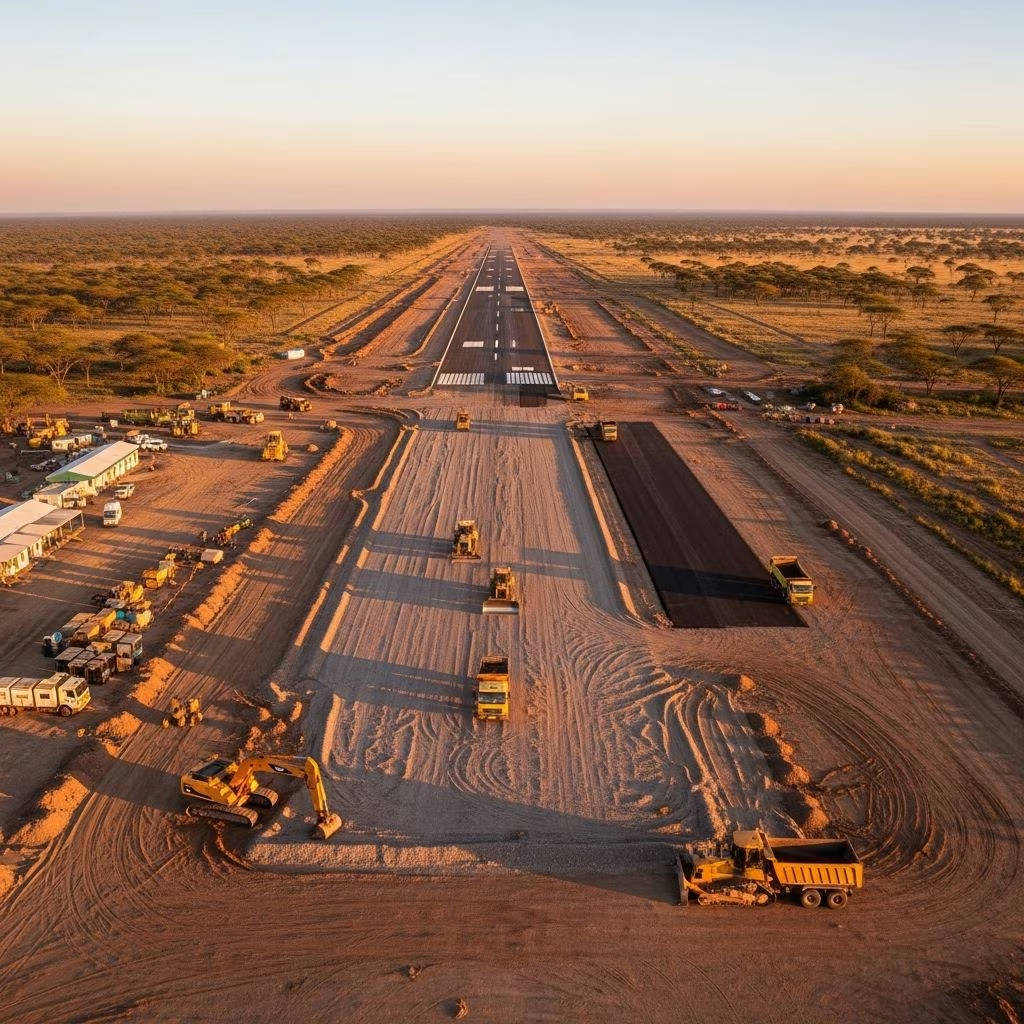
The Tanzanian government has officially greenlit the construction phase of the long-awaited Serengeti International Airport, marking a significant step toward improving access to one of Africa’s most treasured wildlife destinations. This initiative, dubbed the Green International Airport, aims to balance tourism growth with environmental stewardship in the heart of Serengeti National Park.
Plans for an international airport in the Serengeti region date back over a decade, with initial proposals facing delays due to environmental opposition and logistical hurdles. The project gained renewed momentum in early 2025 when the Tanzania Airports Authority (TAA) signed a consultancy contract with Saba Engineering Private Company Limited on February 27, 2025. This agreement focuses on design and feasibility, addressing past stagnation.
Located in the Uwanja wa Ndege ward of Mugumu town, Serengeti District, Mara Region, the airport is strategically positioned to serve the vast Serengeti National Park. Coordinates pinpoint it at approximately 1°51′49″S 34°39′13″E, making it an ideal gateway for visitors exploring the park’s expansive plains.
Political support has been pivotal. During the 2025 campaign, then-presidential candidate Samia Suluhu Hassan highlighted the airport as key to boosting Serengeti tourism, a promise now materializing under government leadership.
In the 2025–2026 national budget, the Tanzanian government earmarked three billion Tanzanian shillings—equivalent to about USD 1.1 million—for the project. Transport Minister Professor Makame Mbarawa announced this during a parliamentary session on May 15, 2025, specifying funds for a detailed feasibility study and preliminary construction works.
Overall project costs are estimated at US$350 million, with expectations to double annual visitors from 0.8 million to 1.6 million and elevate tourism revenue to US$2.8 billion. This investment underscores Tanzania’s commitment to expanding its aviation infrastructure.
| Budget Year | Allocation (TZS) | USD Equivalent | Purpose |
|---|---|---|---|
| 2025–2026 | 3 billion | ~1.1 million | Feasibility study & initial construction |
| Total Estimated | N/A | 350 million | Full development |
Dubbed the “Green International Airport,” the project prioritizes eco-friendly practices to mitigate impacts on the UNESCO World Heritage-listed Serengeti ecosystem. Professor Mbarawa emphasized renewable energy sources, wildlife corridors, and noise-reduction technologies to protect the park’s biodiversity.
Environmental impact assessments will guide every phase, ensuring operations align with conservation goals. Officials assert that the airport will enhance rather than harm ecotourism, serving as a model for sustainable infrastructure in protected areas across Africa.
The airport will function as a regional hub, linking seamlessly with Julius Nyerere International Airport in Dar es Salaam and Kilimanjaro International Airport. This connectivity aims to streamline travel for international tourists, reducing reliance on lengthy road or small-plane journeys.
By facilitating direct flights, the facility is projected to increase visitor numbers, injecting economic vitality into local communities through job creation in construction, operations, and hospitality sectors. Enhanced access could transform Serengeti into a more competitive global destination.
Progress accelerated in 2026 with the Tanzania Airports Authority issuing a tender for construction on March 2, 2026, with bids due by March 10. This targets firms experienced in airport infrastructure (CPV code 45235100), signaling the shift from planning to execution.
These developments confirm the project’s viability, overcoming prior environmentalist concerns that had stalled it for 15 years near the sensitive national reserve.
Critics have long worried about potential harm to Serengeti’s wildlife, including the Great Migration of wildebeest and zebras. The site’s proximity to a UNESCO site amplifies these risks. However, proponents counter that rigorous studies and tech innovations will safeguard the ecosystem.
Government assurances include ongoing monitoring and adaptive management plans. If executed well, the airport could fund conservation through increased tourism revenue, creating a positive feedback loop for preservation.
Beyond tourism, the project supports Tanzania’s aviation expansion, positioning the country as an East African aviation leader. Local benefits include thousands of jobs during construction and permanent roles in airport operations, alongside supply chain opportunities for regional businesses.
Tourism already contributes significantly to GDP; this airport could amplify that, with projections of doubled revenues fostering infrastructure improvements in Mara Region.
With tenders issued and funding secured, full construction could commence soon, potentially welcoming flights within years. Challenges remain, including securing international contractors, navigating regulations, and proving sustainability claims.
Success hinges on transparent environmental compliance and community involvement, ensuring benefits reach locals while preserving the Serengeti’s natural splendor for generations.
A proposed green airport in Mugumu, Tanzania, to serve Serengeti National Park, emphasizing sustainability.
Revived in 2025 with a consultancy contract; budget allocated in 2025–2026.
3 billion TZS (~USD 1.1M) initially; total ~USD 350M.
Design includes wildlife protections and green tech to minimize impact.
Direct flights to double visitors to 1.6M annually.
