

 Travel Essentials
 Travel Essentials

Learn how to view the spectacular seven-planet parade on February 28, 2025, including optimal viewing times, locations, and equipment needed to witness this once-in-a-generation astronomical event.
 Travel Essentials
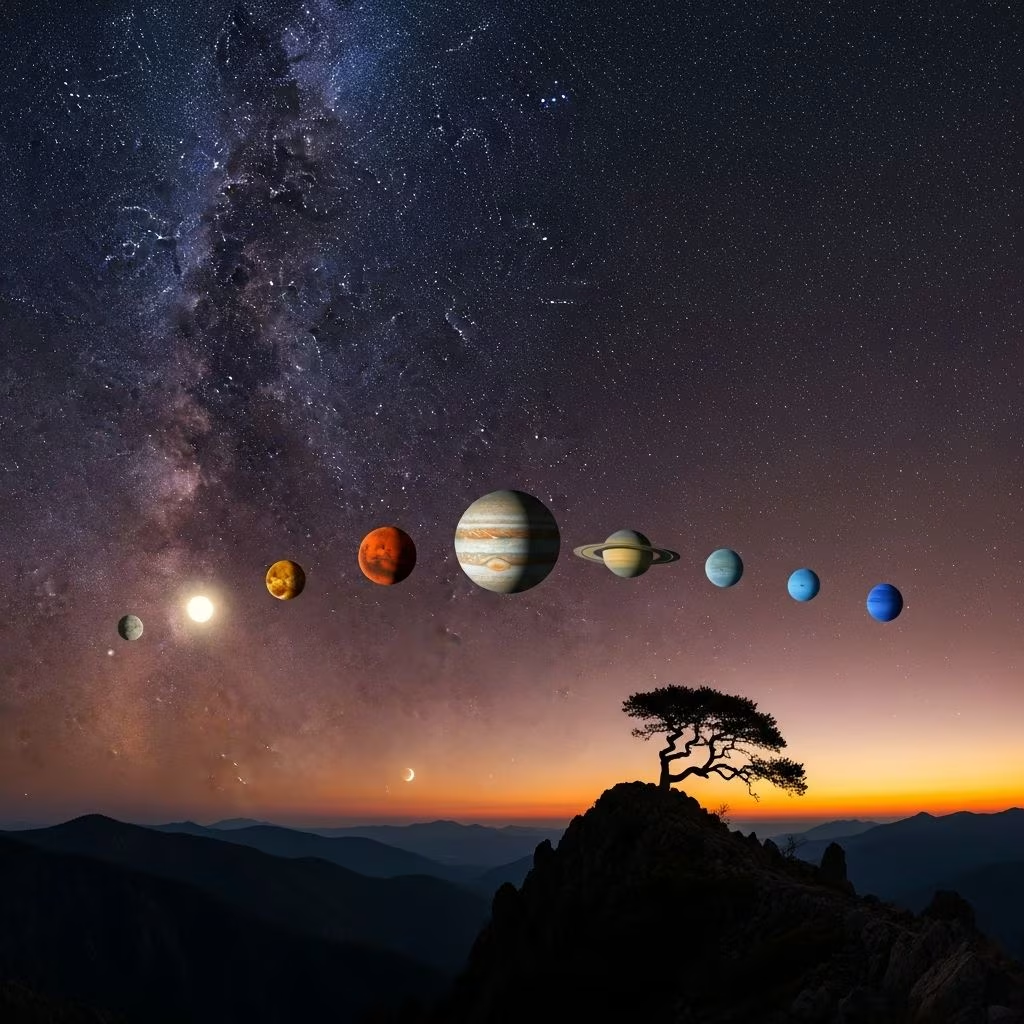
The cosmos offers occasional reminders of our place within the solar system through dramatic celestial events that capture the imagination of both casual observers and dedicated astronomers alike. February 2025 will bring one of these extraordinary moments: a seven-planet alignment that will transform the evening sky into a showcase of planetary wonder. This remarkable gathering, scheduled to reach its peak on February 28, 2025, represents an astronomical phenomenon that won’t repeat itself until 2040, making it a truly significant occasion for anyone interested in observing the heavens.
Understanding this event requires more than simply knowing when to look up. Successful observation depends on preparation, knowledge of viewing conditions, and realistic expectations about what instruments you’ll need. Whether you’re a seasoned stargazer or someone experiencing your first planetary alignment, this guide will equip you with the information necessary to make the most of this celestial opportunity.
A planetary parade occurs when multiple planets align on the same side of the sun, creating an arrangement visible from Earth across a defined band of sky. What makes the February 2025 event exceptional is that seven planets will participate in this alignment simultaneously—a configuration that dramatically exceeds typical multi-planet viewings.
The seven planets involved in this alignment are Mercury, Venus, Mars, Jupiter, Saturn, Uranus, and Neptune. However, not all of these worlds will be equally visible to observers on Earth. The visibility hierarchy depends on several factors, including the planet’s brightness, distance from Earth, and atmospheric conditions at your observation location.
According to astronomical records, the progression leading to this alignment began earlier in the year when six planets were visible in January 2025. As February arrived, Mercury emerged into the evening sky, completing the seven-planet configuration. This gradual assembly of planets created mounting anticipation among the stargazing community throughout the month, with February 28 serving as the optimal viewing date when all seven planets reached their most favorable alignment.
The visibility of each planet during the February 28, 2025 parade varies considerably based on intrinsic brightness and atmospheric factors:
Success in observing the seven-planet parade hinges significantly on timing. The evening immediately after sunset provides the optimal window for observation, as the darkening sky transitions from twilight to full darkness while the planets remain above the horizon.
February 24, 2025 offers a special viewing opportunity when Mercury and Saturn appear in conjunction, positioned just 1.5 degrees apart. This configuration represents a particularly favorable moment to complete the full set of visible planets, though locating Saturn alongside the brighter Mercury requires patience and optical assistance. This alignment reaches its tightest configuration at 12:39 AM Eastern Time on February 26, though the window for observation extends across several days on either side of this peak moment.
The ideal viewing strategy involves stepping outside approximately 30 minutes after sunset, allowing your eyes to begin adjusting to darkness while the planets remain clearly positioned above the horizon. As darkness deepens over the following hours, additional planets become visible, particularly the fainter members of the alignment like Uranus and Neptune.
Location matters considerably when observing the planetary parade. Several geographic and environmental factors influence what you’ll successfully observe:
| Factor | Impact on Observation | Mitigation Strategy |
|---|---|---|
| Light Pollution | Urban areas with significant artificial lighting drastically reduce visible planets, especially fainter ones | Travel to locations outside city boundaries where light pollution is minimal |
| Horizon Clarity | Buildings, trees, and terrain obstruct the low-angle viewing necessary for planetary observation | Choose elevated positions with unobstructed western to eastern sky exposure |
| Atmospheric Transparency | Humidity, dust, and haze significantly reduce planet visibility and brightness | Check weather forecasts for clear, dry conditions; observe after weather systems pass |
| Atmospheric Turbulence | Air movement causes shimmering and image distortion, especially for optical aid users | Allow binoculars or telescopes to reach thermal equilibrium before observing |
The western and southwestern horizon demands particular attention, as this region will host the most prominent and easily observable planets, particularly Venus, which dominates the evening sky throughout February.
Observing the seven-planet parade doesn’t require expensive astronomical equipment. However, strategic use of simple optical aids dramatically enhances the experience:
Importantly, binoculars should be held steadily, either by hand with careful stabilization or mounted on a tripod, to prevent excessive image shake that compromises detail visibility.
Locating planets requires understanding their positions relative to constellations and reference points. Venus serves as the primary guide, shining brilliantly in the western sky and functioning as a natural reference point for locating other planets.
Mars appears roughly halfway up the eastern sky as night falls, displaying its characteristic orange-yellow coloration. During February, Mars maintains close proximity to the constellation Gemini’s brightest stars, Pollux and Castor, creating a recognizable triangle that shifts gradually in size and orientation as the month progresses.
Mercury emerges only in the final week of February, positioned to Saturn’s right when the two planets appear in conjunction on February 24. Scanning approximately two fist-widths at arm’s length directly below Venus reveals this region where Mercury and Saturn reside at dusk.
Jupiter brightens the southern sky, easily identifiable by its steady yellow-white luminosity that distinguishes it from twinkling stars. Neptune requires binoculars or a telescope to locate initially, though once identified through optical aid, careful observation may reveal its bluish coloration.
Beyond the visual spectacle, the seven-planet alignment demonstrates the predictable, ordered nature of our solar system. These alignments have historically enabled space agencies to plan ambitious missions—most notably NASA’s Voyager missions of the 1970s, which exploited a similar alignment to visit Jupiter, Saturn, Uranus, and Neptune in a single mission trajectory.
The predictability of planetary motions, accurately calculated centuries ago through mathematical models, allows astronomers to forecast such events with precision. The seven-planet alignment serves as a tangible reminder of humanity’s evolving understanding of the cosmos and our capacity to predict celestial mechanics with remarkable accuracy.
While the February 28, 2025 alignment won’t recur until 2040, intermediate planetary alignments will provide observing opportunities in subsequent years. The next significant multi-planet alignment involving five bright planets will occur in late October 2028, though this event will be visible only before sunrise, requiring early-rising observers to witness this configuration.
Understanding that such alignments occur periodically but remain sufficiently rare to merit special attention encourages observers to prioritize the February 2025 event. Missing this opportunity means waiting 15 years before witnessing a comparable seven-planet arrangement.
You can see the five brightest planets (Mercury, Venus, Jupiter, Mars, and Saturn) from a reasonably dark backyard location. Uranus and Neptune require binoculars or a telescope, so you’ll need optical equipment to complete the full set.
The planetary alignment persists for several days surrounding February 28. If clouds interfere, observe on an adjacent clear evening. The planets won’t be perfectly aligned, but all seven will remain visible within a few days of the peak date.
No. The five brightest planets are naked-eye visible from moderately dark locations. Inexpensive binoculars ($30-50) significantly enhance the experience and enable viewing of the fainter planets.
No. The planets will cluster on one side of the sun but won’t form a perfectly straight line. They’ll spread across a band of sky spanning roughly the width of several fist-widths at arm’s length.
Early evening (30 minutes to 2 hours after sunset) offers the best opportunity. The sky darkens sufficiently to reveal planets while they remain high enough above the horizon for comfortable viewing.
The seven-planet parade of February 2025 represents a rare convergence of circumstance and orbital mechanics that won’t recur for many years. By preparing appropriately and understanding what to expect, you can transform an ordinary February evening into an extraordinary encounter with the planets that share our solar system. Whether you observe from a remote mountaintop or your neighborhood park, taking time to witness this celestial alignment connects you directly to the larger cosmos and humanity’s enduring fascination with the night sky.
