

 Travel Essentials
 Travel Essentials

Discover the expanded Singapore Oceanarium with 22 themed zones, interactive exhibits, and thousands of marine species in this reimagined underwater experience.
 Travel Essentials
The Singapore Oceanarium stands as one of Southeast Asia’s most ambitious marine attractions, representing a fundamental reimagining of what an aquarium can be. Reopened in July 2025 after an extensive three-month transformation, this facility has evolved far beyond the traditional glass-tank experience to become an immersive storytelling platform that connects visitors with the ocean’s mysteries, history, and future. Located at Resorts World Sentosa on Sentosa Island, the facility now encompasses three times the physical space of its predecessor, the S.E.A. Aquarium, while introducing cutting-edge design principles and innovative marine conservation practices.
The journey to the Singapore Oceanarium represents more than a simple renovation or expansion. The former S.E.A. Aquarium, which had established itself as a cornerstone attraction within Marine Life Park, operated successfully for years with 10 distinct zones and 49 individual habitat exhibits. However, recognizing the changing landscape of marine education and conservation needs, the facility’s operators made the bold decision to completely reimagine the space.
The three-month closure that began in April 2025 marked the beginning of an ambitious transformation project. Rather than simply adding more tanks or increasing animal populations, the development team focused on creating a cohesive narrative experience that would educate visitors about ocean ecosystems while promoting conservation awareness. The reopening on July 24, 2025, unveiled a facility that retained the best elements of its predecessor while introducing 22 thematically organized zones, nearly double the original number.
The structural organization of the Singapore Oceanarium reflects careful curatorial thinking about how visitors process information and experience marine environments. Rather than arranging exhibits purely by aquatic taxonomy or geographic origin, the facility’s designers created zones that tell interconnected stories about the ocean.
The expansion successfully maximized the existing building’s footprint through innovative architectural solutions. By restructuring internal layouts and optimizing vertical space, the design team achieved a tripling of the facility’s size without requiring external expansion. This efficiency demonstrates how contemporary aquarium design prioritizes both visitor experience and operational sustainability.
The Singapore Oceanarium’s most celebrated exhibits showcase the incredible diversity of marine life while highlighting specific evolutionary adaptations and ecological relationships. These showcase exhibits serve dual purposes: they captivate visitors while advancing the facility’s educational mission.
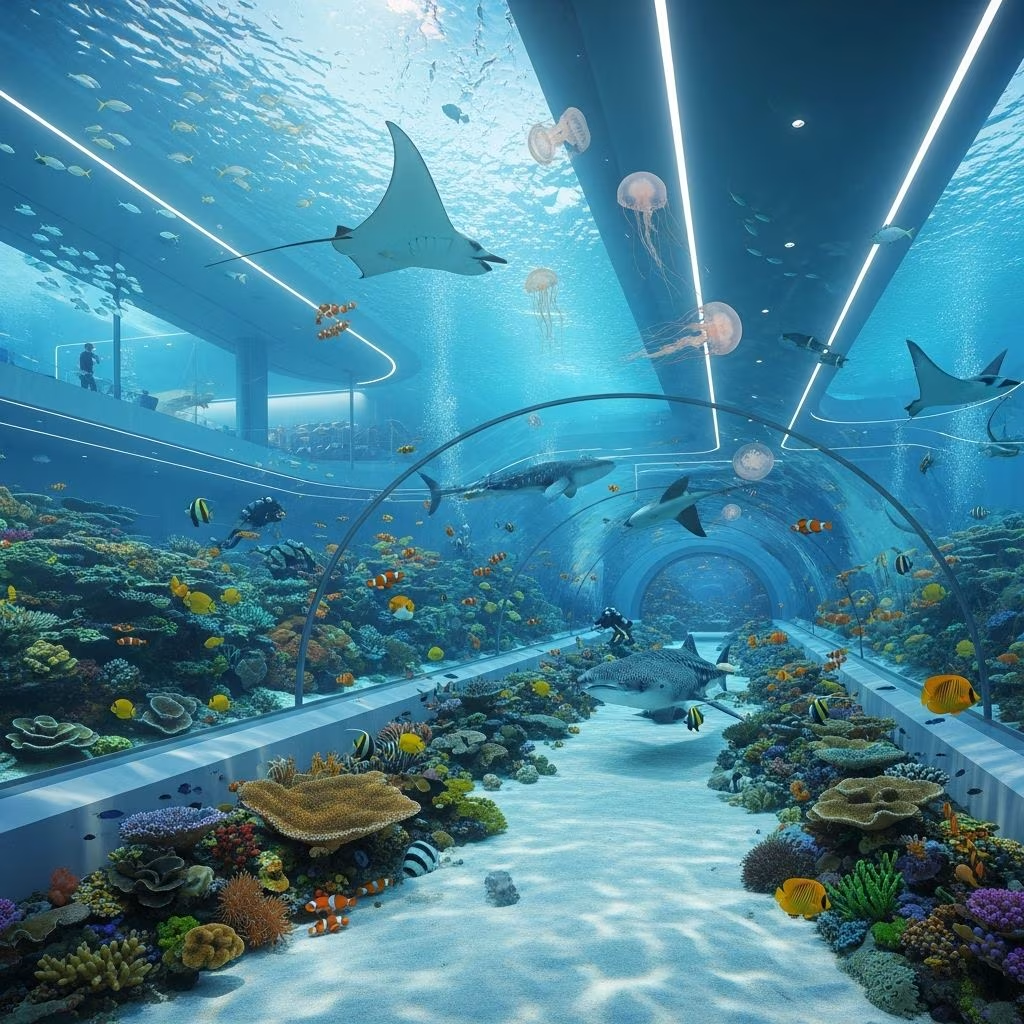
The Open Ocean exhibit stands as the facility’s architectural and experiential centerpiece. Featuring more than 18 million liters of water, this massive tank houses approximately 50,000 schooling fish alongside rays, sharks, and other pelagic species. Multiple viewing panels allow visitors to experience the exhibit from different perspectives, creating the sensation of being surrounded by open ocean life. Giant groupers, Javanese cownose rays, leopard whinrays, pickhandle barracudas, and reef manta rays navigate this expansive environment, providing unforgettable visual experiences.
The Apex Predators of the Seas zone takes a different approach, creating an immersive tunnel that allows visitors to observe larger shark species from close range while remaining safely separated. Blacktip reef sharks, sand tiger sharks, scalloped hammerhead sharks, tawny nurse sharks, and whitetip reef sharks patrol the waters above, creating both awe and respect for these misunderstood creatures.
Beyond these marquee exhibits, the facility showcases specialized environments. The Underwater City zone emphasizes coral reef ecosystems, housing 100 species of hard corals and 20 species of soft corals, along with associated fish species like the regal blue tang and various moray eels. The Quirky Adaptations zone demonstrates evolutionary ingenuity, featuring species such as the blotcheye soldierfish, bumphead parrotfish, elephant fish, and the distinctive weedy seadragon.
Notable additions to the facility include specimens that have gained cultural prominence, such as the albino axolotl, which gained viral fame through popular culture references. These contemporary touches help bridge the gap between formal scientific education and popular culture engagement.
The Singapore Oceanarium distinguishes itself by functioning simultaneously as multiple institution types: aquarium, museum, and science center combined. This multifaceted approach reflects contemporary thinking about experiential learning and public engagement with scientific content.
The facility emphasizes interactive programming and immersive learning that extends beyond passive observation. Guided experiences, including specialized tours focused on deep-sea creatures, provide behind-the-scenes access to support areas where specialized animal care occurs. These programs offer visitors insight into the operational complexity required to maintain such facilities while building appreciation for the animals under care.
The Shipwrecked habitat exemplifies how the facility connects human cultural elements with marine ecology. By showing how shipwrecks function as artificial reefs, the exhibit demonstrates that human influence on marine environments isn’t inherently negative when properly managed. Species like the bowmouth guitarfish and black-blotched fantail rays inhabit these artificially created structures, illustrating ecological resilience and adaptation.
Rather than treating conservation as an afterthought or supplementary messaging, the Singapore Oceanarium has integrated it as a fundamental operational and philosophical principle. The facility recognizes its role in species conservation through ethical and sustainable animal management practices. This commitment extends beyond the facility itself to influence broader conservation efforts in the region and globally.
Educational exhibits specifically address ocean ecosystems and the vital role oceans play in global biological systems. By helping visitors understand marine environments’ complexity and fragility, the facility aims to inspire conservation-minded thinking that extends beyond the visitor experience into daily life choices and policy advocacy.
The expanded facility’s three-fold increase in size offers considerably more content than its predecessor, making time allocation an important consideration for visitors. The 22 zones represent a significant journey through marine environments, and meaningful engagement with exhibits requires deliberate pacing rather than rushed touring.
| Consideration | Details |
|---|---|
| Location | Resorts World Sentosa, Sentosa Island |
| Recommended Duration | 3-4 hours for comprehensive experience |
| Best For | Families, marine enthusiasts, educational groups |
| Key Attractions | Open Ocean exhibit, shark tunnel, coral zones |
| Special Programs | Guided deep-sea tours, interactive learning stations |
Most visitors benefit from allocating 3-4 hours to explore the facility thoroughly without feeling rushed. With 22 distinct zones and thousands of animals, this timeframe allows meaningful engagement with exhibits while maintaining enjoyment.
The facility houses thousands of marine animals representing diverse species and ecological niches. Highlights include sharks, rays, manta rays, large groupers, various coral species, eels, and numerous fish species adapted to different marine environments.
Yes, the facility offers interactive programming and multi-sensory exhibits designed to engage visitors of all ages. Special guided tours and educational stations cater specifically to younger learners.
Unlike traditional aquariums focused primarily on animal display, the Singapore Oceanarium integrates elements of museums and science centers, emphasizing storytelling, conservation education, and interactive learning alongside animal viewing.
Conservation messaging is integrated throughout the facility, with dedicated exhibits and programs focusing on ocean ecosystems, species conservation, and the role aquariums play in protecting marine biodiversity.
The Singapore Oceanarium represents a model for contemporary aquarium design and operation. By combining cutting-edge architectural efficiency with sophisticated conservation messaging and interactive learning, the facility demonstrates how traditional attractions can evolve to meet modern educational and environmental imperatives. The investment in expansion and transformation signals confidence in the ongoing relevance of physical, immersive experiences in an increasingly digital world.
As visitors explore the 22 zones and encounter thousands of marine animals, they participate in a larger narrative about humanity’s relationship with ocean ecosystems. Whether observing massive groupers in the Open Ocean exhibit, walking through a tunnel beneath patrolling sharks, or learning about coral conservation in the Underwater City, each moment contributes to building ocean literacy and conservation awareness that extends far beyond the facility’s walls.
