

 Travel Essentials
 Travel Essentials

Explore Hang Son Doong, the planet's biggest cave by volume, with details on its discovery, jaw-dropping features, and exclusive multi-day expeditions in Vietnam's Phong Nha-Ke Bang National Park.
 Travel Essentials
Hang Son Doong stands as the world’s largest cave by volume, a monumental limestone chamber hidden deep within Vietnam’s Phong Nha-Ke Bang National Park. This natural wonder, capable of housing entire city blocks, draws intrepid explorers for its surreal landscapes of towering stalactites, subterranean jungles, and rushing rivers.
Formed over 2 to 5 million years ago, Son Doong Cave emerged from the relentless erosion of underground rivers carving through limestone along a tectonic fault line in the Annamite Mountains. This process created vast passages with cross-sections unmatched anywhere else on Earth.
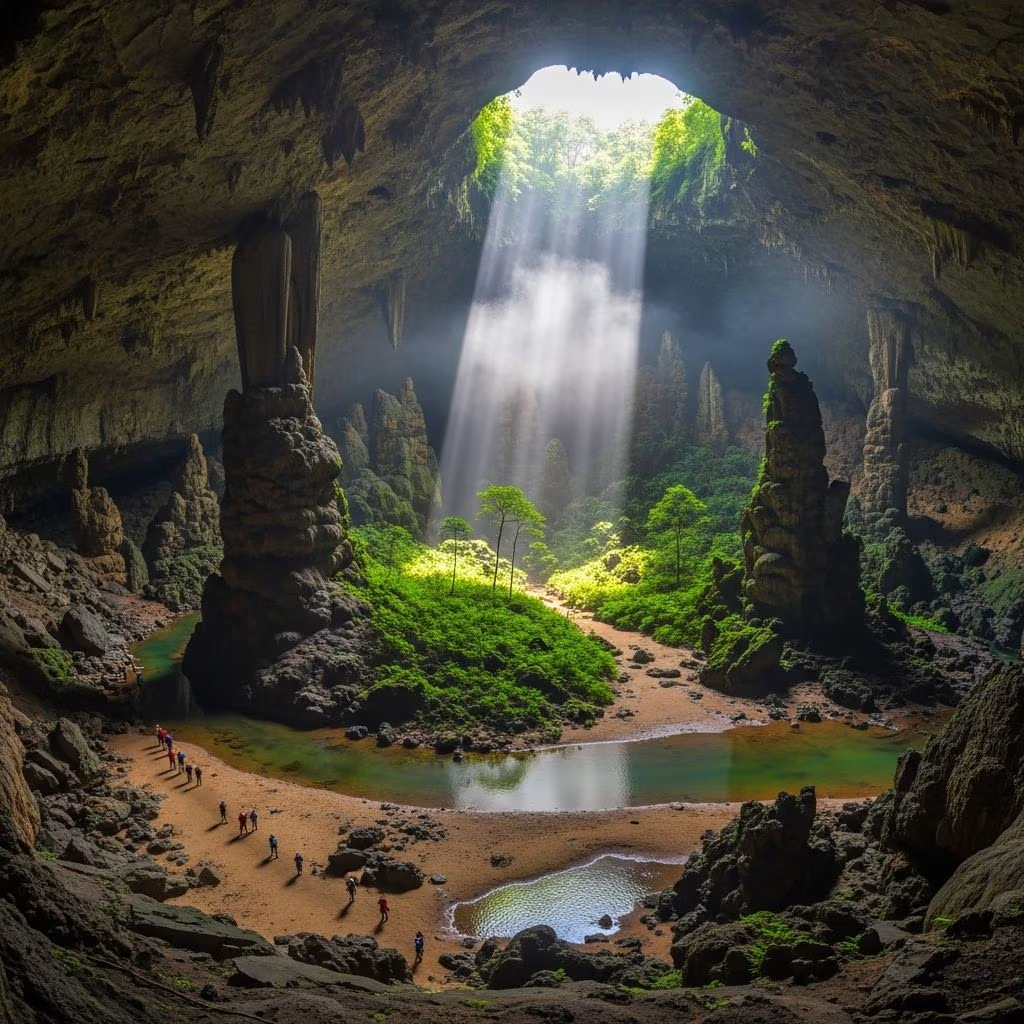
About 300,000 years ago, sections of the cave ceiling collapsed, forming massive openings known as dolines. These skylights flood the interior with sunlight, nurturing ancient forests and diverse ecosystems within the cave’s depths.
With a volume exceeding 38.5 million cubic meters and passages stretching over 9 kilometers, Son Doong dwarfs other caves globally. Its main chamber alone could fit a 40-story skyscraper, underscoring its unparalleled scale.
In 1990, local resident Ho Khanh, a seasoned jungle forager from the Phong Nha region, stumbled upon the cave’s entrance while hunting for agarwood near the Laos-Vietnam border. Intimidated by the sheer 90-meter drop at the entry, he did not enter at the time.
Nearly two decades later, in 2009, Khanh guided the British-Vietnam Caving Expedition, led by Howard Limbert. On April 7, Peter MacNab became the first to descend into the abyss, revealing a hidden world of colossal dimensions.
The team’s surveys confirmed Son Doong’s supremacy, with National Geographic endorsing it as the largest cave in 2011. Ongoing explorations continue to uncover unmapped sections, including potential submerged passages.
Stepping into Son Doong transports adventurers to an otherworldly realm. Massive stalactites and stalagmites, some resembling ancient monoliths, adorn the chambers alongside rare cave pearls formed by mineral-rich drips.
Dolines create verdant oases where sunlight pierces the darkness, supporting 140-million-year-old ferns and lush foliage. Underground rivers carve through the passages, inviting swims amid glowing bioluminescent organisms.
The ‘Great Wall of Vietnam,’ a 90-meter limestone barrier, challenges trekkers with its imposing scale. Conquering it reveals further passages filled with unique fauna, from blind fish to endemic insects adapted to eternal twilight.
| Feature | Description | Unique Aspect |
|---|---|---|
| Main Passage Length | Over 9 km | Longest continuous cave system surveyed |
| Volume | 38.5 million m³ | Largest by volume worldwide |
| Doline Skylights | Two major collapses | Support internal jungles |
| Great Wall | 90m high | Key expedition obstacle |
Accessing Son Doong demands commitment: a 1.5-day jungle trek from Phong Nha town leads to the entrance via river crossings and dense foliage. Expeditions, operated solely by Oxalis Adventure since 2013, limit 1,000 permits annually to preserve the site.
The flagship 4-day, 3-night journey begins with a briefing and village homestay. Day one involves a 3-hour hike to Hang En Cave for overnight camping under a luminous entrance, crossing rivers and scaling hills.
Teams include expert guides, porters, chefs, and safety specialists equipped with harnesses for descents and climbs. Expect boulder scrambles, swims, and zip-lines over chasms.
Permits sell out instantly each October for the next year’s slots—book via official channels. Costs cover all logistics, meals (including fresh jungle cuisine), and gear; personal items include quick-dry clothes, sturdy boots, and a headlamp.
Fitness is crucial: prepare for 10-15 km daily hikes with elevation gains, carrying minimal packs as porters handle loads. Weather windows span February to August; monsoons close the cave.
Safety protocols mirror elite mountaineering: via ferrata systems on walls, life vests in rivers, and medics on hand. Environmental rules ban single-use plastics, ensuring Son Doong remains pristine.
Son Doong hosts a thriving biosphere, from swiftlets nesting in dolines to rare primates and fish species thriving in isolated rivers. Collapsed ceilings foster microclimates supporting biodiversity unseen elsewhere.
Phong Nha-Ke Bang, a UNESCO World Heritage Site, safeguards this jewel. Strict caps prevent overcrowding, with research ongoing via Oxalis and British teams to map untouched areas.
Visitors contribute through no-trace principles, supporting local communities via fair-wage porter jobs and village tourism.
Beyond scale, Son Doong offers transcendence: sunbeams piercing vast chambers evoke sci-fi realms, while the trek fosters camaraderie among diverse groups. It’s not tourism—it’s exploration, echoing early cavers’ awe.
Recent expeditions hint at further secrets, like flooded extensions awaiting dives. For thrill-seekers, it’s the pinnacle of cave trekking, blending physical challenge with natural splendor.
Its massive volume of 38.5 million cubic meters and 9+ km passages set records, confirmed by 2009-2010 surveys.
Moderate to strenuous: daily hikes, climbs, swims require good fitness; no prior caving experience needed.
February-August for dry conditions; book permits a year ahead.
Yes, with professional teams using advanced safety gear and protocols.
Minimum age 18; suitable for fit adults seeking adventure.
| Cave | Location | Volume (m³) | Length (km) |
|---|---|---|---|
| Son Doong | Vietnam | 38.5M | 9+ |
| Mammoth | USA | ~10M | 650+ |
| Deer Cave | Malaysia | ~13M | 3.2 |
Son Doong excels in single-passage volume, unlike longer but narrower systems.
