

 Travel Essentials
 Travel Essentials

Explore comprehensive transportation methods across South Korea, including subway systems, bus networks, rail services, and practical travel tips for visitors.
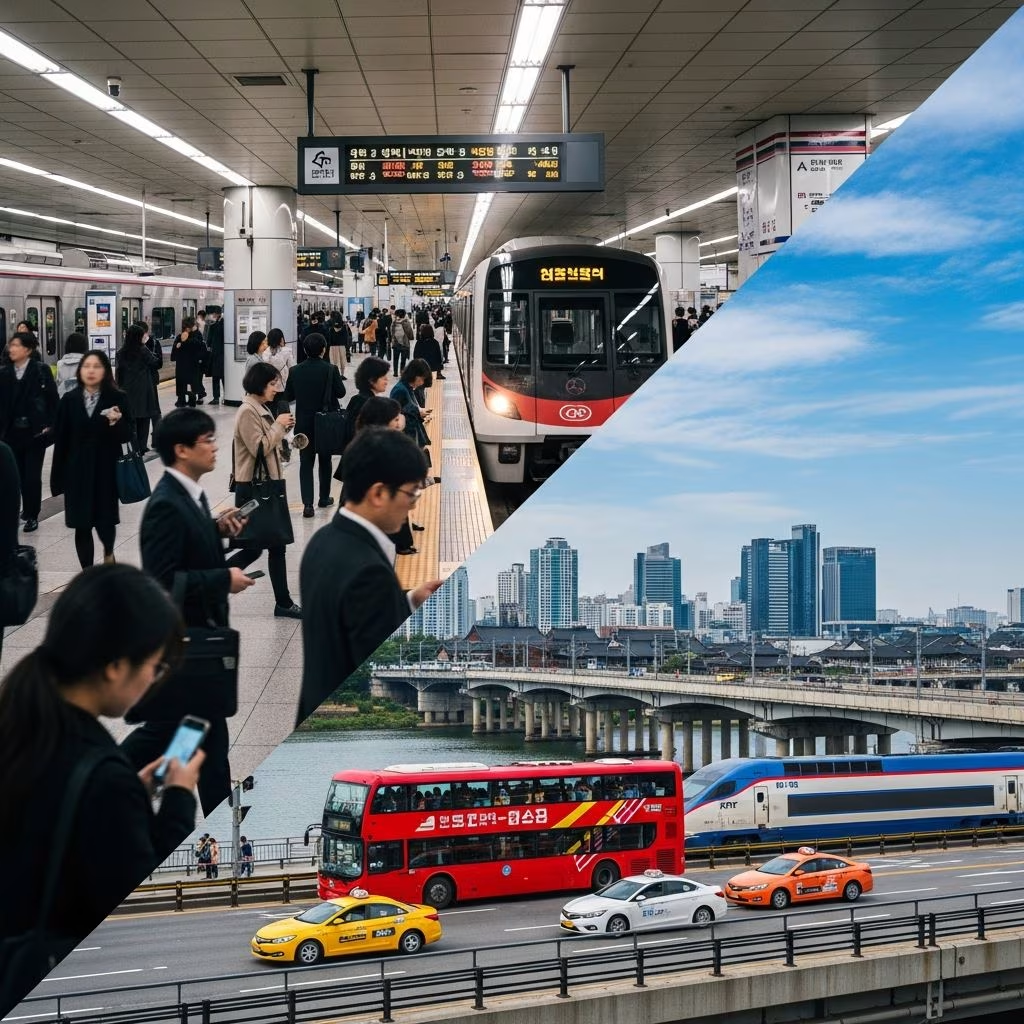 Travel Essentials
South Korea offers one of Asia’s most efficient and user-friendly transportation networks, making it remarkably easy for visitors to explore the country. Whether you’re moving around Seoul’s bustling districts or traveling between major cities, understanding the various transit options available will enhance your travel experience and help you navigate with confidence.
The Seoul Metropolitan Subway represents one of the world’s most reliable and well-maintained rapid transit systems. Operating with exceptional punctuality and cleanliness, the network has earned consistent international recognition for its accessibility and user-friendly design. The system functions nearly around the clock, with trains running from approximately 5:30 AM until midnight, allowing travelers to move through the city during most daylight and evening hours.
The subway network currently comprises 23 lines that radiate throughout Seoul and its surrounding regions. Each line features its own color coding system, making visual identification straightforward even for first-time visitors. This color-coded approach extends beyond the main lines to include specialized transit corridors like the Airport Railroad Independent Area connecting to Incheon International Airport, the Sinbundang Line, the Yongin EverLine serving Everland theme park, and the Ui-Sinseol Light Rail Transit Line.
Accessing Seoul’s subway requires either a single-journey pass or a reusable transportation card. Single-journey passes can be purchased directly at subway station ticket counters and require exact payment for your destination plus a 500-won refundable deposit. However, the T-money card system offers significantly greater convenience for regular transit users. These rechargeable cards can be purchased at nearly every convenience store throughout Seoul and can be instantly reloaded with cash at any time.
The T-money card provides additional benefits beyond simple convenience. Cardholders receive a 100-won discount on adult fares per ride compared to cash payments. This modest discount accumulates substantially over multiple journeys, making the card economically advantageous even for short visits.
Successfully using Seoul’s subway requires minimal planning once you understand the basic system structure. Station signs throughout the network display information in Korean, English, and Chinese, facilitating navigation for international visitors. Most stations feature clear directional signage and maps indicating connection points to other subway lines.
Modern technology further simplifies navigation. Applications like Naver Maps provide detailed routing information, including specific recommendations about which train car to board for optimal transfer connections and exit locations. This level of detail helps minimize confusion during transfers between lines, particularly valuable during rush hours when stations become crowded.
Seoul’s bus system operates as a comprehensive alternative to subway travel, offering extensive coverage and exceptional affordability. The network is organized through a color-coding system that categorizes buses by their service areas and route types.
Blue buses serve as trunk lines operating through downtown Seoul and connecting major central districts along primary corridors. These buses provide the backbone of the city’s internal transit network, running with high frequency throughout operating hours.
Green buses function as branch lines, connecting residential neighborhoods with subway stations and complementing blue bus trunk routes. Smaller green buses, known as maeul buses, operate on shorter routes within individual districts or neighborhoods, providing local circulation that complements the larger transit system.
Yellow buses maintain circulation routes within Seoul’s city center, providing convenient access to business districts and major tourist attractions. These buses prove particularly valuable for visitors focusing their activities within central Seoul’s most popular areas.
Red buses operate as express services connecting downtown areas with destinations in surrounding regions. While less frequently encountered within Seoul proper, these buses extend transit connectivity beyond the city’s primary boundaries.
| Bus Type | Category | T-money Card | Cash Payment | Early Bird Discount |
|---|---|---|---|---|
| Blue/Green Bus | Adult | 1,500 KRW | 1,500 KRW | 1,200 KRW |
| Blue/Green Bus | Teenager | 900 KRW | 1,000 KRW | 720 KRW |
| Blue/Green Bus | Child | 550 KRW | 550 KRW | 440 KRW |
| Yellow Bus | Adult | 1,400 KRW | 1,400 KRW | 1,120 KRW |
Bus fares remain remarkably economical, typically costing around 1,000 won per ride in city center areas. Early morning travelers benefit from reduced fares, with discounts available on most bus categories when traveling before standard daytime hours. The T-money card maintains consistency across most bus operators, though some services continue accepting direct cash payments.
Beyond Seoul’s internal transit, South Korea’s national railway system provides rapid connections between major cities across the country. The rail network operates with exceptional reliability and punctuality, featuring modern facilities and comfortable seating arrangements.
The Korea Train Express (KTX) represents the pinnacle of domestic rail service, offering high-speed connections between Seoul and major destinations throughout the country. These sleek, modern trains entered service in 2004 and occasionally reach speeds exceeding 300 kilometers per hour. The KTX’s Gyeongbu line connects Seoul to Busan, covering the distance in approximately two hours at a fare of 51,800 won.
The KTX’s combination of speed and comfort makes it the preferred choice for time-conscious travelers, though premium pricing reflects these advantages. Trains can be booked at Seoul Station or through the Korail application, which allows pre-booking before your journey.
The Saemaeul train class provides a more economical alternative to KTX service while maintaining respectable journey times and improved comfort compared to standard offerings. Traveling from Seoul to Busan requires over four hours on Saemaeul service, but fares are reduced to approximately 39,300 won—roughly one-third of KTX pricing. The greater legroom typically found on Saemaeul trains often compensates travelers for the extended journey duration.
Express trains provide airport access from both Gimpo International Airport and Incheon International Airport. Express service from Gimpo to Seoul Station takes approximately 20 minutes, while all-stop trains complete the journey in about 26 minutes. Tickets cost between 1,500 and 3,100 won, with trains departing every 10 minutes. These airport trains offer comfortable seating, ample luggage storage, and complimentary Wi-Fi for passengers during their journey.
South Korea’s extensive intercity bus network connects virtually every population center throughout the peninsula, making buses a compelling option for visiting destinations beyond Seoul. The system operates with remarkable frequency, with some scheduled services running as often as every two minutes during peak travel periods.
Long-distance buses are categorized into two primary types: express buses (고속) and intercity buses (시외). Express services typically serve longer routes at premium pricing, while intercity buses offer similar coverage at reduced fares with potentially longer journey times. Confusingly for visitors, express and intercity buses often use separate stations in most cities, and locals themselves sometimes struggle to determine which facility serves specific routes.
An increasing number of cities are consolidating both bus types into unified stations, simplifying navigation for travelers. Gwangju exemplifies this trend, housing both express and intercity operations within a single facility. This consolidation trend should gradually improve the intercity bus experience as additional cities adopt the unified approach.
Taxis provide convenient point-to-point transportation throughout South Korea, with services widely available in urban areas and popular destinations. Rather than hailing taxis on the street, visitors should download Kakao T, the dominant app-based taxi service. This application streamlines the booking process and connects users with drivers more efficiently than traditional street-hailing methods.
Kakao T users should obtain a T-money card for payment, though some drivers continue accepting cash. Using the card reduces complications and prevents potential cancellations by drivers who prefer card payments over cash transactions. The standardized payment system ensures transparent pricing and eliminates fare negotiation concerns.
Incheon International Airport, serving the Seoul metropolitan region, provides multiple ground transportation options for arriving and departing passengers. The Airport Railroad Express (AREX) operates express and all-stop train services from the airport terminals. Express trains cost 9,500 won per journey, while all-stop trains cost between 4,150 and 4,750 won.
Airport limousine buses offer alternative connectivity to various Seoul destinations, including major hotels and popular neighborhoods. These buses provide comfortable seating, luggage storage, and complimentary Wi-Fi throughout the journey. Travel times vary based on specific destinations and traffic conditions, but buses provide direct routing without intermediate stops.
Visitors should note that Google Maps does not function in South Korea, necessitating alternative navigation applications. Naver Maps and Kakao Map serve as the primary digital navigation resources for transit planning and directions. These applications provide comprehensive routing information, fare estimates, and real-time transit updates essential for efficient travel planning.
The Korail application specifically serves railway booking needs, allowing visitors to research schedules and reserve seats for intercity and airport train services in advance. Downloading these applications before arrival ensures seamless access to navigation and booking capabilities throughout your journey.
The T-money card system unifies payment across multiple transit modes—subways, buses, taxis, and many retail locations. Purchasing a card at convenience stores and maintaining adequate balance ensures smooth transit throughout your visit. The card’s compatibility across numerous services eliminates the need for separate payment methods, simplifying logistics considerably.
Subway pricing operates on distance-based calculations: 100 won per 5 kilometers up to 50 kilometers, then 100 won per 8 kilometers beyond that distance. Subway users benefit from the same 100-won per-ride discount provided to bus passengers when using T-money cards.
City bus networks can initially appear overwhelming due to extensive route networks and limited English signage on vehicles and stops. However, once you identify key routes serving your frequent destinations, buses become an excellent transportation method. Routes operate with impressive frequency and remarkable affordability—city bus travel typically costs approximately 1,000 won per journey.
Underground shopping areas located beneath subway stations provide convenient access to food, retail goods, and general merchandise, allowing travelers to make purchases without surfacing to street level. Taking advantage of these underground commercial areas enhances the efficiency and comfort of transit-based travel throughout Seoul.
Yes, the T-money card works across subways, buses, taxis (through Kakao T), and many retail establishments, making it the ideal universal payment solution for transportation throughout South Korea.
The Seoul subway runs from approximately 5:30 AM until midnight daily, making it available during standard tourism hours and evening activities.
Line 2 (green) serves popular destinations including Sinchon, Gangnam, Jamsil, and Seoul National University. Line 4 (light blue) and Line 6 (brown) also serve frequently visited areas.
Express trains reach Seoul Station in approximately 20 minutes compared to 26 minutes for all-stop service. Choose express service if time is prioritized; select all-stop service if budget optimization is preferred.
Research your specific destination in advance to determine whether express or intercity bus service is available and which station serves that route. Apps like Naver Maps can assist in identifying correct facilities.
