

 Travel Essentials
 Travel Essentials

Unlock the secrets to spotting the Southern Lights: best months from March to September, top spots in Tasmania, New Zealand, and Patagonia, plus viewing tips and forecasts.
 Travel Essentials
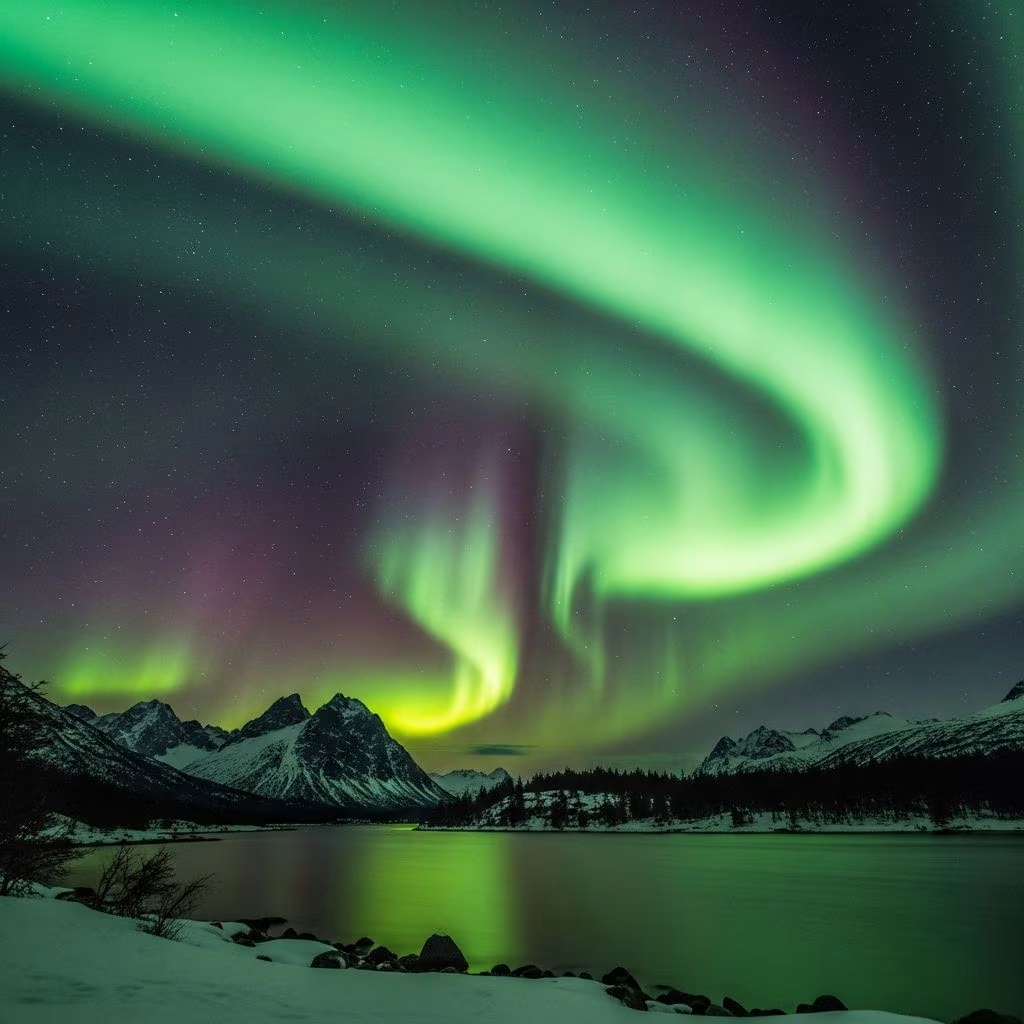
The Aurora Australis, commonly known as the Southern Lights, captivates travelers with its ethereal dance of green, purple, and red hues across the night sky. This natural phenomenon arises from charged solar particles colliding with Earth’s atmosphere near the magnetic south pole, creating a spectacular light show visible primarily in the southern hemisphere. Unlike its northern counterpart, the Aurora Borealis, the Southern Lights are less frequently witnessed due to remote viewing locations, but 2026 offers heightened opportunities thanks to the ongoing solar maximum cycle, which peaks activity and intensifies displays.
Solar winds eject billions of tons of plasma from the sun’s corona, directing these particles toward Earth. Upon reaching the planet, they interact with oxygen and nitrogen molecules in the upper atmosphere, exciting them to emit light at specific wavelengths—greens from oxygen at about 100 km altitude, reds higher up, and purples or blues from nitrogen. This process is most vivid during periods of elevated geomagnetic activity, measured by the Kp index, where values above 5 signal strong auroral potential.
Current solar cycle 25, which began in 2019, is forecasted to reach its maximum in 2025-2026, leading to more frequent and brighter auroras. Space weather agencies track these events in real-time, providing alerts that can extend visibility to lower latitudes during intense storms.
The optimal window for observing the Southern Lights spans the southern hemisphere’s winter, from March through September, when longer nights and darker skies enhance visibility. May to August stands out as the peak period, offering the darkest conditions post-sunset and minimal twilight interference. During these months, nights can stretch up to 15 hours, providing ample opportunity for displays that typically peak between 10 PM and 2 AM local time.
While sightings occur year-round during strong solar events, summer months (October-February) pose challenges from shorter nights and brighter ambient light. Patience is key, as displays last 1-3 hours and depend on solar ejections timed hours earlier.
Proximity to the auroral oval—encircling the geomagnetic south pole—is crucial. Southernmost landmasses offer the best odds, with Tasmania leading for accessibility.
Tasmania’s position, just 2,500 km north of Antarctica, places it under the auroral zone’s edge. Clear nights yield 1-2% daily probability, rising near equinoxes. Hobart benefits from its geomagnetic proximity to the south pole.
| Location | Why It’s Ideal | Accessibility |
|---|---|---|
| Mount Wellington (kunanyi) | High elevation, minimal light pollution | 30-min drive from Hobart |
| South Arm Peninsula | Coastal views, dark skies | 45-min drive south of Hobart |
| Cradle Mountain-Lake St Clair NP | Remote wilderness, pristine air | 4-hour drive from Hobart |
| Bruny Island / Goat Bluff | Isolated beaches, low population | Ferry from Kettering |
The South Island’s clear skies and low light pollution make it a hotspot. Stewart Island, 20 km off the mainland, provides near-Antarctic views.
Ushuaia in Tierra del Fuego, the world’s southernmost city, hosts displays over the Beagle Channel from May-July. El Calafate and Bariloche offer Patagonian drama. Antarctica expeditions guarantee views but demand expedition-level planning.
Capturing the Southern Lights requires preparation beyond the naked eye, where displays often appear as white beams needing long exposures for color.
Forego filters; focus stacking in post-processing reveals faint details. Practice foreground compositions with landscapes to elevate images.
Success hinges on preparation amid unpredictability.
During solar maximum, mainland Australia (Victoria, South Australia) may see rare glimpses, as in recent 2024-2025 storms.
For novices, join aurora tours in Tasmania or New Zealand, including transport, gear, and expert guides. Multi-night packages hedge against single-night misses, often bundling stargazing, photography workshops, and luxury lodges like those at Lake Tekapo. Patagonia cruises from Ushuaia combine aurora hunts with wildlife spotting.
Respect dark sky preserves; use red flashlights to preserve night vision. Indigenous perspectives enrich the experience—Maori in New Zealand view auroras as ancestral signals. Sustainable tourism minimizes impact on fragile ecosystems.
No, probability varies; 1-10% on clear nights in prime spots, higher during solar storms.
Similar science, but Southern Lights are harder to access due to oceanic/icy surroundings. Best seasons oppose: southern winter vs. northern winter.
Clothing for cold; camera optional. Apps and forecasts are vital.
Yes, solar maximum peaks visibility through 2026.
40°S+ ideal; Tasmania (42°S), NZ South Island (46°S), Ushuaia (54°S).
Book flights to Hobart, Queenstown, or Ushuaia 3-6 months ahead for winter. Budget for 5-7 nights to maximize odds. Combine with hiking, wildlife, or wine tours for a holistic trip. The Southern Lights promise memories etched in cosmic fire—chase them under the vast southern skies.
