

 Travel Essentials
 Travel Essentials

Explore the fascinating history of southern Peru, from pre-Inca cultures to the mighty Inca Empire and Spanish colonial era.
 Travel Essentials
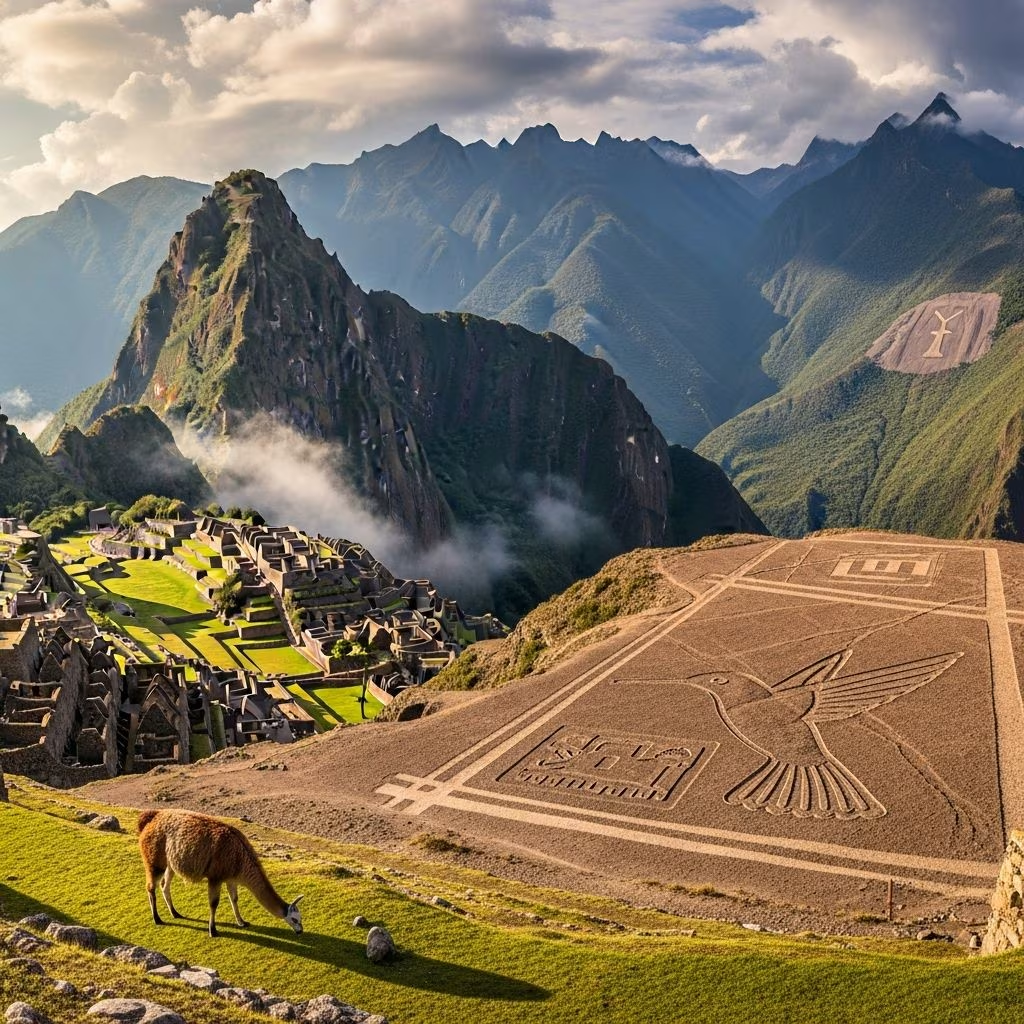
Southern Peru stands as one of the world’s most historically significant regions, bearing witness to thousands of years of human civilization, cultural innovation, and architectural brilliance. The landscape of this high-altitude terrain, with its misty peaks and fertile valleys, cradled some of humanity’s greatest pre-Columbian societies. From the earliest farming communities that emerged along the Andean slopes to the sprawling Inca Empire that commanded one of the world’s largest territorial dominions, southern Peru represents an unparalleled tapestry of human achievement and cultural development.
The story of human habitation in southern Peru begins millennia before recorded history. Archaeological evidence indicates that around 4,000 BC, the inhabitants of this region underwent a profound transformation, transitioning from nomadic hunters and gatherers to settled agricultural communities. This shift marked a turning point in Andean civilization, establishing the foundations upon which subsequent cultures would build their legacies.
The earliest documented settlement in southern Peru and indeed across the entire South American continent is Caral, dating back approximately 5,000 years to 3,000 BC. This archaeological site provides compelling evidence of sophisticated urban planning and communal organization. The people who built Caral were not merely subsistence farmers; they constructed ceremonial structures, established trade networks with distant regions including the Amazon basin, and developed complex social hierarchies. These early inhabitants demonstrated remarkable engineering acumen by constructing irrigation systems to harness water from the arid coastal environment, enabling agricultural productivity in otherwise inhospitable terrain.
Between the decline of the earliest civilizations and the rise of the Inca Empire, southern Peru witnessed the flourishing of numerous distinct cultures, each contributing unique artistic, technological, and administrative innovations. This extended period, roughly spanning from 300 BC through 1,400 AD, saw the emergence of competing regional powers that shaped the political and cultural landscape of the Andes.
The Paracas civilization, which developed along the southern coastal regions around 900 BC, distinguished itself through extraordinary textile artistry. Paracas weavers created some of the finest pre-Columbian textiles in the Americas, utilizing vicuña fibers and cotton to produce garments of unparalleled quality and aesthetic sophistication. When Paracas individuals passed away, their communities engaged in elaborate burial practices that preserved these textiles and other grave goods, providing archaeologists with invaluable insights into the society’s values, beliefs, and technical capabilities.
The Moche and Nazca cultures subsequently dominated coastal regions from approximately 100 BC through 700 AD, establishing themselves as skilled potters, architects, and administrators. The Moche civilization, in particular, developed hydraulic engineering systems that allowed them to channel water across desert landscapes. However, the second half of the sixth century brought catastrophic environmental change. A severe drought devastated coastal Peru, depleting water resources and agricultural yields, ultimately precipitating the collapse of Moche civilization.
This environmental crisis created a power vacuum that enabled the Huari people, based in the Ayacucho region of the central Andes, to rise to prominence. The Huari were distinctive for their expansionist military ambitions and their willingness to employ force to subdue neighboring populations. Their influence extended across vast territories, fundamentally reshaping regional political dynamics and establishing hierarchical administrative structures that would influence subsequent empires.
The Inca Empire represents the culmination of thousands of years of Andean cultural development, representing the largest and most sophisticated state system in pre-Columbian America. This remarkable civilization, though remarkably short-lived, endured for approximately 95 years from 1438 to 1533, during which it transformed from a regional Cusco-based kingdom into a continental superpower.
The empire originated humbly as a small tribal settlement in the Cusco Valley of southern Peru, occupying a strategically advantageous position within the high-altitude Andes. Cusco’s elevation, fertile surrounding lands, and natural defensive capabilities made it an ideal administrative center. The transformation from regional power to continental empire accelerated dramatically under Pachacutec, the ruler who initiated an aggressive expansion program beginning in 1438. Under his leadership and that of his successors, Inca territory expanded northward to encompass regions of modern-day Colombia and Ecuador, while southern boundaries extended into central Chile. At its zenith, the Inca Empire represented one of the world’s largest territorial states, rivaling contemporary European kingdoms in geographical extent and population.
Inca achievements extended far beyond military conquest. The empire’s administrative apparatus was remarkably sophisticated, utilizing an intricate bureaucratic system to govern diverse populations across multiple ecological zones and languages. The famous quipu, a recording device consisting of knotted strings, enabled Inca administrators to maintain detailed records without a written language. Agricultural terracing that remains visible today demonstrates extraordinary engineering expertise, with Inca farmers constructing elaborate stepped landscapes that maximized arable land while preventing soil erosion on steep mountainous terrain. Stone architecture of the Inca period exhibits unparalleled precision, with massive blocks fitted so tightly that mortar was unnecessary, and structures so sturdy that many remain standing after five centuries.
The arrival of Spanish conquistadores in 1532 fundamentally altered Peru’s trajectory, initiating a process that would subordinate indigenous civilizations to European colonial rule. Francisco Pizarro, leading a relatively small force of Spanish soldiers, exploited existing internal divisions within the Inca Empire to achieve military victory. Civil war between Inca Huáscar and his half-brother Atahualpa in 1525 had fractured the empire’s political unity, weakening central authority and creating factions that Spanish forces could manipulate and divide. Within a few years, Spanish conquistadors captured Cusco and began establishing colonial institutions.
The Spanish Crown formalized its control by creating the Viceroyalty of Peru in 1542, establishing a hierarchical colonial administration that extracted vast wealth from conquered territories. Colonial authorities implemented the encomienda system, a labor arrangement that granted Spanish colonists virtually unlimited authority over indigenous Peruvian populations. Under this system, native peoples were compelled to cultivate Old World crops and livestock for their Spanish overlords, fundamentally transforming indigenous economic systems and social organization.
Spanish mining operations became the primary engine of colonial wealth extraction. Silver deposits at Potosí in Upper Peru yielded unprecedented riches that funded Spanish imperial ambitions across the globe. Colonial administrators revived the Inca mita system, a forced labor program that mobilized native communities for dangerous and often deadly mining work. This transformation of Peru into a extractive colonial economy enriched the Spanish Crown while devastating indigenous populations through overwork, disease, and cultural disruption.
By the early nineteenth century, independence movements swept across South America, challenging Spanish colonial dominance. The Peruvian War of Independence, beginning in 1811, represented one chapter in this broader continental uprising against European rule. Two pivotal military figures, José de San Martín from Argentina and Simón Bolívar from Venezuela, played instrumental roles in orchestrating liberation forces and defeating Spanish armies. San Martín ultimately proclaimed Peruvian independence in Lima on July 28, 1821, though Spanish forces continued resisting until their final defeat at the Battle of Ayacucho in 1824. This victory established Peru as an independent republic, formally ending nearly three centuries of Spanish colonial administration.
The physical evidence of southern Peru’s historical significance remains strikingly visible across the landscape. Cusco, despite experiencing substantial Spanish reconstruction and colonial overlay, retains numerous structures displaying Inca architectural mastery. Spanish conquistadors frequently built colonial churches directly atop Inca temples, reusing precisely fitted stone foundations. This architectural palimpsest visually represents the layering of indigenous and European cultures, with Inca stonework often visible supporting Spanish colonial construction.
The Temple of the Sun, considered the most significant religious structure in the Inca Empire, underwent dramatic transformation following Spanish conquest. Spanish authorities systematically dismantled this sacred site, repurposing its finely worked stone blocks as foundation material for the colonial Santo Domingo Church. This practice exemplified Spanish strategies for consolidating control and demonstrating Christian supremacy over indigenous religions.
The surrounding landscape preserves equally remarkable archaeological evidence. Steep agricultural terraces continue ascending mountainsides, testament to Inca engineering ingenuity and sophisticated understanding of soil management and water conservation. Imposing fortress structures dot the highland valleys, their strategic placements revealing Inca military planning expertise. These tangible remnants provide contemporary visitors with visceral connections to ancient achievements.
What made Cusco such an important location for the Inca Empire?
Cusco’s high-altitude location within the Andes provided natural defensive advantages, fertile surrounding valleys supported agricultural productivity, and its central position enabled administrative oversight of extensive territories. These geographic factors made it an ideal imperial capital.
How did the Spanish manage to conquer such a vast empire with relatively few soldiers?
Spanish conquistadors exploited the Inca civil war between Huáscar and Atahualpa, obtaining indigenous allies and using military technology including firearms and steel weapons that provided tactical advantages over indigenous forces using bronze and stone implements.
What archaeological sites can visitors explore in southern Peru today?
Cusco remains the primary destination, featuring both Inca and Spanish colonial architecture. Surrounding regions contain agricultural terraces, fortress ruins, and ceremonial sites. The Sacred Valley near Cusco preserves multiple significant archaeological locations.
How did environmental changes affect pre-Inca civilizations?
The catastrophic sixth-century drought that devastated the Moche civilization demonstrates how climate fluctuations could dramatically impact societies dependent on consistent agricultural productivity, leading to cultural transformation and political reorganization.
Southern Peru’s historical importance extends beyond academic interest or archaeological fascination. This region represents a unique case study in human civilisation, demonstrating how sophisticated societies developed and flourished in challenging high-altitude environments. The progression from early agricultural communities through the sophisticated Inca Empire illustrates fundamental patterns in civilisation development, including technological innovation, administrative expansion, and cultural elaboration.
The Spanish conquest and subsequent colonial period added another layer to this complex historical narrative, illustrating how intercultural contact could result in cultural synthesis, displacement, and transformation. Modern southern Peru embodies these multiple historical layers, with contemporary Quechua-speaking indigenous populations maintaining cultural practices rooted in pre-Columbian traditions while inhabiting landscapes extensively modified by Spanish colonialism.
Understanding this history provides essential context for appreciating contemporary Peruvian society, where indigenous heritage remains culturally significant and economically important through tourism and cultural industries. The physical landscape itself functions as a historical document, with Inca stonework, agricultural systems, and settlement patterns communicating across centuries about the achievements and perspectives of ancient peoples.
