

 Travel Essentials
 Travel Essentials

A new study reveals growing risks from falling rocket bodies to airplanes, with busy airspaces facing up to 26% annual exposure and calls for controlled reentries.
 Travel Essentials
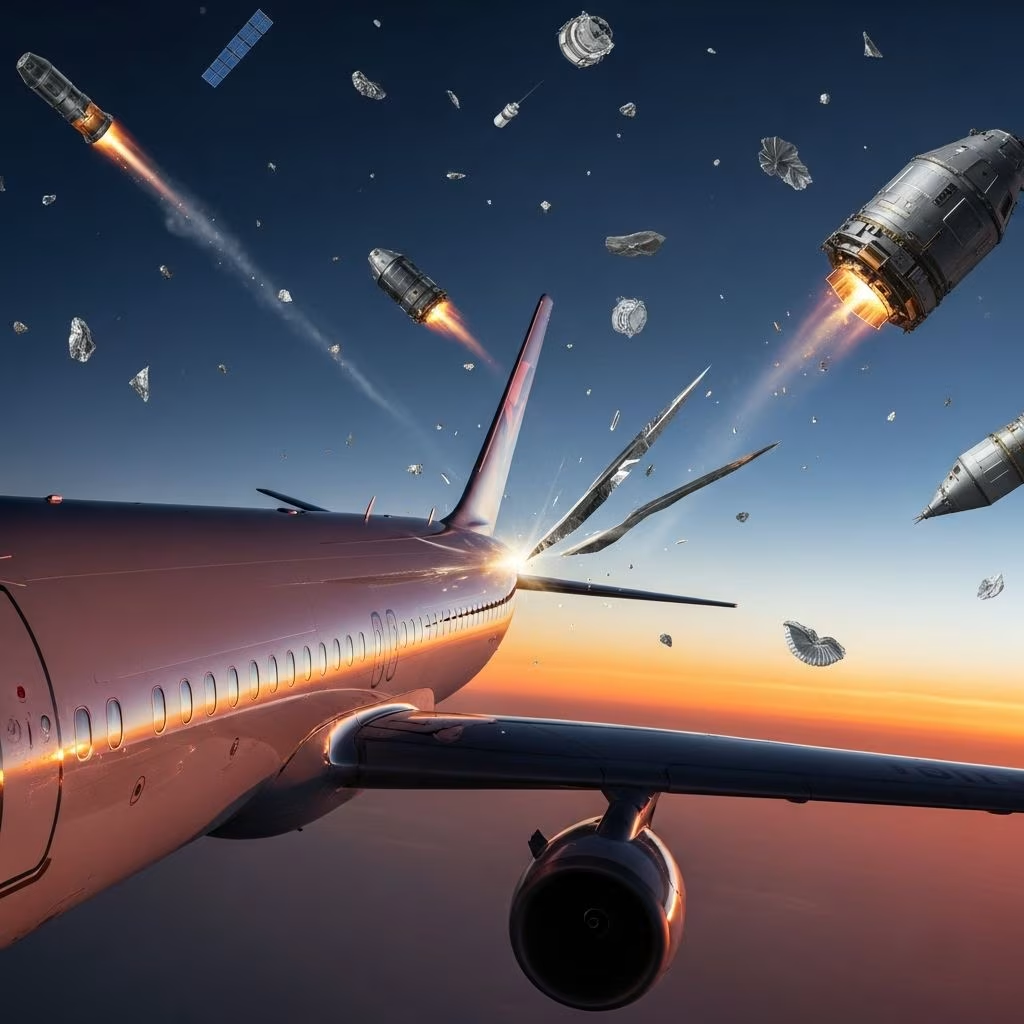
Orbital debris, often called space junk, is transforming from a cosmic curiosity into a tangible hazard for global air travel. Recent research highlights how uncontrolled reentries of rocket bodies into Earth’s atmosphere are increasingly overlapping with commercial flight paths, raising the specter of catastrophic collisions.
Earth’s orbit is cluttered with over 2,300 rocket bodies destined for uncontrolled atmospheric reentry, a number that continues to swell with frequent launches. Trackable objects in orbit have doubled in the past decade, fueled by the boom in satellite deployments and space missions. Daily commercial flights have nearly doubled since 2000, creating denser skies where debris reentries pose direct threats.
Space junk encompasses defunct satellites, spent rocket stages, and fragments from collisions or anti-satellite tests. While large pieces are monitored by networks like the U.S. Space Surveillance Network, smaller untrackable debris remains the stealthiest danger. Micrometeoroids and orbital debris (MMOD) top NASA’s risk list for spaceflight, but their descent now endangers aviation below.
A groundbreaking study from the University of British Columbia models the intersection of reentry paths and air traffic density worldwide. High-density zones near major airports face a 0.8% annual chance of uncontrolled reentry impact, escalating to 26% in busier corridors like the northeastern U.S., northern Europe, or Asia-Pacific hubs.
Though direct strikes remain improbable—estimated at 1 in 100,000 for fatal collisions—the consequences could be devastating. Even gram-sized fragments surviving reentry could shatter windshields or engines at cruising altitudes. Rocket bodies, due to their mass, represent the gravest threats, plummeting unpredictably.
| Airspace Type | Annual Reentry Risk | Examples |
|---|---|---|
| High-Density (Airports) | 0.8% | Major international hubs |
| Busy Corridors | 26% | NE U.S., N. Europe, Asia cities |
| Global Average | Increasing | All commercial routes |
This table summarizes risk levels from the UBC study, underscoring vulnerabilities in populated flight zones.
Precautionary airspace closures already strain aviation. In 2022, a 20-ton Long March 5B rocket body prompted predictions of a fall over southern Europe, leading to restrictions that delayed 645 flights by 29 minutes on average. Diversions swelled traffic in unaffected areas like Italy, Portugal, and Greece, introducing new operational hazards.
Authorities face a dilemma: restrict airspace and risk congestion elsewhere, or fly blind amid falling debris.
Less than 35% of launches employ controlled reentries, where operators guide debris to safe ocean zones via propulsion. The rest burn up haphazardly, a “design choice” rather than inevitability, per researchers. Over 2,300 orbiting rocket bodies guarantee decades of challenges for airspace managers.
Private ventures like SpaceX amplify the issue, with frequent deployments outpacing debris mitigation. Anti-satellite tests by nations including the U.S., China, and India exacerbate fragmentation.
Imagine a commercial jet at 35,000 feet encountering a surviving rocket fragment hurtling at terminal velocity. Debris zips through atmospheres at up to 17,000 mph, rendering evasion impossible. Small pieces—like a coin-sized shard—could puncture fuselages; larger ones guarantee mass casualties.
Historical near-misses, like the 2022 event, preview chaos. Multiplied across weekly reentries, the cumulative threat mounts.
Controlled deorbiting tech exists: retro-rockets, sails, or parachutes direct junk to remote splashdowns. Mandating this for all missions would slash aviation risks dramatically. International guidelines lag, but pressure mounts from aviation bodies.
NASA invests heavily in MMOD shields for spacecraft, a model adaptable to aviation warnings. Enhanced tracking via global networks could predict reentries hours ahead, minimizing closures.
These steps, if implemented, could avert a tragedy.
Beyond collisions, disruptions cascade: delays cost airlines millions hourly; rerouting burns fuel and emits CO2. Busy routes become chokepoints during alerts, amplifying inefficiencies.
Defunct human-made objects in orbit, including rocket parts and satellite fragments.
Low individually (1 in 100,000), but rising with traffic and launches; 26% yearly airspace exposure in key zones.
No—debris descends too fast from high altitudes, passing cruise levels in seconds.
Launch operators; currently, voluntary guidelines prevail.
Airspace closures, flight delays, and diversions, as in the 2022 European incident.
As space access democratizes, aviation must adapt. The UBC study signals an inflection point: without reforms, routine flights risk unprecedented perils. Operators, regulators, and agencies must collaborate to reclaim safe skies.
