

 Travel Essentials
 Travel Essentials

Explore the Statue of Liberty’s history, symbolism, dimensions, engineering, and visitor tips in this concise guide to America’s iconic landmark.
 Travel Essentials
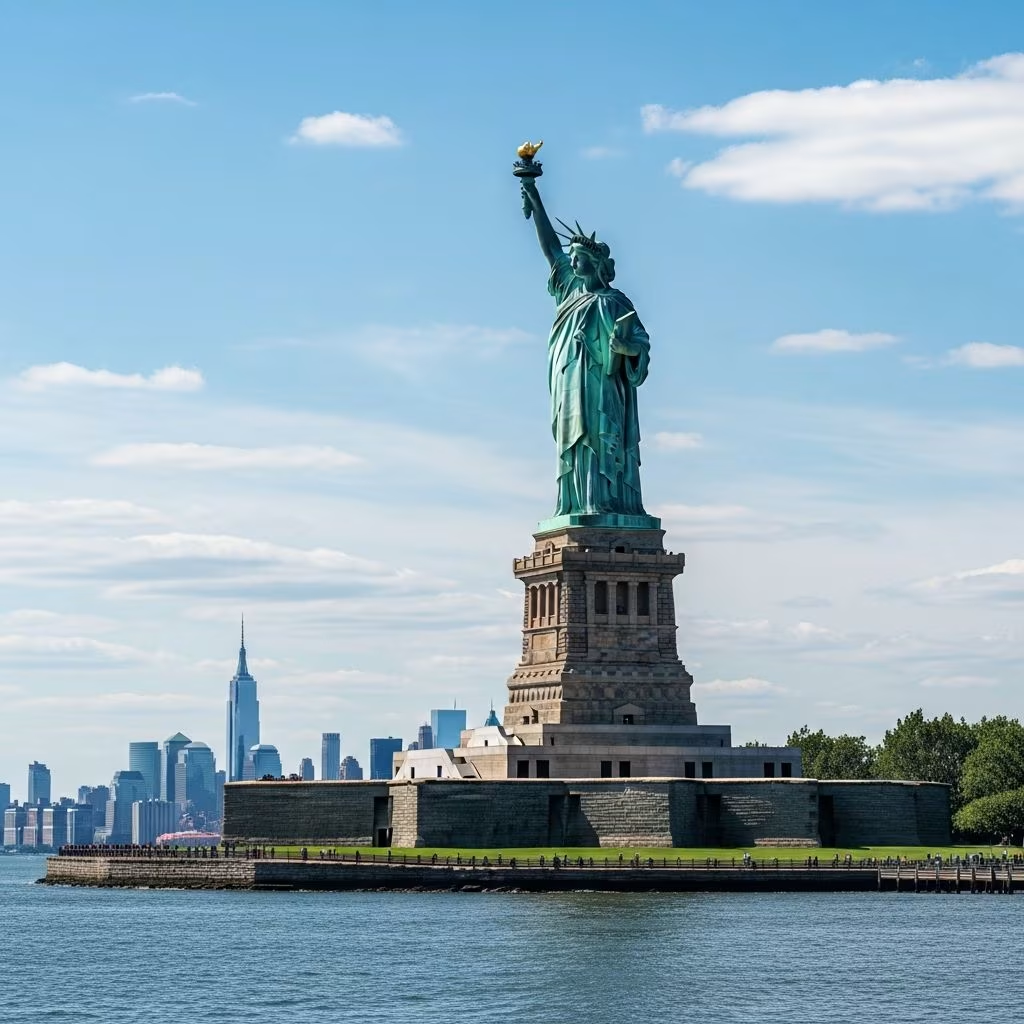
The Statue of Liberty stands as an enduring emblem of freedom, democracy, and opportunity in New York Harbor. Officially titled Liberty Enlightening the World, this colossal sculpture has captivated millions since its unveiling in 1886. Gifted by the people of France to the United States, it embodies shared values of liberty forged during challenging times.
The idea for the statue emerged in the late 1860s amid celebrations of the U.S. centennial and the abolition of slavery. French sculptor Frédéric Auguste Bartholdi envisioned a monumental figure to commemorate the alliance between France and America during the Revolutionary War. Construction began in France in 1875, with the statue completed by 1884 before its transatlantic journey.
Disassembled into 350 pieces and packed into 214 crates, the statue arrived in New York on June 17, 1885, aboard the French frigate Isère. It was temporarily stored on Bedloe’s Island (now Liberty Island) while Americans raised funds for the pedestal, designed by architect Richard Morris Hunt. Delays due to funding shortages pushed the dedication to October 28, 1886, where President Grover Cleveland presided over the ceremony attended by thousands.
Bartholdi’s design draws from classical imagery, depicting Libertas, the Roman goddess of freedom. The robed woman strides forward with her right foot atop a broken chain and shackle, symbolizing emancipation from tyranny and slavery post-Civil War. In her right hand, she raises a torch signifying enlightenment, while her left holds a tabula ansata—a tablet inscribed with JULY IV MDCCLXXVI, marking the Declaration of Independence.
The crown features seven spikes representing the seven continents and seven seas, underscoring liberty’s universal appeal. This nimbus-like halo evokes sun rays spreading light worldwide. Bartholdi reportedly modeled the face after his mother, Charlotte, blending personal and allegorical elements.
From pedestal base to torch tip, the statue measures 305 feet (93 meters) tall, making it the world’s tallest iron structure upon completion. The statue itself rises 151 feet (46 meters), with the pedestal adding 154 feet. It weighs 225 tons, clad in 300 sheets of hammered copper over a steel framework engineered by Gustave Eiffel—famous for the Eiffel Tower.
| Feature | Measurement |
|---|---|
| Total Height (with pedestal) | 93 meters (305 feet) |
| Statue Height Alone | 46 meters (151 feet) |
| Weight | 225 tons |
| Waistline | 11 meters (35 feet) |
| Shoe Size | 879 (women’s) |
| Index Finger Length | 8 feet |
These proportions highlight its grandeur: the nose spans 4.5 feet, the head 17.25 feet (larger than a small house), and the tablet 23 feet by 13 feet.
Gustave Eiffel’s internal pylon system allows the copper skin to move independently, accommodating expansion from 600 annual lightning strikes and high winds that sway the torch up to 5 inches. The original torch was replaced in 1984 with a gold-leaf-covered version for better illumination.
Initially functioning as a lighthouse from 1886 to 1901 under the U.S. Lighthouse Board, its electric light guided ships until transferred to the Department of War, then the National Park Service in 1933.
For over nine million immigrants arriving via Ellis Island from 1892 to 1954, the statue was their first glimpse of America, symbolizing hope and new beginnings. Nearly 12 million passed through Ellis Island, now a museum reopened in 1990.
Designated a National Monument in 1924 and restored for its 1986 centennial, it draws over 4 million visitors yearly. Access to the crown requires climbing 354-377 narrow, spiraling stairs; the pedestal rim is elevator-accessible.
Fundraising was arduous: France covered the statue, America the pedestal. Joseph Pulitzer’s 1885 newspaper campaign raised $100,000 from small donations. The pedestal’s eleven-pointed star-shaped foundation echoes the island’s former military fort from 1807.
Exposed to harsh elements, the copper has oxidized to its iconic green patina over decades. It withstands 600 lightning bolts yearly and hurricanes, thanks to Eiffel’s flexible design. Major restorations include 1984 torch remake and ongoing preservation by the National Park Service.
Liberty Island spans 12 acres in New York Harbor. Ferries from Battery Park or Liberty State Park offer views; advance tickets needed for crown or pedestal. The 25 crown windows provide panoramic vistas, but the climb tests endurance—no elevator beyond the pedestal.
Prohibited items include large bags; security is strict. Best times avoid peak summer crowds.
Beyond tourism, the statue inspires globally as freedom’s beacon. From sonnets like Emma Lazarus’s “The New Colossus” to modern protests, it remains vital to American identity.
Frédéric Auguste Bartholdi designed it, with Gustave Eiffel’s engineering framework.
93 meters total, including pedestal.
Yes, via 354 stairs; reservations required.
Copper oxidation formed patina over time.
Originally friendship gift; became immigration icon late 19th century.
Statue City Cruises ferries; book online.
