

 Travel Essentials
 Travel Essentials

Discover the millennia-spanning history, construction methods, and ongoing mysteries surrounding Stonehenge, one of humanity's most remarkable ancient monuments.
 Travel Essentials
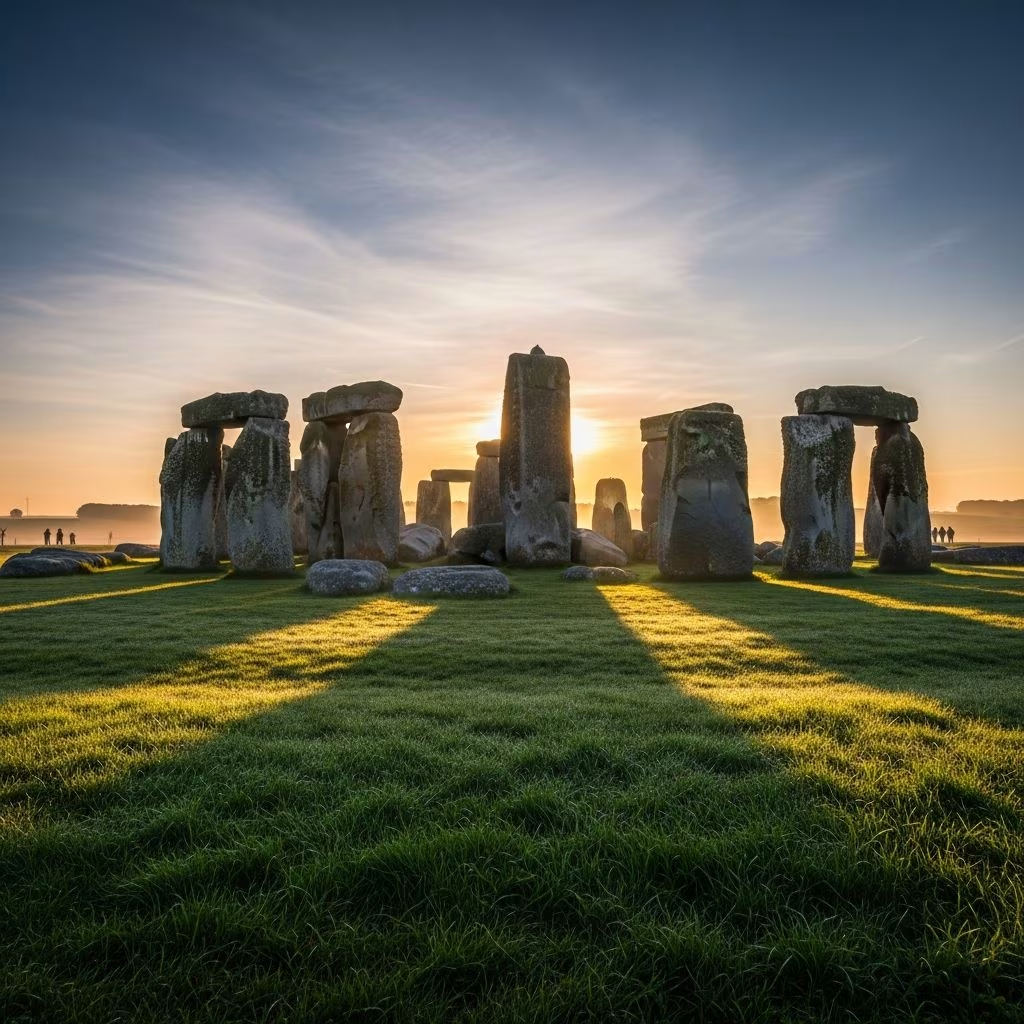
Few structures on Earth command as much fascination and scholarly debate as Stonehenge. Rising from the Salisbury Plain in Wiltshire, England, this extraordinary arrangement of standing stones represents one of humanity’s most ambitious prehistoric undertakings. Built across more than a millennium by Neolithic and Bronze Age peoples, Stonehenge stands as a testament to the ingenuity, spiritual devotion, and organizational capacity of ancient societies. The monument predates the Great Pyramids of Egypt and has captivated archaeologists, historians, and visitors for centuries, yet much about its true purpose remains tantalizingly elusive.
The creation of Stonehenge was not a single event but rather an extended process spanning approximately 1,300 years. Construction commenced around 3000 BC during the late Neolithic period, beginning not with the iconic stones but with earthworks. The earliest major phase involved the excavation of a circular ditch with an inner and outer bank, creating an enclosed area roughly 100 meters in diameter with two entrances. This circular earthwork represented an early form of henge monument—a distinctive type of ceremonial enclosure characteristic of Neolithic Britain.
The transformation of Stonehenge into the monument we recognize today unfolded gradually. Between 2600 and 2400 BC, enormous sarsen stones—massive blocks weighing up to 30 tons—were positioned to form the famous outer circle. These stones, quarried from sites in the Marlborough Downs approximately 20 miles away, required sophisticated knowledge of engineering and logistics to transport and erect. The sarsen arrangement created a structure of remarkable sophistication, with carefully aligned horizontal lintels connecting the vertical stones.
Alongside the sarsen stones came the famous bluestones, smaller stones transported an astounding 350 kilometers from the Preseli Hills in southwest Wales. The effort required to move these materials across such distances suggests that every component held profound symbolic or spiritual significance for the people who built Stonehenge. The positioning of these bluestones evolved over centuries, with evidence suggesting they achieved their current arrangement between 2400 and 2200 BC, though they may have been present at the site as early as 3000 BC.
Archaeological evidence increasingly points to Stonehenge functioning primarily as a sacred burial ground and place of spiritual significance. Cremated remains discovered at the site indicate that Stonehenge served as a necropolis—a place of the dead—from its earliest phases through its period of greatest importance in the mid-third millennium BC. This function likely extended across social hierarchies, suggesting that Stonehenge held ritual importance for diverse members of ancient British society.
The astronomical alignments built into Stonehenge’s architecture reinforce its sacred character. The monument’s orientation with respect to the summer and winter solstices indicates that ancient builders possessed sophisticated astronomical knowledge. For hundreds of years, Stonehenge became a place where the sun’s course was carefully observed and ceremonially celebrated. The solstices held particular significance for farming communities, marking the changing seasons and the turning points of the agricultural calendar. Large gatherings and celebrations likely occurred at these pivotal moments, drawing people from across the surrounding regions.
The spiritual dimensions of Stonehenge extended beyond its physical structure. Recent archaeological interpretation suggests that a ritual journey along the Avon River culminated at Stonehenge, representing a symbolic passage from life to death and an opportunity to honor past ancestors and recently deceased members of the community. This processional understanding reveals Stonehenge not as an isolated monument but as part of a broader ceremonial landscape.
The selection and procurement of materials used in Stonehenge’s construction reveal sophisticated decision-making processes. The bluestones, quarried from distant Wales, were likely chosen not merely for practical reasons but for their supposed healing properties or spiritual significance. Similarly, the imposing sarsen stones created an atmosphere of awe and reverence, their sheer scale and permanence suggesting connection to the sacred or eternal. The extraordinary effort expended in moving these materials across vast distances underscores their ceremonial importance and the communal commitment to Stonehenge’s creation.
The construction techniques employed reflect considerable engineering sophistication. Workers used stone tools and wooden implements to shape and position massive blocks, demonstrating problem-solving abilities and organizational coordination across generations. The horizontal lintels atop the sarsen circle required precise measurement and fitting, suggesting knowledge of basic architectural principles. Recent archaeological discoveries have expanded understanding of construction methods, revealing that Stonehenge resulted from sustained effort by communities with sophisticated understanding of their environment and celestial mechanics.
Stonehenge’s significance did not diminish with the completion of its primary construction phases. During the Early Bronze Age, numerous burial mounds were constructed in proximity to the monument, indicating its continued association with death rituals and its status as a sacred focal point. This pattern of continued investment in the Stonehenge landscape demonstrates the monument’s enduring importance across changing cultures and centuries.
The monument maintained ceremonial relevance through successive historical periods. During the Iron Age, around 700 BC, a significant hillfort known as Vespasian’s Camp was constructed approximately two kilometers east of Stonehenge, suggesting the broader region retained strategic and perhaps spiritual importance. The Roman period brought new populations to Britain, and archaeological evidence indicates that Stonehenge was frequently visited during Roman occupation beginning in AD 43. Many Roman artifacts recovered at the site suggest that Romano-British populations recognized Stonehenge’s significance and may have incorporated it into their own ritual practices.
Even after the Roman withdrawal, Stonehenge retained cultural resonance. A decapitated individual, possibly a criminal, was buried at Stonehenge during the Saxon period, indicating that the monument remained a meaningful location in Anglo-Saxon Britain. The earliest surviving written references to Stonehenge date from the medieval period, with references and artistic depictions becoming increasingly common from the 14th century onward.
Modern archaeology has fundamentally transformed our comprehension of Stonehenge. Early antiquarian theories, such as architect Inigo Jones’s proposal that Romans constructed Stonehenge, have given way to evidence-based understanding of its Neolithic origins. Medieval scholar Geoffrey of Monmouth, writing in the twelfth century, was among the first to propose that Stonehenge functioned as a funerary monument and to advance theories about the spiritual properties of its stones.
Contemporary research led by specialists like Mike Parker Pearson of the Stonehenge Riverside Project has revolutionized interpretations of the monument’s purpose. His work demonstrates conclusively that Stonehenge was a place of burial from its inception through its most significant phases. This research emphasizes that Stonehenge functioned as a domain of the dead, with cremations and burials indicating ritual practices spanning centuries.
Recent excavations continue to yield new insights. The identification of an unusual pentagonal-shaped stone through luminescence soil dating provided additional evidence of earlier ceremonial activity at the site, with findings consistent with Stonehenge’s earliest construction phases. Each new discovery adds nuance to our understanding of why ancient peoples invested such tremendous effort in this remarkable monument.
Despite centuries of study, Stonehenge’s exact purpose remains partially mysterious. What is certain is that multiple functions—burial, astronomical observation, ceremonial gathering, healing sanctuary, and spiritual center—likely coexisted throughout its history. The monument served as a focal point for communities separated by distance, drawing them together for solsticial celebrations and ritual observances. It represented a visible manifestation of shared spiritual beliefs and communal identity.
The ongoing debate about Stonehenge reflects deeper questions about how we interpret prehistoric societies. Archaeological evidence consistently indicates that Neolithic and Bronze Age peoples possessed remarkable sophistication in their beliefs, organizational abilities, and technical knowledge. Spirituality lay at the heart of Stonehenge from its inception, driving the sustained effort required to create this monument. The immense resources devoted to Stonehenge suggest a culture that valued ceremonial life, honored the dead, and sought connection with celestial and spiritual realms.
Stonehenge was built in several phases beginning around 3100 BC and continuing until approximately 1600 BC. The distinctive sarsen stone circle was erected between 2600 and 2400 BC. This makes Stonehenge approximately 5,000 years old, predating both the Egyptian pyramids and the Roman Empire.
While its exact purpose remains debated, archaeological evidence suggests Stonehenge served multiple functions: a burial and cremation site, an astronomical observatory aligned to solstices, a place of healing and spiritual significance, and a ceremonial gathering place for large communities.
The smaller bluestones were transported from the Preseli Hills in southwest Wales, approximately 350 kilometers away. The larger sarsen stones came from the Marlborough Downs, about 20 miles distant from the monument.
Stonehenge’s construction spanned approximately 1,300 years, extending from around 3000 BC through the Bronze Age. This extended timeline reflects multiple construction phases rather than continuous uninterrupted work.
Neolithic and Bronze Age peoples built Stonehenge, likely organized communities with shared spiritual beliefs and ceremonial practices. The immense effort devoted to construction suggests the monument held profound sacred significance, possibly serving as a symbol of cultural identity and spiritual connection.
Stonehenge stands as a monument to ancient human ambition, ingenuity, and spirituality. For over five millennia, this remarkable structure has commanded attention and inspired questions. The effort required to transport massive stones across considerable distances, the astronomical precision incorporated into its design, and the evidence of sustained ritual use across centuries all testify to its profound importance for ancient peoples.
Modern archaeological research continues to illuminate Stonehenge’s mysteries while acknowledging that complete certainty about all its functions remains elusive. What emerges from contemporary scholarship is appreciation for the complexity and sophistication of Neolithic and Bronze Age societies. Stonehenge represents not a primitive curiosity but a deliberate, carefully planned expression of spiritual belief and communal identity. As research continues and new technologies provide additional insights, Stonehenge remains a powerful reminder of humanity’s enduring need to create lasting monuments, honor the dead, and seek meaning in the movements of celestial bodies.
