

 Travel Essentials
 Travel Essentials

Explore the Taj Mahal's rich history, from its origins as a Mughal emperor's tribute to his wife, through its grand construction, unique design features, and modern preservation efforts.
 Travel Essentials
The Taj Mahal stands as one of the world’s most breathtaking architectural achievements, a shimmering white marble mausoleum on the banks of the Yamuna River in Agra, India. Commissioned by Mughal Emperor Shah Jahan in 1631, it serves as the final resting place for his beloved wife, Mumtaz Mahal, who passed away during childbirth. This iconic structure not only embodies profound personal grief but also exemplifies the pinnacle of Mughal artistry, blending Persian, Islamic, and Indian influences into a harmonious masterpiece.
Shah Jahan, the fifth Mughal emperor reigning from 1628 to 1658, met Arjumand Banu Begum—later titled Mumtaz Mahal, meaning ‘Exalted One of the Palace’—in 1607 at Meena Bazaar in Agra. At just 14 and 15 years old respectively, they fell deeply in love. Though their marriage was delayed for political reasons, they wed in 1612 with Emperor Jahangir’s blessing. Mumtaz became Shah Jahan’s inseparable companion, accompanying him on military campaigns and bearing 14 children.
Tragedy struck in 1631 during the siege of Burhanpur when Mumtaz died giving birth to their 14th child, a daughter named Gauhar Ara Begum. Shah Jahan was devastated; historical accounts describe him growing a beard from grief, his hair turning white overnight, and entering a month-long mourning period. Vowing to honor her memory, he immediately began planning a mausoleum that would surpass all others in beauty and grandeur.
Construction commenced around 1632 and spanned over two decades, concluding the main mausoleum by 1648, with surrounding structures finished by 1653. The project demanded immense resources: an estimated 20,000 to 22,000 artisans, laborers, and architects from across India, Persia, the Ottoman Empire, and Europe. Nearly 1,000 elephants transported heavy materials like marble from Makrana quarries in Rajasthan.
The cost was staggering—around ₹32 million at the time, equivalent to roughly US$827 million in modern terms. Materials included semi-precious stones such as jasper from Punjab, jade from China, turquoise from Tibet, lapis lazuli from Afghanistan, sapphire from Sri Lanka, and carnelian from Arabia, inlaid using the pietra dura technique for intricate floral and geometric patterns.
| Material | Source Region | Usage |
|---|---|---|
| White Marble | Makrana, Rajasthan, India | Main structure, dome, minarets |
| Red Sandstone | Fatehpur Sikri, India | Base, outer walls, gateway |
| Jasper | Punjab, India | Inlay work |
| Lapis Lazuli | Afghanistan | Decorative inlays |
| Jade | China | Precious stone accents |
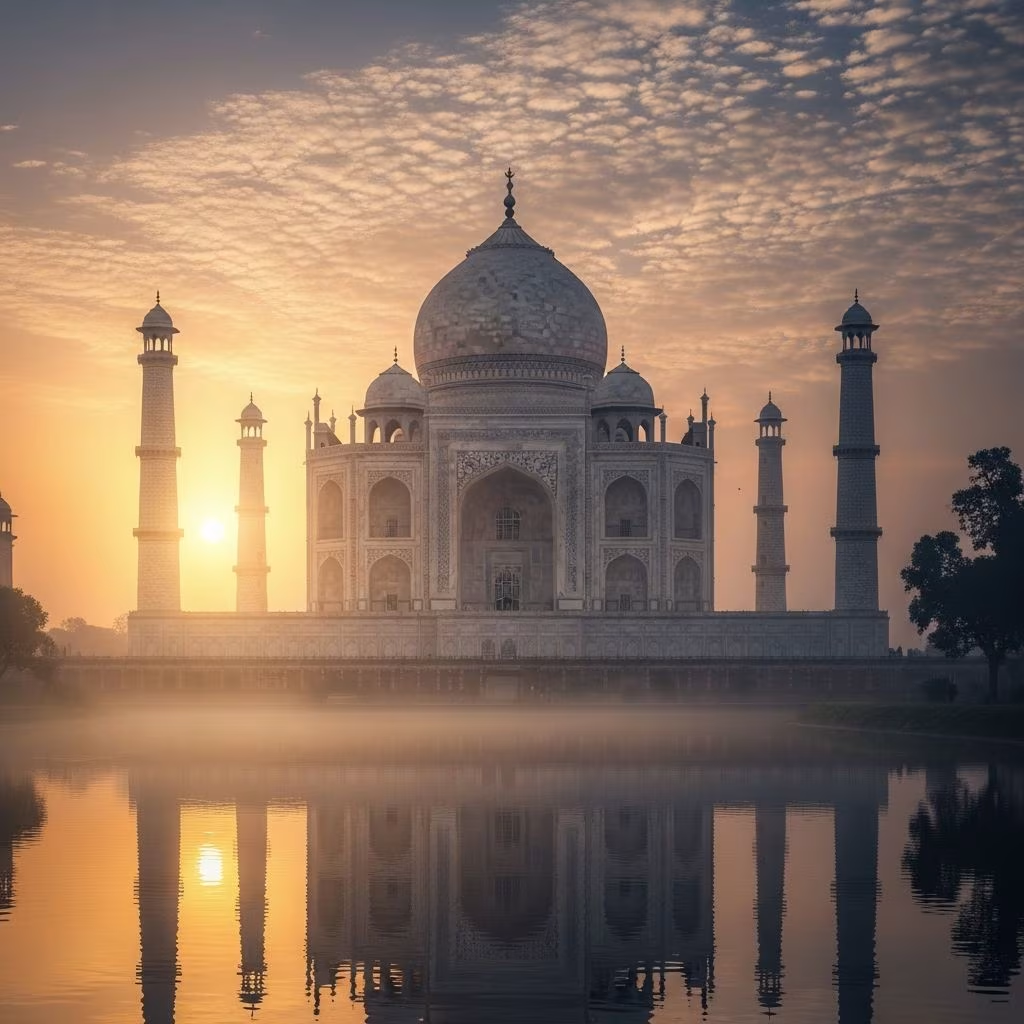
Designed primarily by Ustad Ahmad Lahori, the Taj Mahal complex spans 42 acres (17 hectares), featuring the central mausoleum, a mosque, a guest house (mehman khana), formal gardens, and a towering sandstone gateway. The layout follows a north-south axis along a reflective water channel, creating an illusion of perfect symmetry. The mausoleum rises from a red sandstone plinth topped by a white marble terrace, crowned by a massive onion-shaped dome flanked by four minarets tilted slightly outward for safety.
Islamic paradise motifs permeate the design: the charbagh gardens divided into four quadrants symbolize the Quranic gardens of eternity, with water channels representing the four rivers of paradise. Calligraphic inscriptions from the Quran by master calligrapher Amanat Khan adorn the entrances and tomb, growing larger as they ascend to counter optical distortion.
Inside, the octagonal chamber houses the cenotaphs of Mumtaz Mahal (centered, jewel-inlaid) and Shah Jahan (slightly off-center, added later). The true tombs lie below in a dimly lit crypt, maintaining the site’s solemnity.
The Taj Mahal masterfully employs visual tricks. Viewed from afar, the dome appears to float ethereally; closer, its proportions shift seamlessly. The changing colors—from pink at dawn, white midday, golden at sunset, and silver under moonlight—earned it the nickname ‘Luminous Tomb’ in Mughal texts.
Engineering feats include deep foundations on the Yamuna’s banks to prevent sinking, earthquake-resistant minarets, and a 24-petal lotus finial atop the dome symbolizing purity. Acoustic designs amplify prayers in the mosque, while subterranean channels once cooled the interiors via evaporative systems.
A persistent legend claims Shah Jahan planned a black marble counterpart across the Yamuna in Mehtab Bagh for his own tomb, linked by a bridge. French traveler Jean-Baptiste Tavernier noted in 1665 that construction began but halted due to war. Historians debate this; some dismiss it as myth, citing foundations as garden remnants, while others see evidence in Shah Jahan’s deposition by son Aurangzeb in 1658. Imprisoned in Agra Fort, Shah Jahan spent his final years gazing at the Taj Mahal, dying in 1666 and being buried beside Mumtaz.
In 1983, UNESCO designated the Taj Mahal a World Heritage Site, hailing it as ‘the jewel of Islamic art in India and one of the universally admired masterpieces of the world’s heritage.’ It won the New 7 Wonders of the World in 2007 and draws over 5 million visitors yearly. Managed by the Archaeological Survey of India, it remains a Monument of National Importance.
Tourism booms strain the site: pollution from nearby industries yellows the marble, prompting a 2018 Supreme Court-mandated industrial relocation. Acid rain and insect damage necessitate muqarnas restoration and mud-pack treatments. Visitor caps, bans on Shah Jahan Park entry, and anti-smog measures protect this fragile icon. During the COVID-19 pandemic, closures allowed natural cleaning, restoring luster.
Best times: October to March for mild weather; sunrise or full moon nights (with permits) for magical hues. Entry: ₹50 for Indians, ₹1,100 for foreigners; separate mosque fees. Approach via the south gate for the dramatic reveal. Respect rules: no food, caps off in mosque, modest attire.
Shah Jahan built it in memory of his wife Mumtaz Mahal, who died in 1631.
About 22 years, from 1632 to 1653.
Yes, except Fridays (mosque prayer day) and during Eid.
Cenotaphs of Mumtaz Mahal and Shah Jahan; actual tombs below.
No, public access is limited to the ground floor.
Beyond its beauty, the Taj Mahal whispers tales of devotion, ingenuity, and resilience. It transcends time, reminding us of love’s power to inspire immortality in stone. Whether admiring its symmetry or pondering its legends, every visit reveals new layers to this eternal enigma.
