

 Travel Essentials
 Travel Essentials

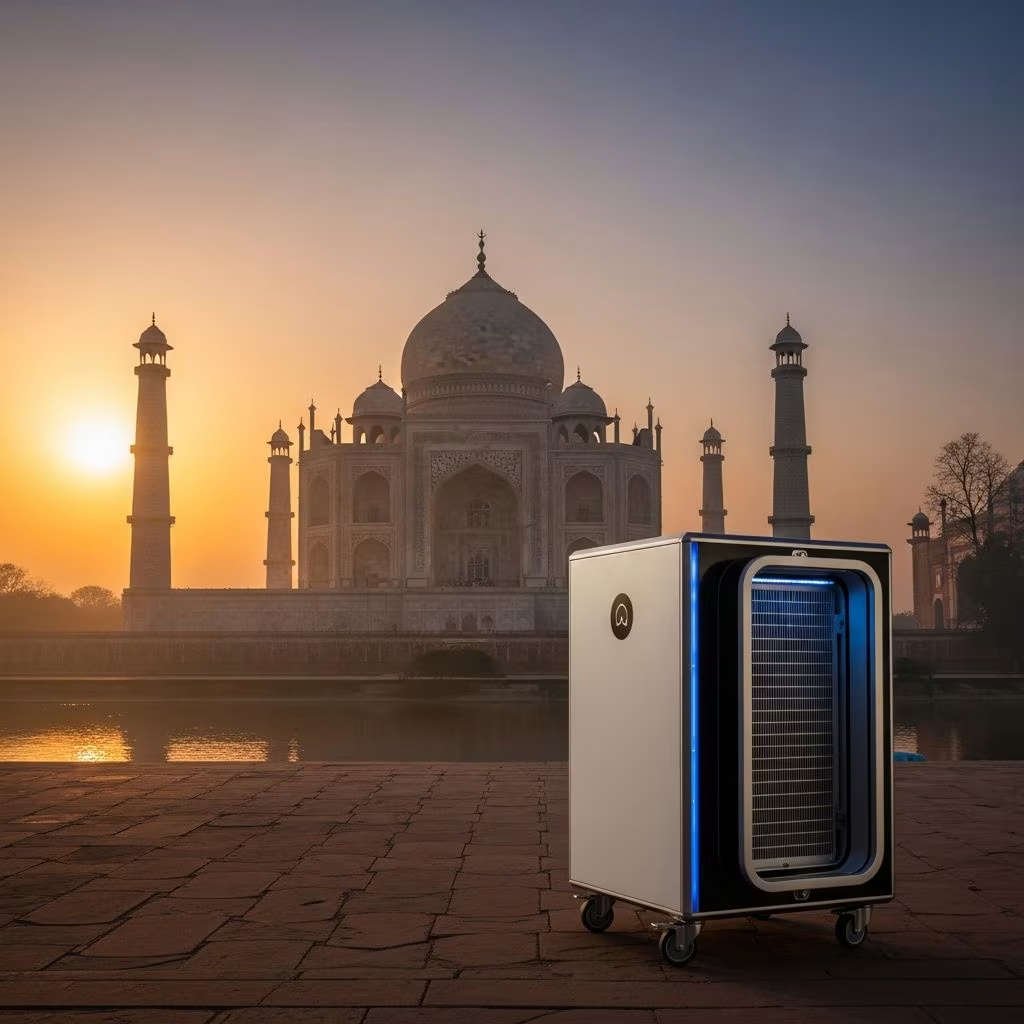
Mobile air purifier vans were deployed to help shield the Taj Mahal from pollution, offering a new model for heritage conservation.
 Travel Essentials
The Taj Mahal stands as one of the most recognizable architectural achievements in human history, attracting millions of visitors annually to the Agra region in Uttar Pradesh, India. However, this magnificent white marble mausoleum faces an increasingly serious threat that extends beyond the typical wear and tear of tourism. The deteriorating air quality across northern India has emerged as a significant concern for heritage preservation specialists and environmental authorities alike. The accumulation of pollutants in the atmosphere surrounding this iconic structure has prompted innovative conservation measures never before attempted at a monument of this scale and importance.
Air pollution in the Taj Mahal region stems from multiple sources including vehicular emissions, industrial activity, agricultural burning practices, and seasonal weather patterns that trap particulate matter over extended periods. The fine particles and chemical compounds suspended in the air settle on the marble surfaces, contributing to discoloration and material degradation that threatens the monument’s structural integrity and aesthetic value for future generations.
Recognizing the severity of the pollution crisis affecting northern India, the Uttar Pradesh Pollution Control Board (UPPCB) undertook an unprecedented initiative to directly address air quality issues at the Taj Mahal. In collaboration with local district administration, municipal authorities, and corporate partner Vodafone-Idea through their corporate social responsibility initiatives, two specialized mobile air purifier vans were transported to Agra in October 2019. These vehicles represented a novel approach to environmental protection, combining mobile technology with large-scale air filtration capabilities.
The decision to deploy these units specifically at the Taj Mahal’s western gate reflected the urgency of the situation, particularly as autumn months brought predictable increases in pollution levels across the region. Air quality measurements during the deployment period showed concerning readings, with monitoring stations in nearby areas recording Air Quality Index (AQI) values exceeding 290—a hazardous level that affects both human health and monument preservation.
The mobile air purification vans deployed at the Taj Mahal possess substantial technical capabilities designed to address large-scale pollution challenges. Each van can process and purify approximately 15 lakh cubic meters (equivalent to 1.5 million cubic meters) of air within an eight-hour operational period. This impressive capacity enables the units to effectively treat air quality within a 300-meter radius surrounding their deployment location, creating a meaningful protective zone around the monument.
The purification systems utilize advanced filtration technology capable of removing both particulate matter and certain gaseous pollutants from the air. By continuously drawing in ambient air, passing it through multiple filtration stages, and releasing cleaned air back into the environment, these vans work to incrementally improve localized air quality conditions. The eight-hour operational cycle aligns with typical peak pollution periods and tourist visiting hours at the monument.
| Specification | Details |
|---|---|
| Air Processing Capacity | 15 lakh cubic meters (1.5 million m³) per 8-hour cycle |
| Operational Duration | Eight consecutive hours per deployment |
| Coverage Radius | 300 meters from deployment point |
| Deployment Location | West gate of Taj Mahal |
| Number of Vans Deployed | Two mobile units brought to Agra |
The decision to implement such aggressive air purification measures at the Taj Mahal reflects broader environmental challenges affecting northern India during specific seasons. The region experiences cyclical pollution patterns, particularly during autumn and winter months when meteorological conditions prevent pollutants from dispersing naturally. Agricultural burning in neighboring states, combined with vehicular emissions from dense urban populations, creates a compounding effect that periodically reduces air quality to hazardous levels.
Environmental scientists and heritage conservation experts have documented how air pollutants directly impact the Taj Mahal’s marble surfaces. Acidic compounds in the air contribute to chemical weathering, while particulate matter accumulates on the stone, altering its pristine white appearance and potentially compromising the material’s longevity. Unlike typical monuments that face pollution challenges, the Taj Mahal’s significance as a UNESCO World Heritage Site amplifies the importance of every conservation effort undertaken.
The deployment of air purification vans represents a coordinated effort among multiple stakeholders with distinct responsibilities in environmental governance and cultural heritage preservation. The Uttar Pradesh Pollution Control Board provided technical expertise and regulatory framework, the district administration offered logistical support and site coordination, and Vodafone-Idea contributed financial resources and equipment through corporate social responsibility commitments. This multi-agency collaboration demonstrates how diverse organizations can unite around shared conservation objectives.
The involvement of a telecommunications company in heritage protection efforts illustrates the evolving concept of corporate responsibility beyond traditional business sectors. By investing in environmental infrastructure that protects iconic cultural assets, private enterprises participate directly in global heritage conservation while demonstrating commitment to sustainable practices that extend beyond profit-focused operations.
While mobile air purification vans represent an innovative direct intervention, authorities have implemented additional measures to address the broader pollution challenge. Water spraying operations around Agra city help suppress dust particles and temporarily improve air quality during peak pollution episodes. These complementary strategies work in conjunction with the mobile purification units to create a more comprehensive environmental management approach.
The layered strategy acknowledges that no single intervention can completely resolve a complex environmental problem rooted in multiple sources. Instead, combining technological solutions, operational practices, and regulatory measures provides a more robust framework for protecting the monument while improving conditions for residents and visitors in the region.
Despite the deployment of sophisticated purification technology, assessing the precise impact of these interventions presents significant challenges. At the time of the vans’ deployment, no continuous air monitoring station existed specifically at the Taj Mahal location to accurately calculate the Air Quality Index and measure improvements. A monitoring station located at Sanjay Palace in Agra provided reference data, but the distance between measurement points limited direct assessment of localized purification effects.
This monitoring gap highlights an important consideration in environmental conservation efforts: the difficulty of quantifying the specific benefits of targeted interventions in complex atmospheric systems. Air quality improvements result from multiple contributing factors, making it challenging to isolate the contribution of any single measure. Future conservation efforts would benefit from dedicated monitoring infrastructure specifically positioned to track real-time changes in the monument’s immediate atmospheric environment.
The Taj Mahal air purification initiative establishes a precedent for applying technological solutions to environmental threats affecting cultural monuments worldwide. As air quality deteriorates in numerous regions containing irreplaceable historical sites, this case study offers valuable insights into responsive conservation strategies. The approach demonstrates that heritage preservation increasingly requires engagement with contemporary environmental challenges rather than relying solely on traditional restoration techniques.
Other UNESCO World Heritage Sites facing similar pollution pressures may consider comparable technological interventions, adapting the mobile purification model to their specific geographical and atmospheric conditions. The success of this initiative, despite measurement limitations, validates the principle that innovative environmental technology can contribute meaningfully to monument protection when implemented with adequate resources and stakeholder coordination.
Looking forward, the integration of permanent air quality monitoring infrastructure at the Taj Mahal would significantly enhance the ability to assess ongoing interventions and optimize protective strategies. Advanced sensor networks, real-time data analysis, and predictive modeling could enable more sophisticated responses to pollution episodes, allowing authorities to deploy resources most effectively when atmospheric conditions deteriorate.
The mobile purification van approach may evolve toward stationary installations with greater processing capacity, or perhaps complementary aerial purification systems. As environmental technologies continue advancing, heritage protection professionals will access increasingly sophisticated tools for addressing pollution-related conservation challenges. The Taj Mahal serves as both a test site for these innovations and a symbol of humanity’s commitment to preserving irreplaceable cultural treasures for future generations.
