

 Travel Essentials
 Travel Essentials

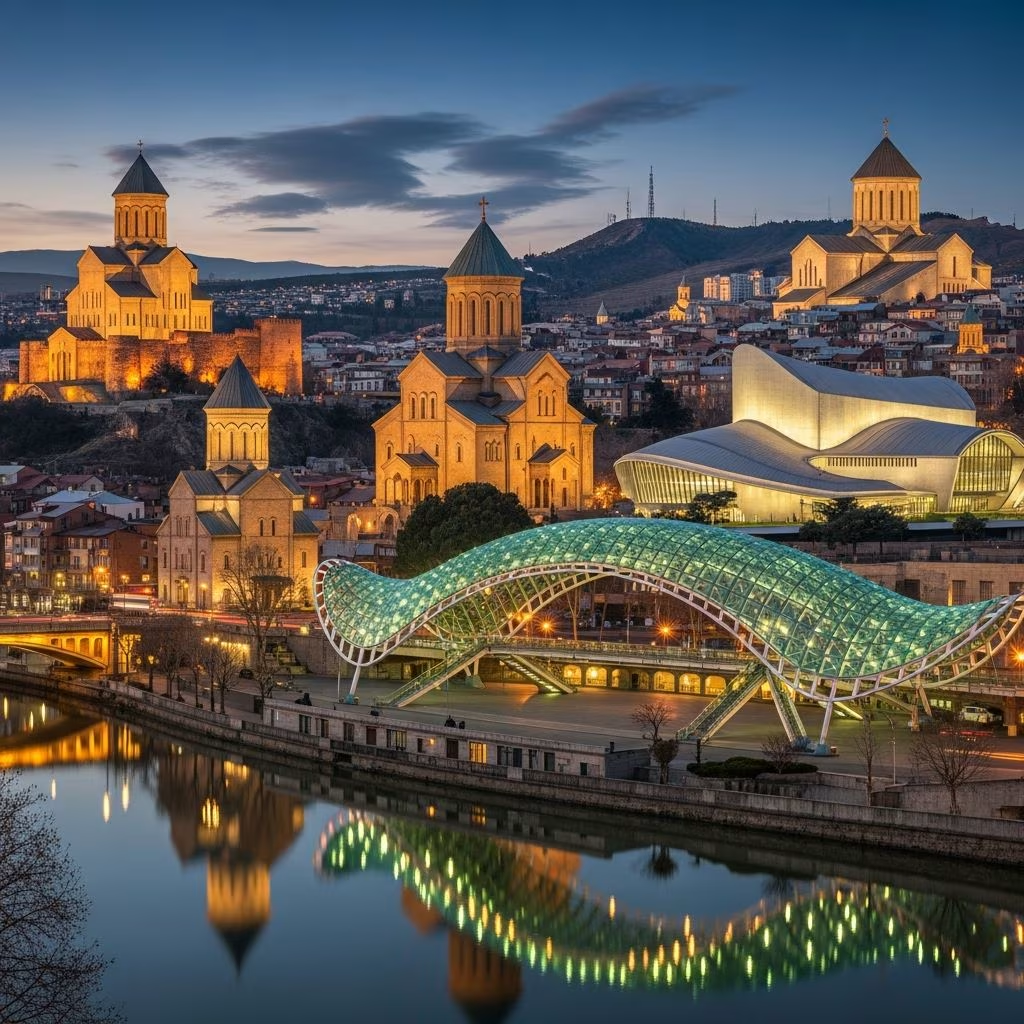
Discover Tbilisi’s layered architecture, from medieval fortresses and Art Nouveau streets to Soviet brutalism and modern glass landmarks.
 Travel Essentials
Tbilisi, Georgia’s vibrant capital, stands as a living museum of architectural styles shaped by millennia of cultural exchanges at the crossroads of Europe and Asia. Its skyline weaves together ancient stone fortresses, ornate 19th-century European-inspired buildings, imposing Soviet-era concrete giants, and sleek modern structures. This fusion reflects the city’s turbulent history—from medieval Georgian kingdoms to Persian, Ottoman, and Russian dominions, and through the Soviet period to contemporary independence. Visitors can trace this evolution by wandering its historic core, upscale avenues, and outer suburbs, where each era leaves its indelible mark.
The oldest layers of Tbilisi’s architecture hark back to its founding in the 5th century AD by King Vakhtang Gorgasali, who legendarily discovered the city’s therapeutic hot springs. Perched on hills overlooking the Kura River, early structures were pragmatic fortifications and basilicas built from local tuff stone, designed to withstand invasions.
These sites cluster in the Old Town (Kala), where narrow cobblestone alleys wind between cliffside perch and sulfur bath complexes like Abanotubani, evoking Tbilisi’s thermal origins.
Under Russian Imperial rule from 1801, Tbilisi exploded into a cosmopolitan hub, with tsarist planners imposing grid layouts and opulent facades. Districts like Sololaki and Vera became showcases of Neoclassical, Beaux-Arts, and Art Nouveau styles, blending Western grandeur with Oriental motifs.
Art Nouveau flourished here from the 1890s, producing whimsical balconies, floral ironwork, and pastel hues on townhouses. Sololaki’s preserved blocks rival European gems, their curvaceous lines contrasting stark Soviet additions. Rustaveli Avenue, the city’s grand artery, lines with theaters, opera houses, and academies in revivalist splendor.
| District | Key Style | Notable Features |
|---|---|---|
| Sololaki | Art Nouveau | Ornate balconies, pastel facades, iron lacework |
| Rustaveli Avenue | Neoclassical/Beaux-Arts | Columned facades, pediments, opera house |
| Vera | Orientalist Revival | Domes, arabesques mixed with European symmetry |
Metekhi Church, overhanging the river, blends 13th-century Gothic elements with 19th-century restorations, symbolizing continuity.
The 20th century brought Soviet standardization, yet Tbilisi’s architects infused brutalism with local flair—raw concrete softened by mosaics, geometric boldness, and public art. Post-WWII, mass housing rose in Saburtalo and Dighomi, but standout projects elevated the style.
Soviet mosaics adorn metro stations and facades, depicting workers, harvests, and Georgian heroes in vivid ceramic tiles—a vibrant counterpoint to concrete austerity. The Palace of Rituals, with its flying saucer dome, adds quirky futurism to suburban landscapes.
Since 1991, Tbilisi has embraced bold modernism, especially under former president Mikheil Saakashvili’s urban renewal push. Glass-and-steel icons signal Georgia’s Western aspirations while honoring heritage.
The Chronicle of Georgia, a massive open-air relief on a hilltop, narrates national history in Soviet-realist scale, offering vistas rivaling Rio’s Christ. Public Service Hall’s interlocking rings evoke interlocking lives in efficient bureaucracy.
To experience this diversity, plan a multi-day itinerary by neighborhood. Start in Kala for antiquity, stroll Sololaki for belle époque charm, bus to Saburtalo for Soviet relics, and taxi to Mtatsminda for panoramic overviews.
Use apps like Google Maps or local buses (e.g., #14 to Gagarin St. brutalism). The Open Air Museum of Ethnography showcases vernacular wooden homes from across Georgia.
Tbilisi’s eclectic built environment faces threats from earthquakes, overdevelopment, and gentrification. UNESCO-listed Old Town sees restoration efforts, but Soviet gems risk demolition for luxury towers. Architects advocate adaptive reuse, like Fabrika, to balance progress with patrimony.
Upcoming projects include riverside eco-parks and high-rises blending smart tech with Georgian motifs, ensuring Tbilisi remains a dynamic architectural laboratory.
Spring (April-May) or fall (September-October) offer mild weather ideal for walking tours and fewer crowds.
Yes, outfits like Tbilisi Free Walking Tours cover Art Nouveau and Soviet sites; book via apps or hotels.
Old Town has steep paths, but modern sites like Bridge of Peace and House of Justice feature ramps and elevators.
Unlike Yerevan’s Soviet uniformity or Baku’s oil-boom glass, Tbilisi uniquely layers medieval, tsarist, and brutalist eras.
Generally yes, but respect services; no flashes in historic basilicas.
