

 Travel Essentials
 Travel Essentials

Explore Tel Aviv’s White City, home to 4,000+ Bauhaus buildings, and discover how modernist design shaped a UNESCO architectural landmark.
 Travel Essentials
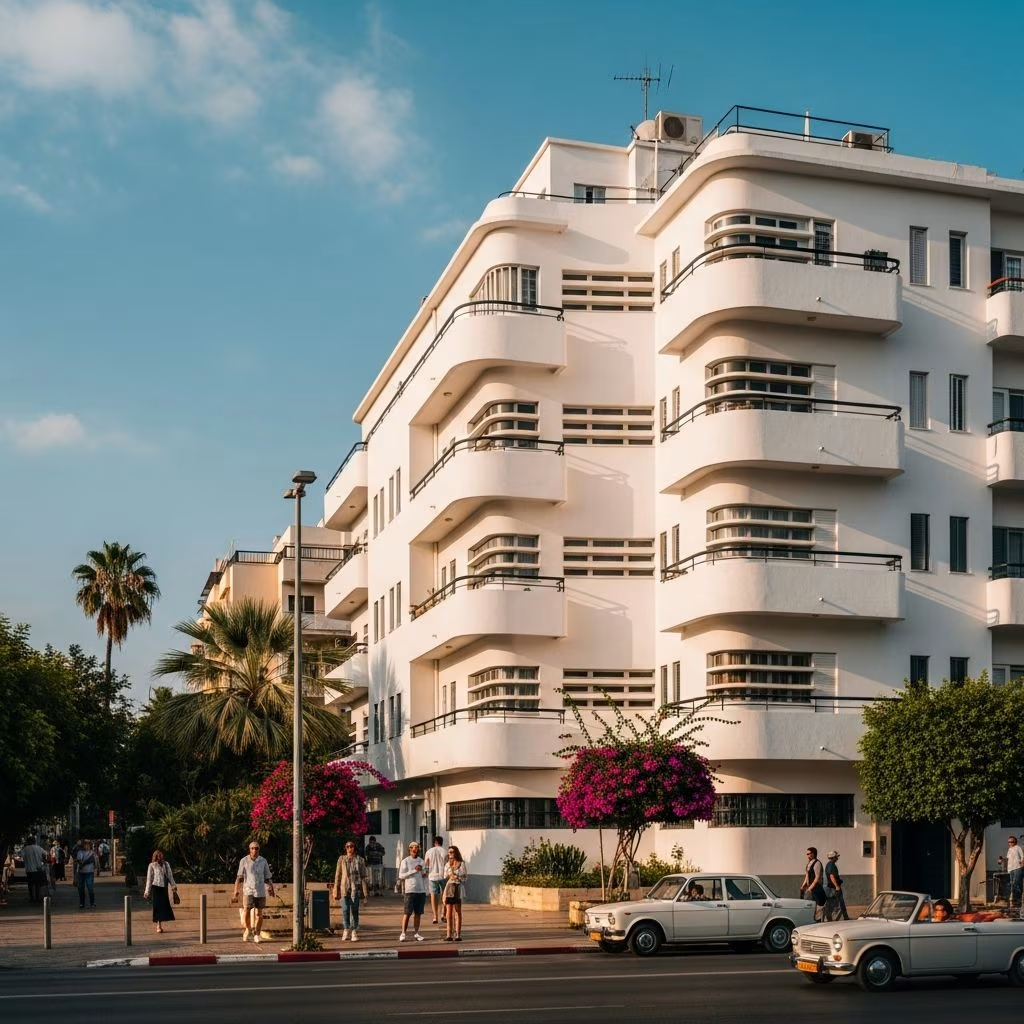
Tel Aviv stands as a living testament to the Bauhaus movement, boasting the world’s largest concentration of buildings in this iconic style. Over 4,000 structures from the 1930s form the White City, a UNESCO World Heritage site that embodies early 20th-century urban innovation and architectural purity. This unique ensemble emerged from the exodus of German-Jewish architects escaping Nazi persecution, transforming a nascent city into a modernist paradise.
The Bauhaus school, founded in 1919 by Walter Gropius in Weimar, Germany, revolutionized design by prioritizing function, simplicity, and mass production. Its closure in 1933 under Nazi rule scattered its talents worldwide, with many finding refuge in British Mandate Palestine. These architects—trained under masters like Gropius, Hannes Meyer, and Ludwig Mies van der Rohe—brought their vision to Tel Aviv, then a burgeoning port city founded in 1909.
In the 1930s, amid massive immigration waves, Tel Aviv needed affordable housing fast. Bauhaus principles aligned perfectly: clean lines, flat roofs, ribbon windows, and asymmetrical massing allowed for efficient, light-filled homes suited to the Mediterranean climate. Unlike rigid European interpretations, Tel Aviv’s version adapted to local needs, incorporating balconies for outdoor living, stilted pilotis for airflow, and white plaster finishes that reflected the sun. This ‘Tropical Modernism’ or ‘Bauhaus Levantino’ blended International Style with regional flair.
Tel Aviv’s rapid growth from a sandy outpost to a metropolis created a blank canvas. No entrenched styles competed, and socialist ideals prevalent among pioneers favored Bauhaus’s democratic ethos—design for the masses, not elites. German immigrants, comprising much of the professional class, imported not just ideas but also construction techniques like reinforced concrete frames, freeing walls for non-loadbearing aesthetics.
The result? A cityscape of four-to-five-story residential blocks, public edifices, and commercial spaces that prioritized communal living. Rothschild Boulevard and Dizengoff Street emerged as prime corridors, lined with these elegant ‘white cubes’. UNESCO recognized this in 2003 as “an outstanding example of new town planning and architecture in the early 20th century,” highlighting its global uniqueness.
Tel Aviv’s White City rewards walkers with clusters of masterpieces. Start at Rothschild Boulevard, home to early icons like Beit Engel (1933), the first Bauhaus building by Zeev Rechter, featuring cantilevered balconies and strict geometry. Nearby, the Bialik House (1920s eclectic precursor) transitions into pure modernism.
| Building | Architect | Year | Highlights |
|---|---|---|---|
| Beit Engel | Zeev Rechter | 1933 | First Bauhaus in TA; corner site on Rothschild Blvd. |
| Dizengoff Square | Genia Averbuch | 1934 | Central plaza, ‘heart’ of White City; modernist planning. |
| Liebling House | Max Liebling | 1930s | Cubist forms; now architectural museum. |
| 77 Dizengoff St. | Various | 1930s | Bauhaus Center hub; exhibitions and shop. |
Dezeen highlights 10 residential standouts selected by Bauhaus Center co-founder Micha Gross, including structures with perfect visual balance and outdoor spaces. Venture to the beachfront for promenade-aligned blocks that fuse sea views with functional design.
Time has not been kind; urban density, humidity, and development pressures threaten these treasures. Many facades peel, interiors modernized beyond recognition. Yet, advocacy from the Bauhaus Center and Society for Preservation of Israel Heritage Sites has protected 2,000 buildings. Gross’s 2015 book Preservation and Renewal documents renewal strategies, balancing authenticity with contemporary needs.
Restoration projects emphasize reversible interventions: cleaning stucco, repairing ribbon windows, and reinstating original gardens. Tel Aviv’s municipality enforces preservation laws in the White City core, ensuring new builds harmonize. Challenges persist—illegal additions, gentrification—but community tours foster appreciation.
The Bauhaus Center at 77 Dizengoff Street is ground zero: a gallery with rotating exhibits on Tel Aviv’s architecture, art, and design; a bookstore stocked with posters, books, and crafts; and professional guided tours. Daily walks (English/Hebrew, ~3 hours) cover 1930s gems, interiors where possible, and hidden staircases revealing original details.
Complement with the Bauhaus Museum on Bialik Street 21: a showroom of modernist furniture (Wed/Fri limited hours, free entry). Self-guided? Download apps or maps from the Center; start at Dizengoff Square, loop Rothschild to Allenby Street. Best time: early morning or Sabbath for quiet streets. Wear comfy shoes—cobblestones and heat demand it.
These buildings shaped Tel Aviv’s identity as a youthful, innovative hub. They symbolize resilience—refugees turning loss into creation—and influence today’s skyline, where high-rises nod to modernist roots. Interiors, though rare survivors, featured built-in furniture and open plans; peek into lobbies for glimpses.
The style permeates design: Bauhaus-inspired cafes, furniture shops, and street art celebrate it. Annual festivals, like White City events, feature lectures and open houses. For deeper dives, visit kibbutzim or Haifa for peripheral examples.
Tel Aviv’s compact core makes it walkable; combine with Jaffa’s ancient vibes or beach lounging. Stay in a restored Bauhaus hotel like the Norman or Market House for immersion. Budget: Tours ~100-150 ILS/person; free self-exploration.
**Practical Tips:**
Its scale (4,000+ buildings), tropical adaptations (pilotis, balconies), and historical context of émigré architects set it apart globally.
Yes, core areas span 1-2 sq km; guided tours cover highlights efficiently.
About 2,000 under law; ongoing restorations protect more.
Rarely; focus on exteriors, lobbies, gardens. Museums showcase style.
Bauhaus Center, Dizengoff 77—exhibits, tours, maps.
