

 Travel Essentials
 Travel Essentials

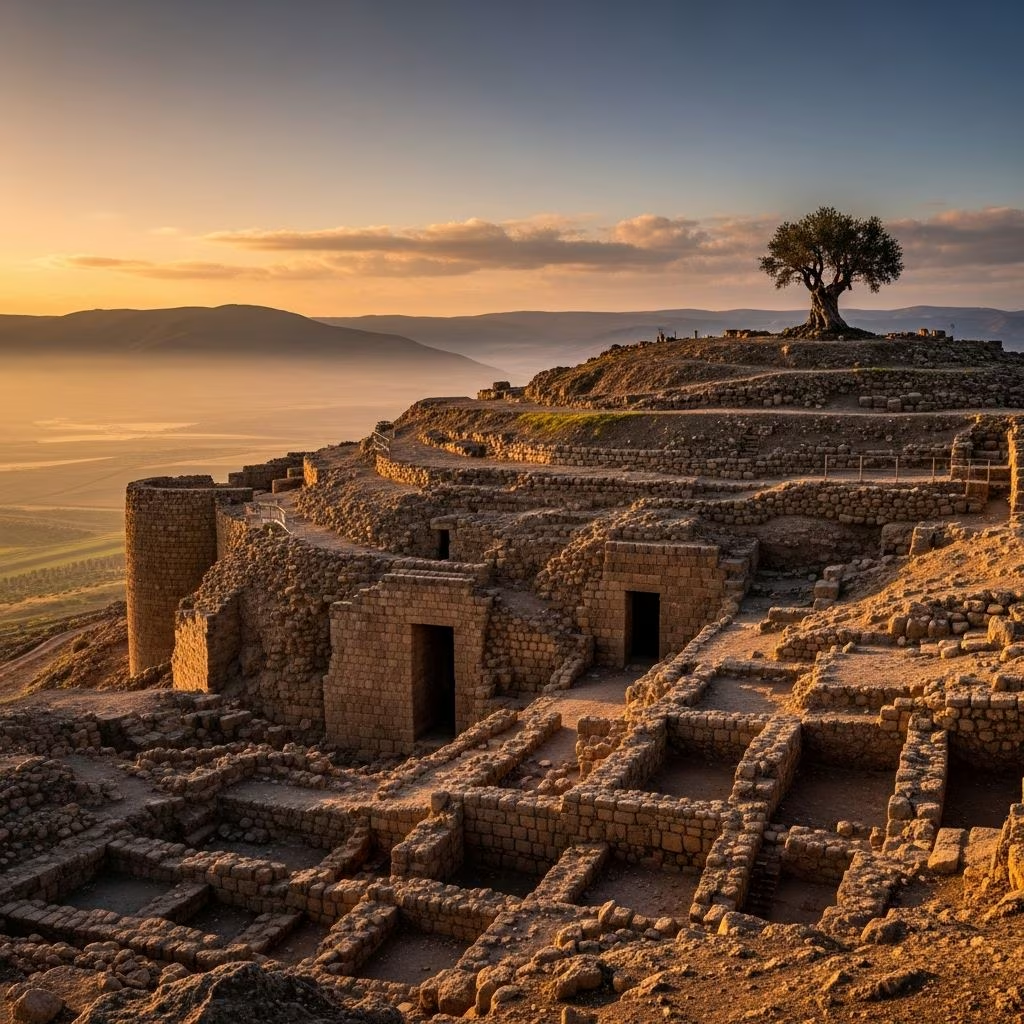
Tel Megiddo in Israel reveals millennia of battles, from pharaohs to modern wars, as the prophesied site of Armageddon with UNESCO-listed ruins.
 Travel Essentials
Tel Megiddo stands as one of Israel’s most captivating archaeological treasures, a layered mound in the Jezreel Valley embodying thousands of years of human conflict and ingenuity. Known biblically as the site of Armageddon, this tel—Hebrew for an artificial hill formed by successive settlements—holds the remains of over two dozen civilizations, making it a pivotal crossroads of ancient history.
Nestled 30 kilometers southeast of Haifa and 90 kilometers north of Jerusalem, Megiddo commands the western edge of the fertile Jezreel Valley, a natural gateway between Egypt and Mesopotamia. This position at the intersection of ancient trade routes—the Via Maris along the coast and inland paths—turned it into a perpetual hotspot for military campaigns. Controlling Megiddo meant dominating the region, as evidenced by its role in battles spanning millennia.
Archaeologists have identified at least 26 distinct layers of occupation here, from the Early Bronze Age around 3000 BCE to the Persian period. Each stratum reveals fortifications, palaces, and water systems built atop predecessors, creating a vertical chronicle of power struggles. Recent radiocarbon dating by teams led by Prof. Israel Finkelstein has refined this timeline, confirming continuous habitation through the Bronze and Iron Ages.
In the New Testament’s Book of Revelation (16:16), the Greek term Har-Magedon—Mount Megiddo—prophesies the final apocalyptic battle between good and evil. Though no actual mountain exists, the name evokes Megiddo’s bloody past, where rivers of blood and divine wrath mirror chapters of devastation unearthed in its soil.
Megiddo’s excavations, ongoing since the early 20th century, paint a vivid picture of repeated destruction and rebirth. Here’s a breakdown of key periods:
| Period | Key Events & Rulers | Archaeological Finds |
|---|---|---|
| Early Bronze Age (3000–2000 BCE) | Initial Canaanite settlements | Temples, early fortifications |
| Middle Bronze Age (2000–1550 BCE) | Egyptian influence peaks | Palaces, massive gates; radiocarbon dated recently |
| Late Bronze Age (1550–1200 BCE) | Pharaoh Thutmose III’s victory (1457 BCE) | Bronze weapons, Egyptian scarabs |
| Iron Age I (1200–1000 BCE) | Multiple destructions ~1200, 1150, 1100 BCE | Burnt layers, “red brick city” inferno |
| Iron Age II (1000–586 BCE) | Israelite kingdom: Solomon, Omri, Ahab | Stables for 450 horses, water tunnel |
Thutmose III’s 1457 BCE battle, detailed in Egyptian inscriptions at Luxor, marked Megiddo’s first recorded clash, with pharaohs claiming victory over rebels after a seven-month siege. By the Iron Age, it became a royal city in the Northern Kingdom of Israel, boasting elaborate defenses attributed variably to Solomon or the Omrides around 900–750 BCE.
Megiddo’s residents mastered survival amid sieges through innovative infrastructure. The most famous is the underground water system from the 9th century BCE: a 70-meter vertical shaft leading to a 100-meter tunnel carved through bedrock to a hidden spring. This allowed water access without exposing defenders to attackers.
Other feats include:
Recent studies by Finkelstein’s Megiddo Expedition have revolutionized timelines. The Bronze Age city fell repeatedly around 1200 BCE (Sea Peoples?), mid-12th century, and ~1100 BCE post-Egyptian retreat. Iron Age reconstruction in the 11th century ended in a cataclysmic fire, baking mudbricks red—the “mother of all destructions.” Culprits remain debated: early Israelites, Philistines, or internal strife?
Assyrian conquest in 732 BCE under Tiglath-Pileser III marked decline, followed by abandonment by the 4th century BCE. Reasons for depopulation puzzle experts: Persian policies, environmental shifts, or war exhaustion.
Megiddo’s martial legacy persisted. In World War I, British General Allenby’s forces crushed Ottomans here in 1918, earning the moniker “Armageddon” anew. During Israel’s 1948 War of Independence, Jewish and Arab armies fought in the valley below, underscoring its timeless strategy.
Today, Megiddo National Park welcomes pilgrims and tourists. Visitors descend into the water tunnel, wander chariot stables, and gaze over the valley where prophecy looms. Bible tours highlight Revelation ties, while archaeologists dig fresh layers.
Location & Access: 37 km southeast of Haifa via Route 65/66. Open daily 8 AM–4 PM (summer longer); entry ~NIS 28 adults.
Highlights Tour:
Tips: Combine with nearby Nazareth or Beit She’an. Hot summers demand hats/water; evenings offer cooler biblical vistas. Guided tours enhance context.
Debates rage: Was the stable Solomonic or Omride? Who torched the red brick city? Finkelstein’s work suggests low chronology, pushing Israelite grandeur later. Future digs may clarify Armageddon’s real-world roots versus myth.
From Hebrew Har Megiddo (Mount of Megiddo), Revelation 16:16 foretells the end-times battle there.
No, it’s a tel—a 10-hectare mound rising 30 meters from layers of ruins.
Likely 9th-century BCE Israelites under Omri/Ahab, per recent dating.
Yes, burnt layers, weapons, and Egyptian records confirm millennia of warfare.
For exceptional Iron Age preservation, illustrating biblical kingdoms.
