

 Travel Essentials
 Travel Essentials

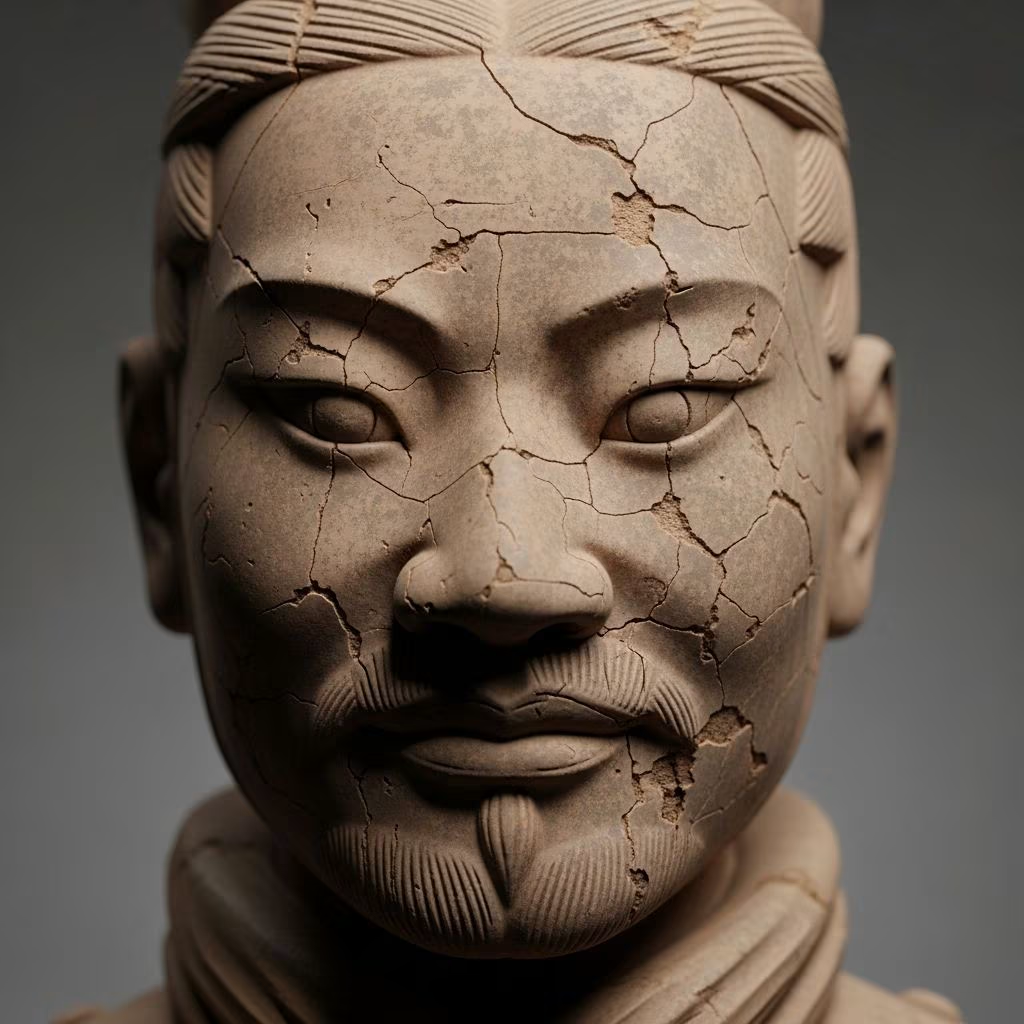
Advanced 3D scanning technology has exposed unique fingerprints, individualized features, and military precision in the Terracotta Army, suggesting they were based on real warriors from Emperor Qin Shi Huang's era.
 Travel Essentials
The Terracotta Army, one of the most astonishing archaeological discoveries of the 20th century, continues to yield secrets through modern technology. Buried for over 2,000 years alongside China’s first emperor, Qin Shi Huang, these life-sized clay figures have long fascinated the world with their individuality and precision. Recent 3D imaging and AI-driven analysis have provided compelling evidence that these warriors were not mere artistic inventions but direct representations of real soldiers from the Qin dynasty.
In 1974, farmers digging a well near Xi’an, China, stumbled upon an underground vault filled with thousands of terracotta statues. This chance find unveiled the Terracotta Army, part of a vast necropolis intended to safeguard Qin Shi Huang in the afterlife. The emperor, who unified China in 221 BCE, commanded the construction of this mausoleum starting around 246 BCE, mobilizing hundreds of thousands of laborers.
The army comprises over 8,000 soldiers, 130 chariots, and 670 horses, arranged in precise battle formations across three main pits. Each figure stands between 1.75 and 2 meters tall, with officers noticeably taller, reflecting a strict hierarchy. Originally vibrantly painted, the statues lost most color upon exposure to air, but remnants show they once depicted a lifelike military force.
Excavations revealed real bronze weapons—over 40,000 arrows, spears, and halberds—many still sharp and functional, indicating advanced metallurgy for the era.
Traditional excavation risked damaging the fragile figures, limiting insights. Enter 3D scanning technologies like Structure-from-Motion (SfM) photogrammetry and high-resolution laser scanners. Researchers capture thousands of overlapping photographs, which software processes into detailed point clouds and interactive models.
In recent years, Artec 3D scanners, with resolutions up to 0.1 mm, have been deployed on-site. These tools map textures, fractures, and minute details without physical contact, preserving artifacts while enabling virtual study. For instance, scanning warrior heads and ears revealed subtle variations supporting the ‘real army’ hypothesis.
AI integration in 2025 accelerated discoveries. Machine learning algorithms analyzed scans to detect patterns in fingerprints pressed into clay, weapon grips, and facial structures invisible to the human eye.
| Scanning Technology | Key Features | Application in Terracotta Army |
|---|---|---|
| Structure-from-Motion (SfM) | Photo-based 3D modeling via feature matching | Warrior heads, ears for individuality analysis |
| Artec Spider Scanner | 0.1 mm resolution, texture capture | Bone fragments, statue surfaces |
| AI-Enhanced Analysis | Pattern recognition, anomaly detection | Fingerprints, military formations |
One of the most striking revelations from 3D scans is the presence of thousands of fingerprints embedded in the clay. These marks, left by ancient artisans, show variations consistent with a diverse workforce modeling figures from life. AI scans suggest these were not generic stamps but impressions from actual hands, possibly those of soldiers themselves.
Facial analyses confirm hyper-realism. While initial molds created base faces (at least 10 identified), artisans added clay for personalization—noses, ears, hairstyles tailored to individuals. Morphological studies link these traits to modern Shaanxi locals, implying models were drawn from Qin troops.
Ears, often overlooked, vary dramatically: lobe shapes, canal depths, and helix curves differ like human populations, not stylized art. This supports the theory of a ‘full-scale recreation’ of the Qin military, capturing chain-of-command and ethnic diversity.
Recent morphological studies have shown a strong resemblance between the statues and modern inhabitants of the local region, leading scholars to theorize high stylistic realism from actual soldier models.
Beyond individuality, scans reveal organizational genius. Warriors stand in exact formations mirroring Qin tactics: infantry phalanxes, archer flanks, cavalry supports. Ranks dictate posture—generals with hands clasped behind backs, soldiers at attention.
Weapons, once thought symbolic, prove lethal. Bronze arrows retain chromium plating for corrosion resistance, a Qin innovation. Scans show grip positions matching combat stances, with some figures holding real hilts.
AI modeling posits the army replicates the ‘real Chin military system’—divisions, uniforms by region, even horse breeds.
Crafted in workshops near the site, figures used modular assembly: separate heads, torsos, limbs fired then luted with clay. Legs mimicked drainage pipe techniques for efficiency. This ‘assembly line’—700,000+ workers—produced 8,000+ statues in decades, a logistical marvel.
Local clay sources ensured material consistency, while diverse labor (convicts, craftsmen) explains fingerprint variety.
Qin Shi Huang, paranoid about death, sought eternal guardianship. Historical texts describe live burials, but mercy spared soldiers—instead, their likenesses served. The army embodies his unification: standardized yet personalized, conquering even the afterlife.
Scans uncovered paint traces (now preserved via climate control) and hidden chambers, hinting at more—acrobats, officials, civilians.
Debates persist on Greek influences via Silk Road, given realistic proportions. 2025 research notes anatomical accuracy akin to Hellenistic art, though Qin origins dominate.
Unexcavated pits and the emperor’s tomb (mercury rivers detected via soil analysis) promise more. AI predicts thousands await discovery.
Humidity and oxidation threaten the site. 3D models allow virtual tourism, reducing footfall. Ongoing projects use AI for fracture prediction and restoration planning.
Over 8,000 soldiers, plus horses and chariots, with more likely buried.
Yes, in vivid colors that faded upon excavation; scans preserve traces.
No, due to preservation risks and high mercury levels.
Diverse artisans modeled unique, lifelike soldiers from real people.
Yes, via 3D models from SfM and Artec scans.
