

 Travel Essentials
 Travel Essentials

Discover the Terracotta Army’s origins, craftsmanship, 1974 discovery, and what makes Qin Shi Huang’s clay guardians a global wonder.
 Travel Essentials
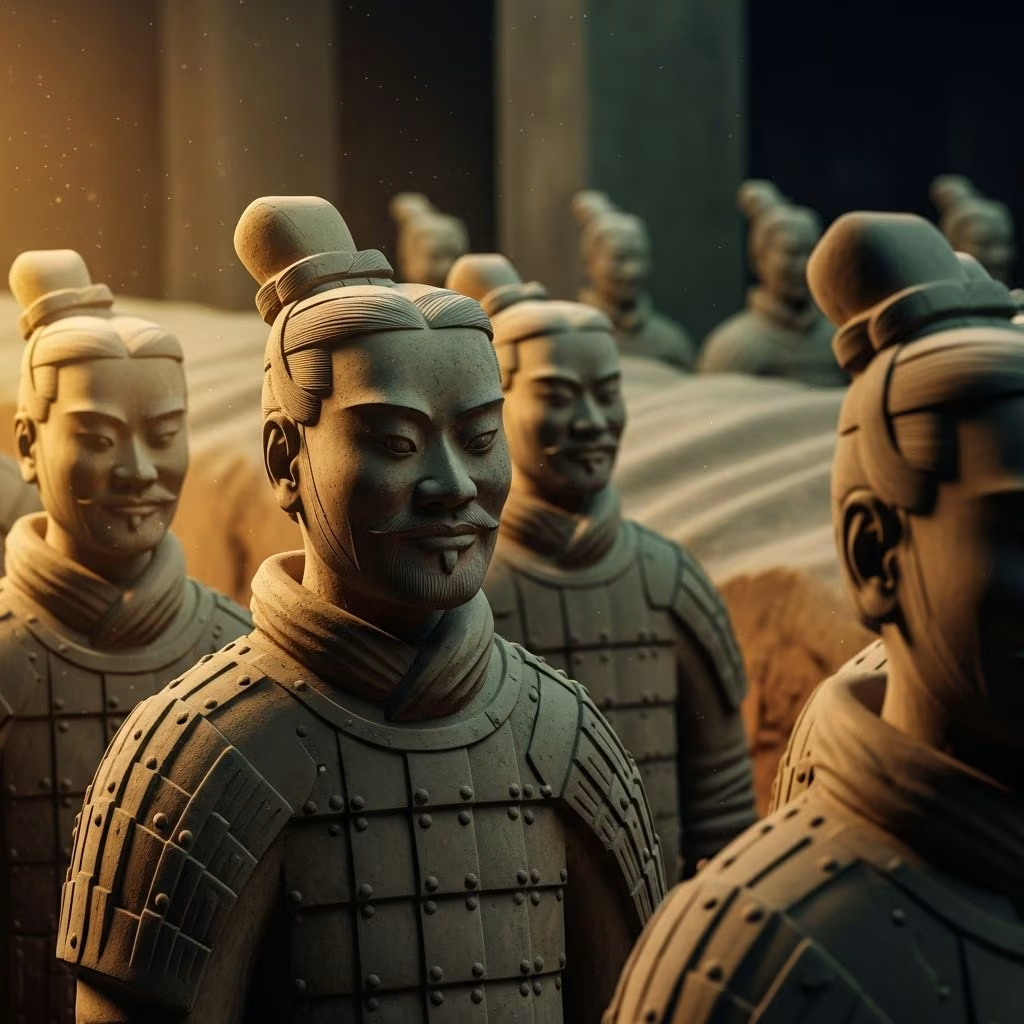
The Terracotta Army stands as one of the most extraordinary archaeological marvels of the world, a silent legion of clay soldiers poised for battle in the afterlife. Crafted over two millennia ago, these life-sized figures guard the tomb of China’s first emperor, Qin Shi Huang, offering profound insights into ancient Chinese artistry, military prowess, and imperial ambition.
Qin Shi Huang, born in 259 BCE, ascended to power at just 13 years old as king of the Qin state. By 221 BCE, he unified the warring states of China, proclaiming himself the First Emperor and establishing the Qin Dynasty. His reign marked the beginning of imperial China, with sweeping reforms including standardized weights, measures, currency, and a vast network of roads and canals.
Obsessed with immortality, Qin Shi Huang pursued elixirs and alchemical quests, but his true bid for eternity lay in his colossal mausoleum at Mount Li near modern-day Xi’an. Construction began around 246 BCE, mobilizing up to 700,000 laborers over decades. The emperor envisioned an underground palace replicating his earthly domain, complete with rivers of mercury simulating the Yangtze and Yellow Rivers, and a ceiling studded with pearls as stars.
Central to this necropolis was the Terracotta Army, designed to protect him from spiritual threats in the afterlife. Legends suggest the idea stemmed from his chancellor Li Si, who proposed clay substitutes for live human sacrifices to avoid unrest. Artisans modeled the warriors after real soldiers from the emperor’s elite guard, ensuring lifelike fidelity.
In March 1974, local farmers in Shaanxi Province, digging a well amid drought, struck upon fragments of a clay warrior’s head. Led by Yang Zhifa and his brothers, along with neighbor Wang Puzhi, this chance find about 1.5 km east of the emperor’s tomb mound unveiled the pits housing the army. Initial excavations revealed hundreds of shattered statues, prompting a massive archaeological effort.
Today, the site spans three main pits covering 20,000 square meters, with over 8,000 soldiers, 130 chariots, and 520 horses partially excavated. A fourth pit remains empty, hinting at unfinished work as the dynasty crumbled shortly after the emperor’s death in 210 BCE. The discovery rivals Egypt’s pyramids in scale and has drawn millions, cementing its status as a UNESCO World Heritage Site since 1987.
Each terracotta figure is a testament to ancient engineering, standing 1.75 to 1.95 meters tall and weighing around 200 kilograms. Produced in workshops near the site, the process involved molding body parts separately—legs, torsos, arms—then assembling and firing them in kilns at high temperatures for durability.
Individuality defines the army: no two faces are alike, with distinct facial features, hairstyles, mustaches, and expressions conveying determination or alertness. Warriors wear bulky tunics tied with intricate knots, armor plates, and boots suited to infantry, cavalry, or archers. Standing archers kneel realistically, bows at the ready, while officers sport elaborate plumes and mustaches denoting rank.
Weapons were once real: real steel swords, spears, crossbows, now mostly corroded but preserved in some cases with chrome plating for rust resistance—a technology centuries ahead of its time. Chariots, pulled by teams of horses, feature bronze fittings and intricate detailing.
| Warrior Type | Key Features | Estimated Number |
|---|---|---|
| Infantry | Straight swords, armor, varied poses | ~6,000 |
| Archers | Bows/crossbows, kneeling/standing | ~1,000 |
| Cavalry | Horses, lighter armor | ~300 |
| Officers | Plumed helmets, commanding stances | ~100 |
| Charioteers | Chariots with bronze horses | ~100 chariots |
Pit 1, the largest at 210m x 60m, houses 6,000+ soldiers in battle formation: front ranks with archers, middle infantry, rear crossbowmen. Pit 2 features more elite units like cavalry and chariots, while Pit 3, smaller, likely served as a command post with high-ranking officers. A vast network of underground chambers suggests more awaits discovery, including acrobats, officials, and animals.
The Museum of Qin Terracotta Warriors, 40 km east of Xi’an, welcomes over 9 million visitors yearly. Three exhibition halls display the pits, with elevated walkways offering panoramic views. The site’s scale impresses: from afar, ranks appear uniform; up close, unique traits emerge.
Practical Tips:
Combine with Xi’an’s City Wall, Muslim Quarter, and Big Wild Goose Pagoda for a full itinerary. Stay in Xi’an’s vibrant center for nightlife and cuisine like biangbiang noodles.
The Terracotta Army transcends archaeology, symbolizing China’s unified past and imperial might. Exhibitions worldwide—such as at the Asian Art Museum—have toured figures, chariots, and weapons, introducing millions to Qin legacy. Films, books, and replicas proliferate, yet nothing rivals the site’s aura.
Scholars debate if figures are true portraits or stylized ideals, but their realism evokes confrontation with history. They highlight Qin’s harsh rule—forced labor, book burnings—but also standardization enabling enduring civilization.
Modern tech aids restoration: 3D scanning, AI facial recognition for duplicates, and climate-controlled domes combat deterioration. Over 2,000 figures restored; thousands more crumble underground. Experts urge caution opening the main tomb due to toxic mercury.
Recent digs reveal rare kneeling archers and green-faced officials, hinting at diverse pigments from minerals. International collaboration ensures the site’s legacy for generations.
Estimates exceed 8,000 soldiers, plus horses and chariots, though only about 2,000 are fully excavated.
Over 700,000 conscripted workers and artisans from across the empire, starting in 246 BCE.
No, view from walkways above; some figures displayed at eye level in halls.
Not yet; high mercury levels pose risks. Technology may allow future non-invasive exploration.
Fly into Xi’an Xianyang Airport, base there 2-3 days, day trip to site via bus or tour.
