

 Travel Essentials
 Travel Essentials

Explore the evolution of the Olympic Games, their ancient origins, revival in the modern era, iconic host cities, and enduring cultural significance worldwide.
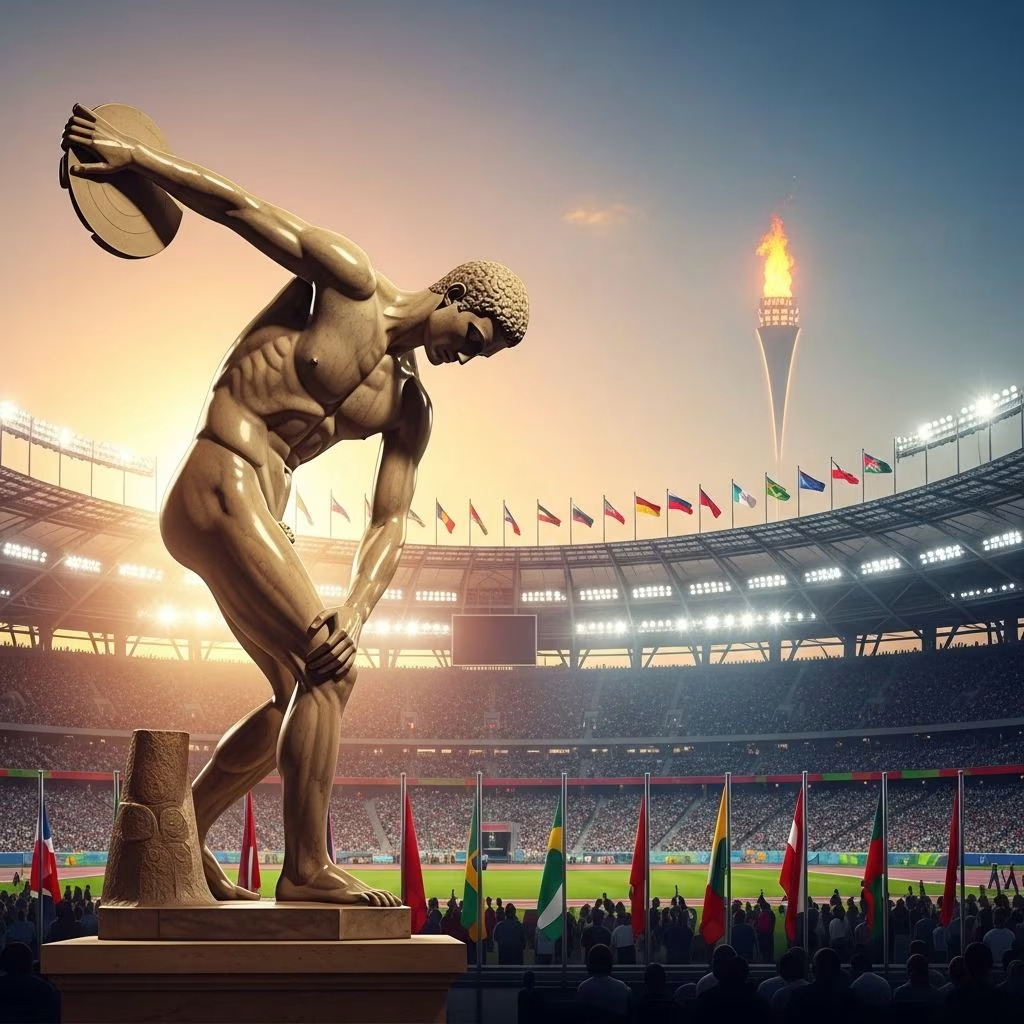 Travel Essentials
The Olympic Games stand as one of humanity’s most enduring symbols of unity, competition, and achievement. Originating as a religious festival in ancient Greece, they have evolved into a global phenomenon that captivates billions every four years. This article delves into their ancient roots, modern rebirth, transformative host cities, and lasting legacy, offering travelers and sports enthusiasts a roadmap to understanding this iconic event.
The story of the Olympics begins over 2,800 years ago in the sacred valley of Olympia, Greece. The first recorded games took place in 776 BC, marking the start of a quadrennial celebration dedicated to Zeus, the supreme deity in Greek mythology. Initially, these gatherings were modest, consisting of a single footrace called the stadion, a sprint roughly 192 meters long—the length of the stadium at Olympia.
Athletes from across Greek city-states converged during a sacred truce, suspending wars to honor the gods through physical prowess. Over centuries, the program expanded to include wrestling, boxing, pankration (a brutal mix of wrestling and boxing), chariot racing, and even artistic contests like poetry recitals. Winners received olive wreaths from a sacred tree, symbolizing divine favor, and returned home as heroes, often with statues erected in their likeness.
By the 5th century BC, the Olympics had peaked, drawing tens of thousands and fostering pan-Hellenic identity amid political rivalries. However, Roman conquest diminished their prestige, and Emperor Theodosius I banned them in 393 AD as pagan practices, ending nearly 1,200 years of tradition.
The flame of the Olympics reignited in the late 19th century through the determination of French educator Baron Pierre de Coubertin. Inspired by ancient ideals and contemporary athletic festivals like England’s Wenlock Olympian Games, Coubertin envisioned a event promoting international peace and youth development. In 1894, he convened the Sorbonne Congress in Paris, founding the International Olympic Committee (IOC) and scheduling the first modern Games for Athens in 1896.
The 1896 Athens Olympics drew 241 athletes from 14 nations to the restored Panathenaic Stadium, competing in 43 events across nine sports. American sprinter Thomas Burke won the 100m with a revolutionary ‘crouch start,’ while Greek shepherd Spyridon Louis triumphed in the marathon, inspiring national pride. These Games symbolized a bridge between antiquity and modernity, setting the stage for global expansion.
| Era | Key Milestone | Impact |
|---|---|---|
| Ancient (776 BC – 393 AD) | Religious athletic festival | Unifies Greek city-states |
| Modern Revival (1894) | IOC founded by Coubertin | Globalizes sports competition |
| 1896 Athens | First modern Games | 241 athletes, 14 nations |
Post-1896, the Olympics grew amid world wars and social shifts. Cancellations in 1916, 1940, and 1944 tested resilience, but perseverance prevailed. The 1924 Chamonix Winter Olympics introduced cold-weather sports, alternating biennially with Summer Games since 1994. Athlete numbers surged from hundreds to over 11,000 by Tokyo 2020, with events ballooning to 408 across 35 sports.
Women’s inclusion marked a pivotal evolution. Charlotte Cooper of Britain became the first female gold medalist in tennis at Paris 1900, though barriers persisted until the 21st century. Today, gender parity nears realization, reflecting broader equality strides.
Each Olympiad transforms host cities into global stages, blending sport with culture. Travelers flock to legacy venues, from Athens’ marble stadium to Beijing’s Bird’s Nest.
The Panathenaic Stadium, hewn from Pentelic marble, hosted both ancient and modern inaugurations. 2004’s venues like the Acropolis-inspired swimming complex draw visitors year-round.
Paris’ Seine River events and Eiffel Tower backdrops epitomized grandeur. 2024 featured sustainable sites like La Défense Arena.
Iconic Coliseum and Rose Bowl remain pilgrimage sites for fans tracing Usain Bolt’s records.
Italy’s dual-host promises skiing in Cortina d’Ampezzo (1956 host) and urban flair in Milan, highlighting sustainability.
| City | Year | Legacy Venue | Visitor Draw |
|---|---|---|---|
| Athens | 1896, 2004 | Panathenaic Stadium | Marathon route tours |
| Paris | 1900, 1924, 2024 | Stade de France | River cruises |
| London | 1908, 1948, 2012 | Olympic Park | |
| Tokyo | 1964, 2020 | Yoyogi National Gymnasium | Cultural immersion |
Governed by the IOC’s Olympic Charter, the Movement promotes Olympism—harmonizing sport, culture, and education. Five interlocking rings symbolize five continents united in competition. The torch relay, ignited at Olympia, embodies peace and continuity.
Economic impacts are profound: hosts invest billions, gaining infrastructure boosts. Barcelona 1992 transformed a fading port into a tourist mecca. Yet challenges like doping scandals and politicization persist, addressed via rigorous testing and neutrality pledges.
Summer and Winter Olympics alternate every two years within a four-year Olympiad cycle.
Baron Pierre de Coubertin established the IOC in 1894.
At Paris 1900, with full parity approaching in recent Games.
The stadion sprint, dating to 776 BC.
Yes, Winter Games in Milano Cortina, Italy.
Looking ahead, Los Angeles 2028 introduces flag football and squash, while Brisbane 2032 emphasizes eco-friendliness. The Games continue adapting, incorporating esports and urban sports to engage younger generations, ensuring relevance in a changing world.
From dusty tracks in Olympia to high-tech arenas, the Olympics transcend sport, fostering global dialogue. Whether chasing medal moments or cultural gems, they invite us to celebrate human potential.
