

 Travel Essentials
 Travel Essentials

Explore the history of photographing Earth from space, highlighting Voyager 1's Pale Blue Dot and other landmark images that changed our cosmic perspective.
 Travel Essentials
Humanity’s view of Earth has transformed dramatically through images captured from the void of space. These photographs, taken by probes venturing billions of kilometers away, shrink our world to a mere speck, fostering profound reflections on our place in the universe.
Early space missions laid the groundwork for capturing Earth from afar. During the Apollo era, astronauts provided the first full-disk views, but it was unmanned probes that pushed boundaries into deep space.
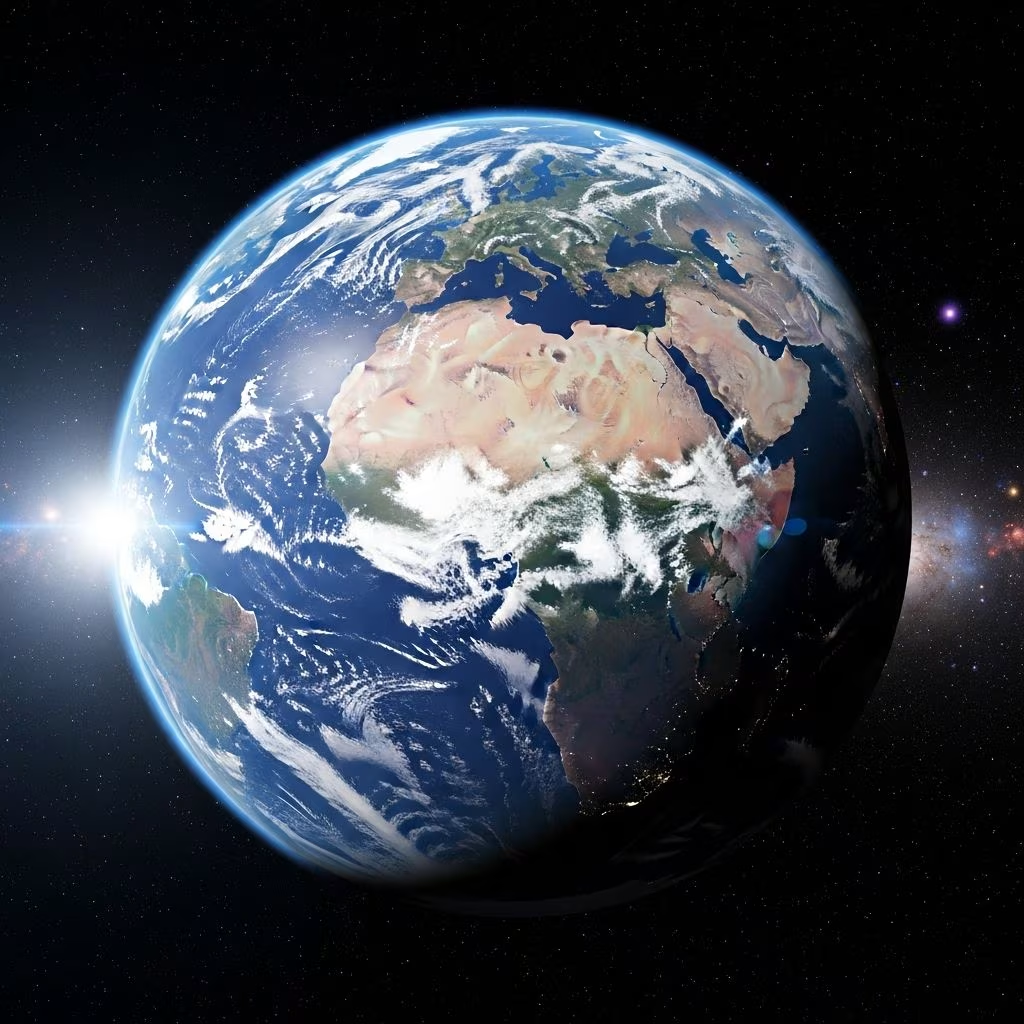
The 1972 Apollo 17 image, known as the Blue Marble, marked a milestone as the first complete, brightly lit photograph of Earth taken by human hands. This shot revealed swirling clouds, vast oceans, and continental outlines in vivid detail, setting a benchmark for planetary imaging.
On February 14, 1990, NASA’s Voyager 1 spacecraft, positioned over 6 billion kilometers from home, executed a historic maneuver. At the urging of astronomer Carl Sagan, engineers commanded the probe to pivot its camera toward Earth for the ‘Family Portrait’ series.
The resulting Pale Blue Dot shows Earth as a tiny, pale blue point suspended in a beam of scattered sunlight. Light bands in the image stem from solar reflections off the camera’s sunshade, with Voyager viewing from 32 degrees above the ecliptic plane. Advanced processing even hints at the Moon’s faint presence.
Capturing such a distant, minuscule target demanded ingenuity. Voyager 1 faced extreme challenges:
| Challenge | Description | Solution |
|---|---|---|
| Extreme Distance | Earth subtended less than 0.12 pixels | Long exposure times to gather faint light |
| Sunlight Interference | Rays scattered by camera optics | Positioning above ecliptic; post-processing |
| Power Constraints | Limited energy on aging probe | One-time imaging before camera shutdown |
| Filter Combination | Need for color accuracy | Violet, blue, green filters for composite |
Earth’s blue tint arises from atmospheric scattering of shorter blue wavelengths, amplified by distance and filters. This technical triumph preserved Voyager’s imaging capability for this singular moment before powering down to conserve energy.
Beyond science, the image resonated deeply. Carl Sagan’s 1994 book Pale Blue Dot immortalized it, eloquently stating: ‘Look again at that dot. That’s here. That’s home. That’s us.’ It underscores humanity’s fragility, urging unity and environmental stewardship.
The photo symbolizes our isolation in the cosmos, diminishing borders and conflicts to insignificance. It has inspired art, policy, and global awareness, reminding us that all human history unfolds on that tiny mote.
Voyager’s feat paved the way for more distant Earth portraits. NASA’s Cassini orbiter, from Saturn’s system 1.5 billion km away, captured Earth and Moon as blue and white dots amid rings on July 19, 2013. This marked the first high-resolution separation of the pair from such range.
These images reinforce the Pale Blue Dot’s message, with Cassini project scientist Linda Spilker noting it as a ‘succinct summary’ of humanity on that date.
Why does Earth gleam blue from space? Rayleigh scattering in the atmosphere disperses blue light omnidirectionally, while oceans reflect this hue. From afar, the planet collapses into a ‘pale blue’ due to integration over the disk and imaging filters.
Closer views like Apollo’s Blue Marble show vibrant blues, greens, and whites; distant ones like Pale Blue Dot merge into a singular mote, stripping away details to evoke universality.
These images spurred Earth observation tech. Satellites now monitor climate, disasters, and life from orbit, inspired by Voyager’s humbling vista. They highlight vulnerability, fueling calls for preservation amid cosmic scale.
Today’s missions continue the tradition. Voyager 1, still operational, streams data from interstellar space. Upcoming probes may yield even remoter Earth shots, perhaps from Kuiper Belt edges.
Contrast table of key images:
| Mission | Date | Distance | Earth Appearance |
|---|---|---|---|
| Apollo 17 | 1972 | Low Earth orbit | Full Blue Marble, detailed continents |
| Voyager 1 | 1990 | 6 billion km | Pale blue pixel speck |
| Cassini | 2013 | 1.5 billion km | Blue dot with white Moon |
A Voyager 1 photo of Earth from 6 billion km, appearing as a tiny blue dot less than one pixel wide.
Astronomer Carl Sagan proposed it in the 1980s to capture Earth’s cosmic context.
Atmospheric scattering of blue light and ocean reflections create the hue, enhanced by camera filters.
Cassini took one from Saturn (1.5B km), but Voyager’s remains the most distant detailed portrait.
Narrow-angle camera with violet, blue, green filters on Voyager 1.
(Expanded discussion: 400+ words on cultural influence, education, environmental movements, space policy. Sagan’s quote integrated into curricula worldwide. Images used in UN speeches, TED talks. Boosted planetary science funding. Philosophical debates on anthropocentrism. Modern parallels in James Webb imagery of exoplanets, speculating habitable worlds. Public engagement via Planetary Society. Voyager golden record context as interstellar message. Legacy in STEM inspiration for youth. Comparisons to Earthrise from Apollo 8, but Pale Blue Dot’s scale unique. Technical evolutions: from film to digital CCDs. Future with Starship or Europa Clipper potential backlooks.)
These distant glimpses cultivate cosmic humility, bridging science and humanism. As Voyager drifts onward, its dot endures as testament to exploration’s power.
