

 Travel Essentials
 Travel Essentials

Explore how the Wilderness Act protects millions of acres, preserves wild character, and supports biodiversity, recreation, and clean water.
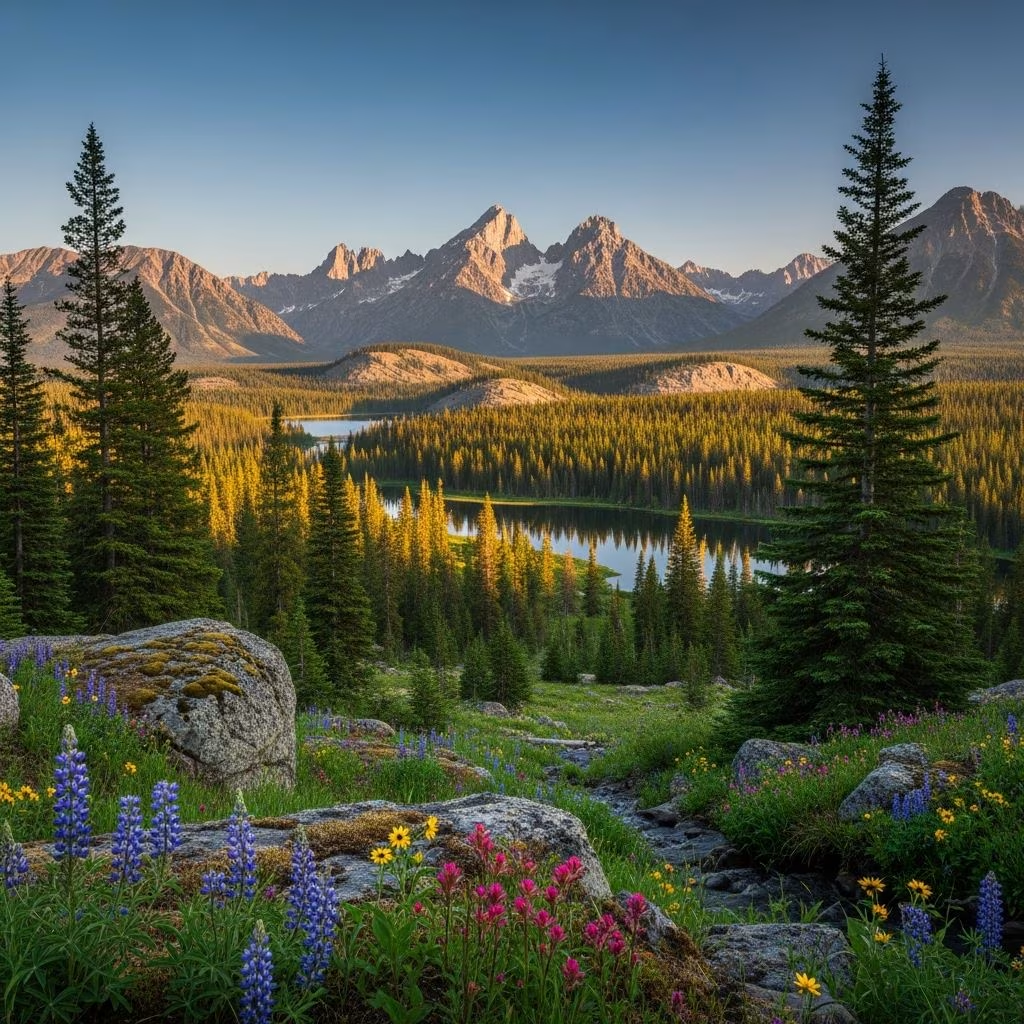 Travel Essentials
The United States boasts a vast network of protected wilderness areas, born from visionary legislation that prioritizes natural integrity over development. At its core lies the Wilderness Act of 1964, a landmark law that formalized the preservation of pristine federal lands, ensuring they remain untouched by modern intrusions for the benefit of all citizens.
Signed into law by President Lyndon B. Johnson on September 3, 1964, the Wilderness Act emerged after years of dedicated advocacy. Howard Zahniser of The Wilderness Society crafted over 60 drafts, refining a vision to counter the encroaching tide of industrialization on America’s remaining wild frontiers. This legislation not only codified the concept of wilderness but also launched the National Wilderness Preservation System (NWPS), initially safeguarding 9.1 million acres across national forests.
By defining wilderness as areas retaining their primeval character, the Act set a precedent for federal land management. It mandated that these spaces offer opportunities for solitude, scientific study, and unconfined recreation, free from permanent human improvements or motorized access.
Central to the Act is its precise legal definition in Section 2, which outlines criteria for eligible lands. These include:
This framework ensures wilderness areas serve as living laboratories and sanctuaries, managed by agencies like the National Park Service (NPS), U.S. Forest Service, and others to preserve their character indefinitely.
Section 3 of the Act established the NWPS, incorporating pre-existing primitive areas in national forests and initiating reviews for further designations. Secretaries of Agriculture and Interior were tasked with evaluating roadless areas in forests, parks, and wildlife refuges, submitting recommendations to the President for congressional action.
Today, the NWPS encompasses over 800 areas totaling 109.5 million acres—about 5% of U.S. federal lands—spanning 44 states and Puerto Rico. Iconic inaugural sites include the Gila Wilderness in New Mexico, Boundary Waters Canoe Area in Minnesota, and Bob Marshall Wilderness in Montana, embodying the Act’s immediate impact.
| State | Key Wilderness Area | Acres (Approx.) | Designated |
|---|---|---|---|
| New Mexico | Gila Wilderness | 533,000 | 1924/1964 |
| Minnesota | Boundary Waters Canoe Area | 1,098,000 | 1978 |
| Wyoming | Bridger Wilderness | 428,000 | 1964 |
| Montana | Bob Marshall Wilderness | 1,009,000 | 1964 |
| California | Ansel Adams Wilderness | 231,000 | 1964 |
This table highlights foundational areas, showcasing geographic diversity and scale.
While the 1964 Act provided the blueprint, subsequent laws have vastly expanded protections. Agencies continue inventorying lands, with Congress holding sole authority to designate new areas via specific boundary statutes, ensuring permanence unless revisited legislatively.
Modern bills build on this legacy. For instance, proposals like H.R. 2546, the Protecting America’s Wilderness Act, aim to designate additional acres in states such as Colorado, enhancing connectivity near national parks like Dinosaur and Mesa Verde. These efforts address threats from energy extraction and urbanization, promoting ecological resilience.
Wilderness management emphasizes minimal intervention. Federal agencies preserve wilderness character while allowing traditional uses like grazing in some forest areas. Limited exceptions permit water resource prospecting or facilities deemed in the public interest, subject to presidential authorization.
Military overflights and training routes are accommodated without ground disturbance, balancing defense needs with preservation. Public involvement is key: before recommendations, agencies publish notices in the Federal Register and local media, fostering transparency.
These protected zones sustain biodiversity, harboring rare species and intact ecosystems. They act as carbon sinks, buffers against climate change, and sources of clean water. Recreationally, they offer profound experiences—solitude in vast expanses fosters mental restoration and cultural appreciation of nature.
Economically, wilderness supports tourism, generating jobs in gateway communities through hiking, fishing, and wildlife viewing, without the infrastructure costs of developed sites.
Despite successes, pressures mount. Climate shifts alter habitats, invasive species encroach, and adjacent development fragments ecosystems. Debates arise over access—balancing preservation with equitable recreation opportunities, especially for underserved groups.
Legislative hurdles persist; some amendments seek to weaken protections for resource extraction, underscoring the need for vigilant advocacy.
Ongoing campaigns target roadless expanses in the Rockies, Alaska, and beyond. Collaborative efforts between NGOs like The Wilderness Society, local stakeholders, and lawmakers drive new designations. Enhanced scientific monitoring will inform adaptive management amid global changes.
The Wilderness Act of 1964 created the NWPS to permanently protect federal lands in their natural state, prohibiting development and motorized use.
Approximately 109.5 million acres across 757 areas in 44 states and Puerto Rico.
Primarily the NPS, Forest Service, Fish and Wildlife Service, and Bureau of Land Management.
No—mechanical transport and devices like drones are banned to maintain primitive conditions.
Congress passes specific legislation after agency reviews and public input.
Visitors to the Bob Marshall Wilderness recount multi-day treks amid grizzly habitats, where silence amplifies nature’s symphony. In Boundary Waters, paddlers navigate labyrinthine lakes, glimpsing moose at dawn—testaments to the Act’s enduring gift.
Scientists value these areas for baseline research; long-term studies track forest dynamics unaltered by logging, informing global conservation strategies.
