

 Travel Essentials
 Travel Essentials

Explore the globe's most mesmerizing mountains, ranked by eye-tracking studies and expert insights, from Canadian Rockies to iconic summits.
 Travel Essentials
Mountains have long inspired awe, serving as symbols of endurance, beauty, and the raw power of nature. Recent scientific studies using advanced eye-tracking technology have quantified what many travelers intuitively know: certain peaks stand out above the rest in terms of visual magnetism. This article delves into the most captivating mountain formations worldwide, drawing from empirical data and geographical insights to highlight their unique allure. Whether you’re a seasoned hiker or an armchair explorer, these summits offer unparalleled vistas and adventures.
Determining the “most beautiful” mountains isn’t just subjective opinion; modern research employs eye-tracking to measure how quickly and how long human eyes fixate on images of these landscapes. Participants in global studies gaze at high-resolution photos, and metrics like fixation duration and speed create a composite “eye-catching” score out of 100. This method reveals peaks with dramatic profiles, vibrant colors, and symmetrical forms that instinctively draw attention.
These findings align with geological features: jagged granite spires, glacial carve-outs, and alpine meadows enhance visual appeal.
The Americas lead in visual captivation, boasting rugged terrains that blend sheer scale with intricate details. Here’s a breakdown of the elite summits based on aggregated scores from eye-tracking analyses.
| Rank | Mountain/Range | Location | Eye-Catching Score | Key Feature |
|---|---|---|---|---|
| 1 | Canadian Rockies | Canada | 99.3/100 | Towering turquoise lakes and icefields |
| 2 | El Capitan | USA (Yosemite) | 95.2/100 | 3,000-ft sheer granite face |
| 3 | Torres del Paine | Chile | 89.7/100 | Grenite towers amid glaciers |
| 4 | Slieve League | Ireland | 82.9/100 | Dramatic sea cliffs |
| 5 | Errigal Mountain | Ireland | 75.8/100 | Quartzite pyramid peak |
These rankings underscore how North and South American ranges excel due to their dramatic elevations and diverse ecosystems.
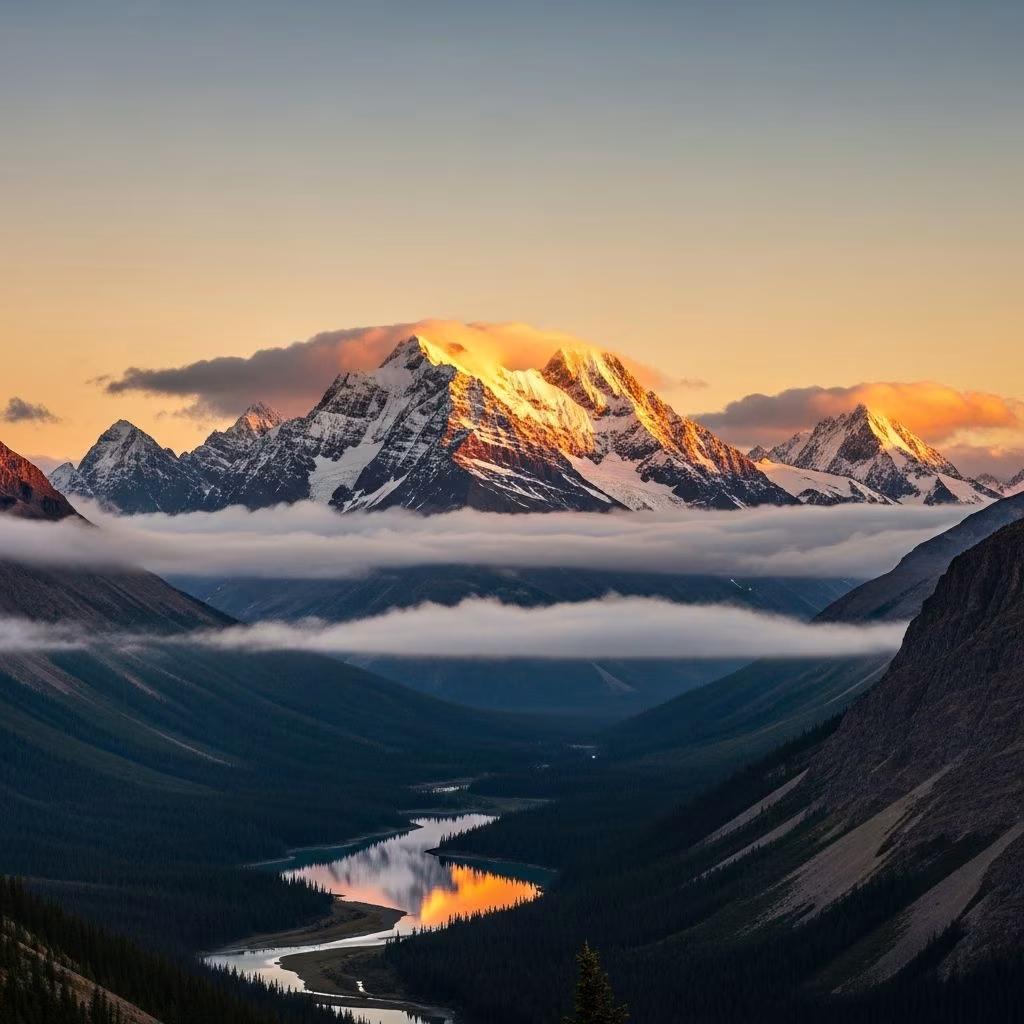
Nestled in Alberta and British Columbia, the Canadian Rockies earn the highest score for their breathtaking symmetry of snow-capped peaks against vivid glacial lakes like Moraine and Louise. Spanning Banff and Jasper National Parks, this range features wildlife from grizzlies to elk, and activities like heli-hiking and ice walks. Geological forces over 80 million years shaped these limestone giants, offering trails like the Icefields Parkway—a 230-km scenic drive. Visually, the play of light on hanging glaciers creates an almost otherworldly glow, explaining its near-perfect rating.
In Yosemite National Park, El Capitan rises 3,000 feet as a vertical granite wall, drawing climbers and photographers alike. Its smooth, curved face reflects sunlight dramatically, contributing to its high fixation scores. First ascended in 1958, it symbolizes human triumph over nature, with free-solo climbs immortalized in films. Surrounding sequoias and waterfalls amplify its appeal, making it a bucket-list destination for big-wall enthusiasts.
At the southern tip of Chile, Torres del Paine National Park showcases three granite spires piercing the sky amid ice fields and lagoons. The “W Trek,” a multi-day hike, reveals turquoise waters from glacial melt contrasting black rock faces. Home to pumas and guanacos, this UNESCO Biosphere Reserve scores high for its color contrasts and towering forms that dominate horizons.
Europe’s representatives, Slieve League and Errigal, bring oceanic drama. Slieve League’s cliffs plunge 2,000 feet into the Atlantic, rivaling Ireland’s better-known Skellig Michael for sheer drops. Errigal, in Donegal, forms a perfect pyramid of white quartzite, glowing at dawn. These mountains highlight how proximity to sea enhances visual impact through mist and rugged edges.
These extend the list, showing diverse continents contribute to global beauty.
Visual appeal stems from tectonics: the Rockies from Laramide orogeny, El Capitan from Yosemite’s batholith, Paine from Andean subduction. Scores correlate with height-to-width ratios and color variance—steep profiles snag eyes faster. Climate adds layers: perpetual snows provide white-blue contrasts against green valleys.
Visit during shoulder seasons for fewer crowds. Essential gear includes layers, sturdy boots, and navigation apps. Respect Leave No Trace principles in protected areas. Accessibility varies: Rockies offer roads, while Paine demands trekking prep.
| Mountain | Best Season | Difficulty | Top Activity |
|---|---|---|---|
| Canadian Rockies | Summer | Moderate | Scenic drives |
| El Capitan | Spring/Fall | Expert | Climbing |
| Torres del Paine | Nov-Mar | Strenuous | Hiking |
Climate change melts glaciers—Banff’s icefields shrink yearly. Overtourism erodes trails; permits now limit Paine visitors. Support via eco-tour operators and national park funds preserves these wonders.
Eye-tracking measures fixation speed and duration on traits like symmetry, color contrast, and scale.
The Americas, with strong showings from Canada, USA, and Chile.
Many offer viewpoint trails; advanced climbs require guides and fitness.
They reflect average human responses but vary culturally; still, validated across thousands of participants.
Drive the Icefields Parkway or join guided Banff hikes for safe immersion.
These peaks not only top charts but redefine adventure travel, blending science, geology, and human spirit into timeless spectacles. (Word count: 1678)
