

 Travel Essentials
 Travel Essentials

Discover the remarkable story of the Yamaki Pine, a centuries-old bonsai that miraculously survived the 1945 Hiroshima bombing and now serves as a powerful testament to endurance and international reconciliation.
 Travel Essentials
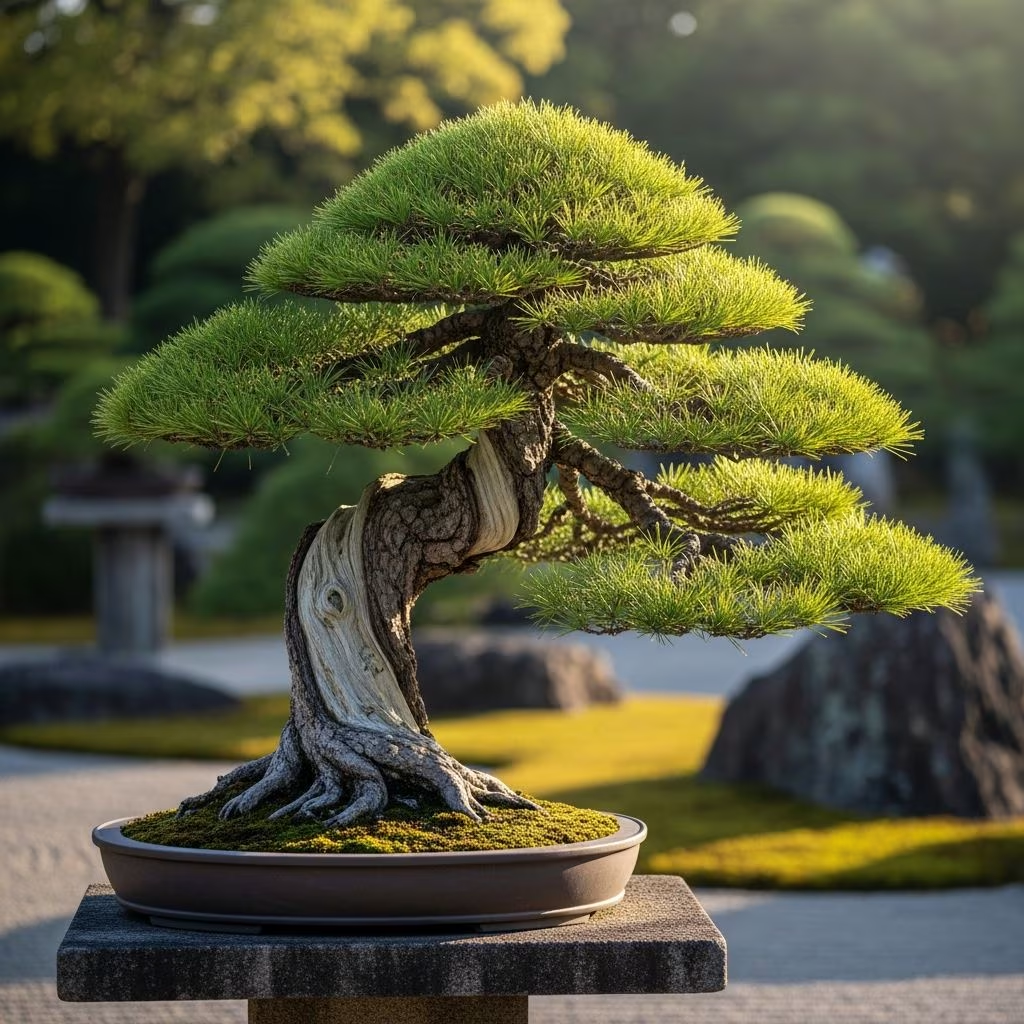
Throughout human history, certain objects transcend their original purpose to become powerful symbols of resilience, hope, and reconciliation. Among these remarkable artifacts stands an unassuming bonsai tree—a Japanese white pine approximately two feet in height with a thick, gnarled trunk. This living testament to survival has captivated the imagination of countless visitors who have encountered it at the United States National Arboretum in Washington, D.C. What makes this particular tree extraordinary is not merely its considerable age or horticultural significance, but rather its profound connection to one of the darkest chapters in modern history.
The story of this remarkable bonsai begins long before the atomic age, rooted in the deep traditions of Japanese horticulture. The tree was meticulously cultivated by the Yamaki family, a family of bonsai masters whose expertise spanned generations. For five consecutive generations, members of the Yamaki household invested their knowledge, skill, and devotion into shaping and maintaining this singular specimen. This was not merely a hobby or commercial venture; rather, it represented a profound philosophical commitment to the art form itself.
The tree itself was planted in 1625, making it over four hundred years old in the modern era. Its origins in the Edo period connect it to a time of profound artistic and cultural flourishing in Japan. The Yamaki family maintained a nursery in Hiroshima where they cultivated multiple bonsai specimens, each one receiving individualized attention according to principles passed down through their ancestral lineage. This horticultural tradition embodied centuries of accumulated knowledge about how to coax living wood into artistic expression while maintaining the vitality of the plant itself.
On August 6, 1945, at 8:15 in the morning, the world entered a new and terrifying era. An American B-29 bomber nicknamed the “Enola Gay” released an atomic bomb over the city of Hiroshima, just two miles from the Yamaki family home and nursery. The explosion devastated nearly ninety percent of the city’s structures, killing approximately eighty thousand people instantaneously and causing the eventual deaths of more than one hundred thousand additional victims through injuries and radiation exposure.
Bonsai master Masaru Yamaki was inside his home when the blast struck. The force was so tremendous that it shattered windows throughout the house, sending glass fragments flying through the air with lethal velocity. Yamaki suffered cuts from these glass shards, but he and his family survived the immediate impact. The nursery where the bonsai trees were kept stood protected by a substantial stone wall that shielded the plants from the direct blast effects. The tree stood only about three kilometers from the epicenter of the explosion, yet the wall provided sufficient protection to preserve its life.
In historical photographs and film footage from the Yamaki nursery taken after the bombing, the pine tree can be seen standing unharmed in the background, its needles still green, its trunk intact. This survival seemed almost miraculous given the wholesale destruction that surrounded it. Trees throughout Hiroshima had been incinerated or stripped of their bark by the intense heat. Yet this particular bonsai, carefully tended for three centuries, had endured.
Following the devastation of Hiroshima and the subsequent surrender of Japan, the Yamaki family faced the monumental task of rebuilding their lives in a conquered and occupied nation. Despite the extraordinary nature of their bonsai’s survival, they initially chose not to publicize this fact. The tree remained in Japan for several decades, continuing to receive the devoted care that had sustained it through centuries of change.
In 1976, Japan extended a remarkable gesture of friendship and cultural bridge-building toward the United States. To commemorate the bicentennial of American independence, the Nippon Bonsai Association selected fifty-three prized bonsai specimens to be gifted to the American people. The Yamaki Pine, with its extraordinary age and history, was included among these specimens. Masaru Yamaki, the bonsai master whose family had maintained the tree through the catastrophic events of the twentieth century, personally arranged for the donation.
When the tree arrived at the National Bonsai and Penjing Museum at the United States National Arboretum, it was catalogued and displayed with minimal fanfare. The museum staff understood that the tree was a valuable specimen from Japan, but the dramatic history of its survival remained unknown to them. For twenty-five years, the bonsai stood near the museum’s entrance, its spectacular lineage hidden beneath ordinary cataloguing information. Thousands of visitors walked past it, admiring its distinctive appearance and age without comprehending the profound historical narrative embedded within its very wood.
The hidden history of the Yamaki Pine remained concealed until March 2001, when two brothers arrived at the National Arboretum on a mission of personal pilgrimage. Shigeru Yamaki and Akira Yamaki, grandsons of Masaru Yamaki, had grown up hearing family stories about their grandfather’s remarkable tree. They had learned how it survived the atomic bomb, how it endured the occupation, and how it was eventually sent to America as a gesture of friendship. Wanting to see this legendary specimen with their own eyes, the two brothers made the journey from Japan to Washington, D.C.
Upon locating the tree at the museum, the Yamaki grandsons spoke with the curatorial staff and, through a translator, shared their family’s complete narrative. The museum staff, hearing this account for the first time after two and a half decades, realized they had possessed an extraordinary historical artifact without fully comprehending its significance. The revelation transformed how the institution understood and presented this particular bonsai. What had been simply an old and beautiful tree suddenly became a living monument to survival, resilience, and peace.
The significance of the Yamaki Pine extends far beyond its botanical or horticultural value. According to museum curator Kathleen Emerson-Dell, the tree represents much more than a survivor of physical catastrophe. She emphasized that the donation itself was fundamentally “a gift of friendship and connection, the connection of two cultures.” This perspective reframes the tree’s journey from one dominated by loss and trauma to one centered on reconciliation and mutual understanding.
For Japan, the gift of these bonsai specimens symbolized a commitment to moving forward from the devastation of war toward a peaceful future. For the United States, receiving such a generous cultural offering from the nation it had defeated just thirty-one years earlier demonstrated the possibility of transformation and healing after profound conflict. The Yamaki Pine, standing silently at the center of this exchange, embodied both the pain of the past and the potential for future cooperation.
The tree has become recognized as a powerful emblem of peace and resilience. Its four-hundred-year lifespan encompasses centuries of human history, yet its most defining characteristic remains its presence at a moment of unprecedented destruction. That it survived, that it continued to grow, that it eventually became a bridge between two nations—these facts speak to something deeper than mere biological persistence. The bonsai represents humanity’s capacity to endure, to heal, and to choose connection over continued division.
As awareness of the Yamaki Pine’s history has spread, the tree has received increasingly prominent recognition within the National Arboretum. In recent years, the museum constructed a new Japanese Pavilion specifically designed to honor the institution’s collection of Japanese bonsai and to provide appropriate cultural context for their display. The Yamaki Pine was relocated to take pride of place near the entrance of this new structure, where its historical significance and artistic beauty could be appreciated in a setting that reflects the cultural traditions from which it emerged.
The tree’s relocation to the Japanese Pavilion represents more than a simple curatorial decision. It reflects a commitment to telling the complete and honest story of this artifact—acknowledging both its artistic lineage within Japanese horticultural tradition and its profound historical resonance. Visitors approaching the pavilion now encounter detailed information about the Yamaki family, the bombing of Hiroshima, and the tree’s journey across the Pacific. What was once anonymous has become a centerpiece of public historical memory.
The National Bonsai and Penjing Museum has also marked significant anniversaries related to the tree, including commemorations of the bombing’s anniversary and celebrations of the tree’s longevity. These observances draw attention not only to the specific historical events associated with the Yamaki Pine but also to larger questions about how societies process trauma, remember losses, and build bridges across the divisions created by war.
To fully appreciate why the Yamaki Pine represents such a remarkable achievement, one must understand something of the horticultural and artistic traditions that created it. Bonsai cultivation represents a sophisticated synthesis of artistic vision, botanical knowledge, and philosophical outlook. Practitioners shape living trees into carefully composed forms that suggest natural landscapes compressed into miniature scale. This requires not only technical skill but also a deep understanding of plant physiology and long-term commitment to the living organism’s welfare.
The Yamaki Pine, with its thick trunk and gnarled character, exemplifies the aesthetic ideals of mature bonsai artistry. Its appearance reflects centuries of thoughtful pruning, wiring, and styling. Yet this controlled beauty represents not dominance over the plant, but rather a partnership between human vision and natural growth. The tree’s survival of the atomic bomb did not require human intervention—it required only the protective wall that happened to shield the nursery. What makes the tree extraordinary is not that human hands saved it, but that it endured on its own.
In an era marked by ongoing international tensions and climate-related threats to plant and animal populations, the story of the Yamaki Pine carries particular resonance. The tree demonstrates both the fragility of life in the face of human-created catastrophe and the remarkable resilience that living things can manifest when circumstances permit. It stands as a testament to the possibility of healing after profound trauma and to the power of cultural exchange to transcend historical divisions.
For those who visit the National Arboretum today, encountering the Yamaki Pine offers an opportunity for reflection on themes both personal and global. The tree invites contemplation about survival, about the passage of time, about the relationship between humans and the natural world, and about the ongoing work of building peace across national boundaries. Its quiet presence at the museum carries the weight of history while remaining fundamentally alive and growing, a living embodiment of continuity and transformation.
