

 Travel Essentials
 Travel Essentials

Explore the accelerating decay of the Titanic wreck, threats from tourism and bacteria, historical context, and global efforts to protect this underwater heritage site from total collapse.
 Travel Essentials
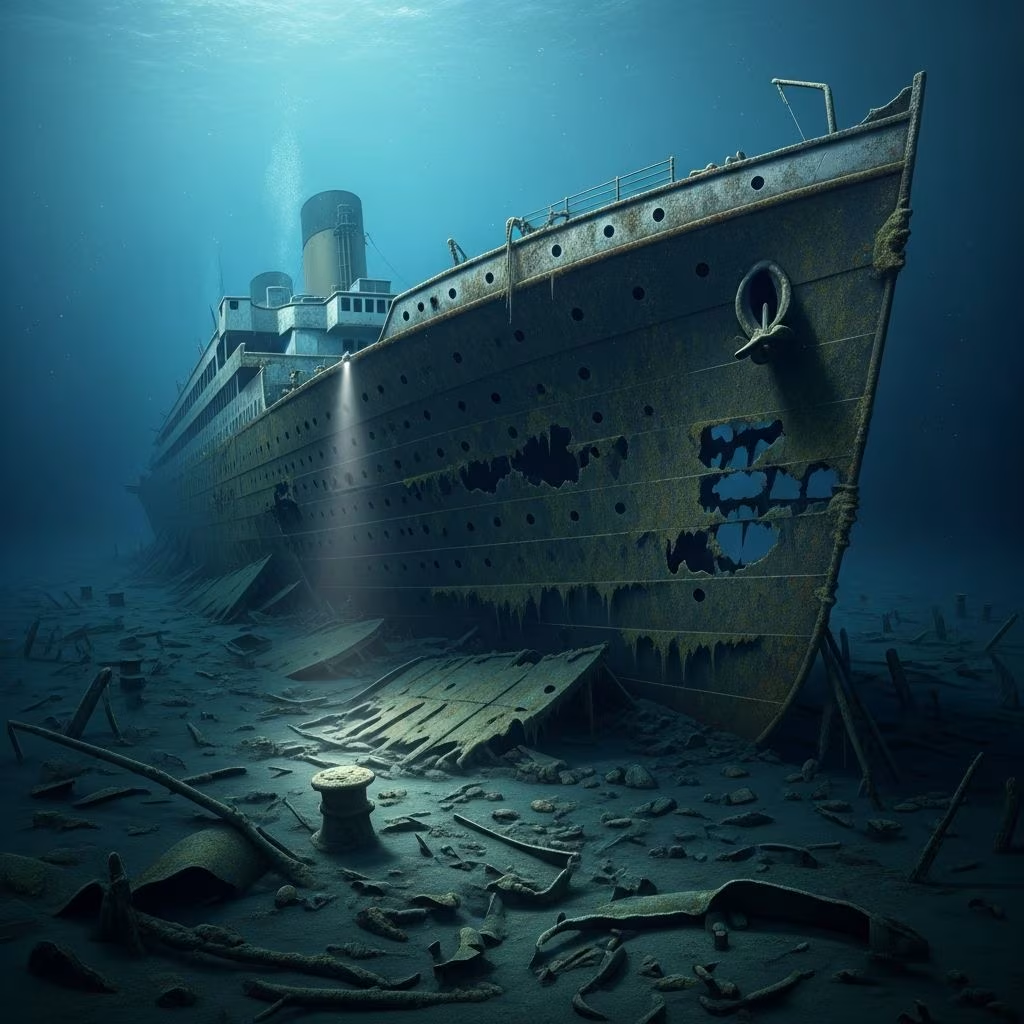
The RMS Titanic, once the pinnacle of early 20th-century engineering, now lies in ruins on the North Atlantic seabed, its steel hull succumbing to relentless natural and human-induced forces. Discovered in 1985, the wreck has captivated the world, but experts warn it could fully disintegrate within decades, urging a reevaluation of how we engage with this fragile relic.
In 1985, a joint Franco-American expedition led by Robert Ballard located the Titanic at approximately 3,800 meters deep, about 600 kilometers southeast of Newfoundland, Canada. The ship had split into two primary sections separated by roughly 600 meters, a result of the catastrophic impact with an iceberg on April 15, 1912. This find not only confirmed long-held theories about the sinking but also opened a new era of deep-sea archaeology.
Early expeditions used advanced sonar and remotely operated vehicles (ROVs) to map the site, revealing haunting details like the grand staircase, personal artifacts, and the ship’s massive propellers. These missions recovered thousands of items, from china to jewelry, many now conserved and displayed in museums worldwide. However, these salvage efforts sparked debates over ethical recovery versus in-situ preservation.
The primary threat to the Titanic is Halomonas titanicae, a bacterium discovered in 2010 that thrives in the cold, dark, oxygen-poor environment of the wreck. This microbe forms iron-eating rusticles—stalactite-like structures that accelerate steel corrosion. Since the sinking over a century ago, these bacteria have transformed much of the hull into rust, with projections indicating the structure could collapse entirely within 50 years.
Environmental factors exacerbate this decay. The wreck’s exposure to deep-sea currents carries sediment and pollutants, while pressure at 3,800 meters compresses the fragile remains. Unlike shallower wrecks preserved by sediment burial, Titanic’s position leaves it vulnerable to constant erosion. Scientists note that without intervention, the bow and stern sections may merge into an unrecognizable debris field by mid-century.
While nature works slowly, human activities pose immediate risks. Commercial submersible tours, pioneered by companies like OceanGate starting in 2021, brought paying tourists to the site. These visits, though limited, disturbed silt layers and potentially spread invasive microbes via equipment. The tragic implosion of OceanGate’s Titan submersible on June 18, 2023, near the wreck—killing five—halted such operations but highlighted the dangers of unregulated tourism.
Over 140 individuals had visited by 2012, and salvage operations continue to extract artifacts, further destabilizing the structure. Robert Ballard, the discoverer, has criticized these intrusions, estimating they hasten decay. The National Oceanic and Atmospheric Administration (NOAA) warns that combined disturbances could precipitate structural failure sooner than natural processes alone.
| Human Activity | Impact on Wreck | Example |
|---|---|---|
| Submersible Tours | Silt disturbance, micro-organism transfer | OceanGate Titan missions (2021-2023) |
| Artifact Recovery | Structural weakening, site fragmentation | Thousands of items salvaged since 1987 |
| ROV Mapping | Minor propeller wash erosion | Expeditions by RMS Titanic Inc. |
The Titanic’s sinking claimed over 1,500 lives due to a confluence of errors: ignored iceberg warnings from ships like the Baltic, excessive speed in ice-prone waters, and insufficient lifeboats for all aboard. U.S. Senate investigations in 1912 exposed these lapses, leading to global maritime reforms like the International Ice Patrol and enhanced lifeboat requirements.
Captain Edward Smith received at least three ice alerts on April 14, yet no speed reduction or extra lookouts were ordered—a stark example of overconfidence in the ‘unsinkable’ ship. This hubris, echoed in media hype, mirrors modern risk management failures where warnings are dismissed.
Recognizing its cultural value, the wreck gained protection under the UNESCO 2001 Convention on the Underwater Cultural Heritage in April 2012. This treaty prohibits commercial exploitation and mandates non-destructive study. Proposals to raise the ship—wild ideas like ping-pong ball inflation or liquid nitrogen encasement—were deemed impractical due to fragility.
Ballard proposed using ROVs to apply anti-fouling paint, aiming to shield the hull without physical contact. Governments, including the U.S. and U.K., enforce treaties through NOAA oversight, fining illegal salvagers. Recent calls post-Titan implosion emphasize stricter no-touch policies.
Future conservation leans toward technology. Autonomous underwater vehicles (AUVs) could map decay in 3D without disturbance. Biofilm inhibitors or cathodic protection—electrical currents to prevent rust—show promise in tests on other wrecks. Collaborative efforts by UNESCO, RMS Titanic Inc., and research institutes prioritize digital twins: high-res VR models for public access, reducing physical visits.
Challenges remain funding-intensive, with costs exceeding millions annually. Public awareness campaigns, leveraging the wreck’s mythic status, could garner support for endowments.
Approximately 3,800 meters (12,500 feet) in the North Atlantic.
Halomonas titanicae bacteria form rusticles that eat iron, accelerated by ocean conditions.
No, it’s too fragile; protected by UNESCO against such attempts.
Yes, submersibles disturbed sediment and spread microbes, per NOAA estimates.
UNESCO 2001 Convention bans exploitation; monitored by international bodies.
Beyond tragedy, the site symbolizes human ambition’s limits and nature’s dominance. As it fades, it reminds us to balance exploration with stewardship. Virtual reality tours and AI monitoring offer ways to honor it indefinitely, ensuring future generations witness its story without hastening its end.
