

 Travel Essentials
 Travel Essentials

Explore the Tokaido Shinkansen's history, routes, tips, and scenic highlights from Tokyo to Osaka, offering a perfect blend of speed, comfort, and Japanese landscapes.
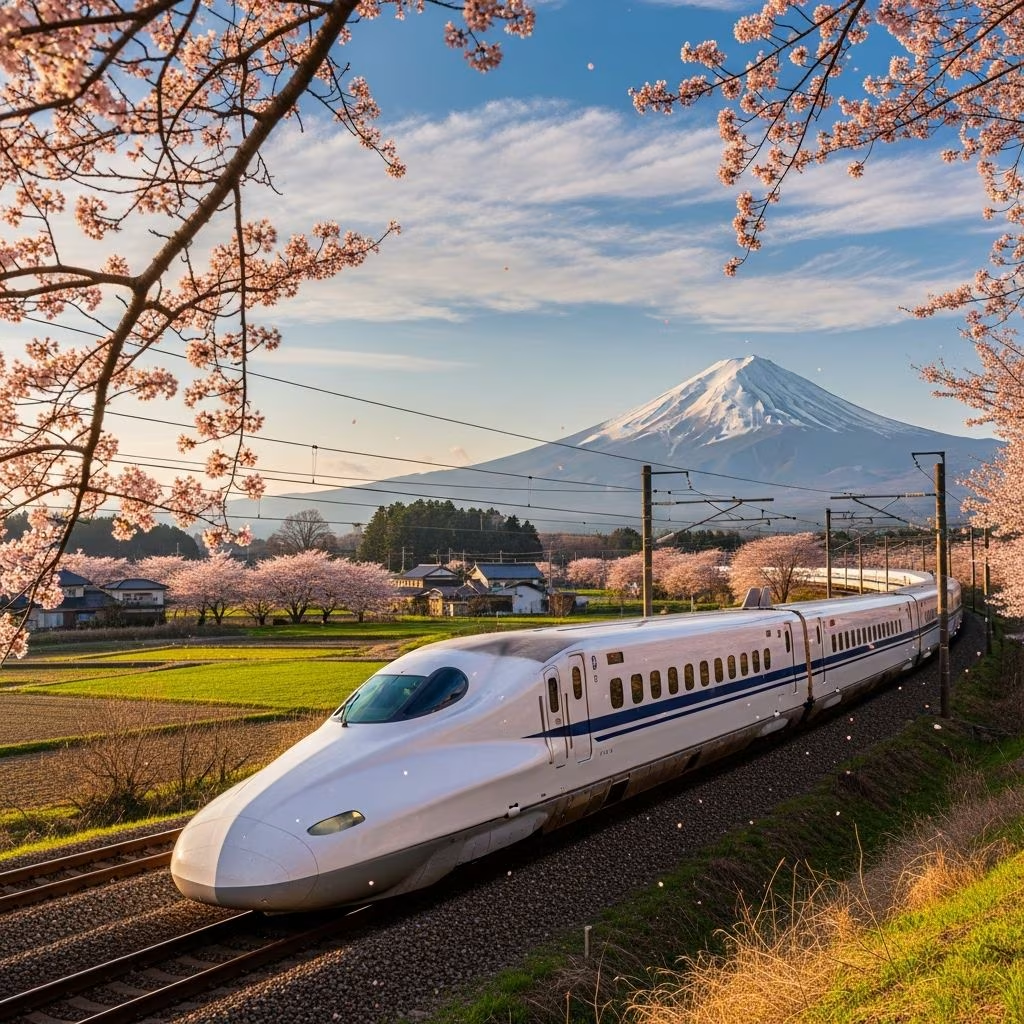 Travel Essentials
The Tokaido Shinkansen stands as a testament to Japan’s engineering prowess, revolutionizing travel by linking major cities with unparalleled speed and reliability. Spanning 515 kilometers from Tokyo to Shin-Osaka, this high-speed rail line has transported millions since its inception, shrinking what was once a six-hour journey into under three hours.
Launched in 1964 ahead of the Tokyo Olympics, the Tokaido Shinkansen marked the world’s first high-speed rail service, reaching speeds of 210 km/h initially and evolving to 285 km/h today. This innovation not only boosted economic connectivity between Tokyo, Nagoya, Kyoto, and Osaka but also set global standards for rail transport. Unlike slower conventional trains that took hours across the same distance—comparable to London to Amsterdam—this line transformed daily commutes and tourism.
Over decades, the Shinkansen network expanded, with the Tokaido line forming the backbone. It handles over 350 daily trains, serving as a lifeline for commuters and sightseers alike. The system’s hallmark is precision: trains depart and arrive on schedule, often within seconds, exemplified by rapid 12-minute station turnarounds where cleaning crews meticulously prepare cars for the next run.
The journey commences at Tokyo Station, a bustling hub, and hurtles toward Shin-Osaka Station. Major stops include Nagoya, Japan’s third-largest city, and Kyoto, famed for temples and tradition. Nozomi services, the swiftest, cover the route in 2 hours 22 minutes, while Hikari and Kodama options add stops for a more leisurely pace.
| Service Type | Travel Time (Tokyo-Shin-Osaka) | Key Stops | Peak Speed |
|---|---|---|---|
| Nozomi | 2h 22m | Tokyo, Nagoya, Kyoto, Shin-Osaka | 285 km/h |
| Hikari | ~3 hours | More frequent stops | 285 km/h |
| Kodama | ~4 hours | All stations | 285 km/h |
This table highlights service differences, aiding travelers in choosing based on speed versus exploration needs. Beyond Shin-Osaka, the Sanyo Shinkansen extends to Fukuoka, creating a seamless Tokyo-Hakata link in under five hours.
Boarding feels like clockwork: passengers file in orderly lines, doors seal, and the train glides out precisely on time. Interiors boast spotless cleanliness, ergonomic seating, and free WiFi, ensuring productivity or relaxation. The ride’s smoothness belies speeds over 300 km/h—no jolts, just serene acceleration.
Quiet carriages allow reading or napping, while panoramic windows frame the passing scenery. Commuters around cities use it daily, underscoring its integration into Japanese life.
Though urban-heavy, the route dazzles with natural gems. About 45 minutes from Tokyo, between Mishima and Shin-Fuji stations, Mt. Fuji looms majestically on clear days—opt for window seats in row 2E for optimal views. Further on, the train bridges Lake Hamana, a coastal lagoon where tracks skim over water, mimicking an ocean dash.
Post-Nagoya, rural patches reveal terraced fields and mountains, contrasting cityscapes. Kyoto Station offers fleeting glimpses of historic rooftops, while approaching Osaka, urban energy builds. Unlike northern lines with vast countrysides, Tokaido blends metropolis and vignettes.
“The ride was so quiet and stable that I could easily read, work, or just relax.”
Booking via the SmartEX app or station machines simplifies ticketing; JR Pass holders enjoy flexibility on non-Nozomi services. Arrive early—platforms are marked clearly, but crowds demand punctuality. Luggage fits overhead or in dedicated spaces; larger bags require reservations.
Stations like Nagoya and Kyoto are central, easing onward travel to castles or shrines.
Aviation seems faster, but door-to-door, Shinkansen wins: no security lines, central stations versus remote airports, and vistas absent at 30,000 feet. Environmentally, electric trains emit less per passenger than planes. Cost-wise, singles start at ¥13,000 (~$90 USD), competitive with flights plus transfers.
From Shin-Osaka, hop to Kansai Airport or explore Osaka’s neon streets. Link with Sanyo for Hiroshima’s Peace Park or Kyushu adventures. Day trips from Tokyo to Mt. Fuji area stations add variety.
The Nozomi service on Tokaido Shinkansen takes 2 hours 22 minutes.
Yes, on clear days between Mishima and Shin-Fuji; right-side seats recommended.
Yes for Hikari and Kodama, but not Nozomi or Mizuho.
Extremely—delays under a minute annually; iconic for reliability.
Regional specialties like Nagoya’s miso katsu or Kyoto’s yudofu.
Japan Rail Group maintains rigorous safety, with zero passenger fatalities in 60 years despite quakes. Future upgrades promise magnetic levitation extensions, but Tokaido remains core. Travelers rave: “One of the highlights of my trip—fast, smooth, stress-free”.
This rail marvel encapsulates Japan’s blend of tradition and innovation, inviting global visitors to experience efficient wanderlust.
