

 Travel Essentials
 Travel Essentials

Explore Scotland's richest historical landmarks, from prehistoric villages to medieval fortresses and Roman frontiers, offering a journey through millennia of Celtic, Viking, and royal heritage.
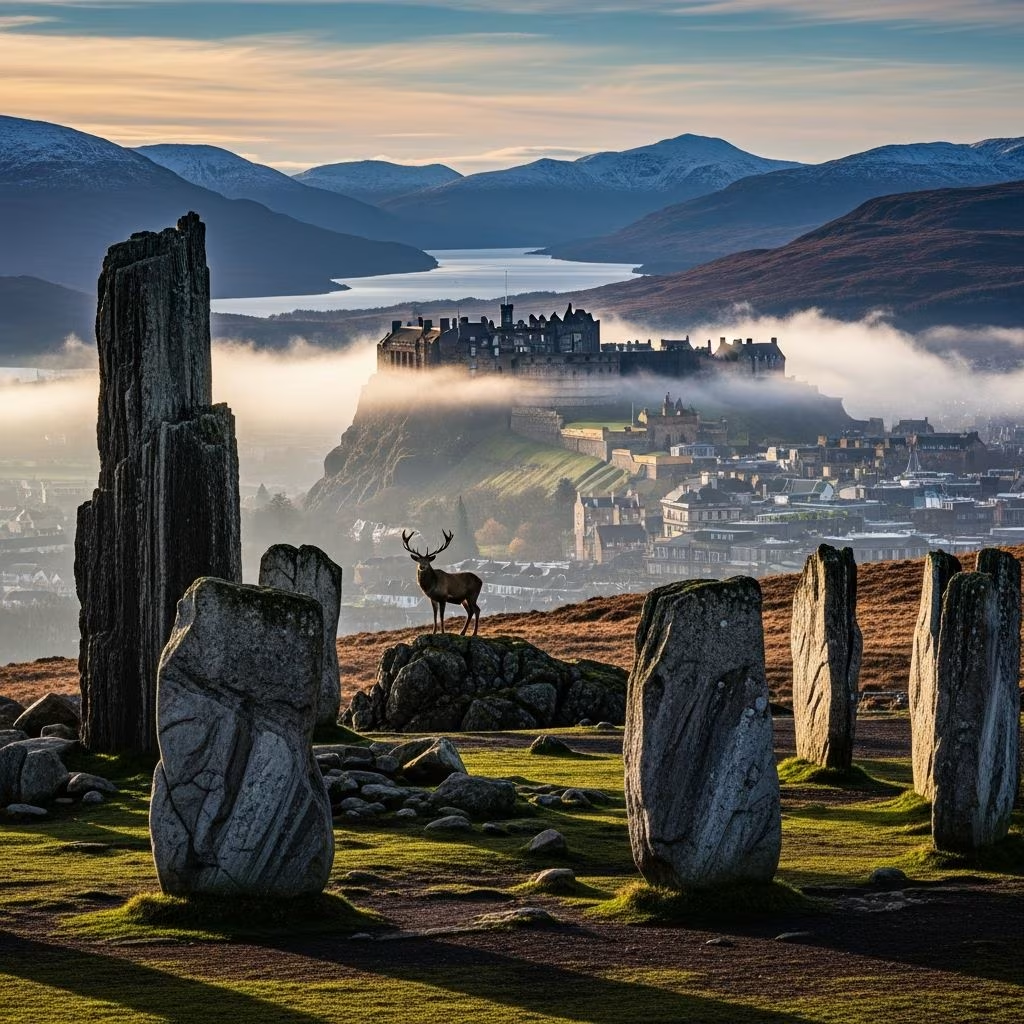 Travel Essentials
Scotland’s landscape is a living tapestry of history, where rugged hills guard secrets from prehistoric times, mighty castles echo tales of kings and warriors, and misty glens whisper of lost battles. From the wind-swept Orkney Isles to the bustling streets of Edinburgh, these sites offer more than ruins—they reveal the soul of a nation shaped by Celts, Romans, Vikings, and Scots. This guide uncovers the must-visit landmarks, blending archaeological marvels with royal strongholds and sacred abbeys, all while providing practical advice for modern explorers.
Long before written records, Scotland’s early inhabitants left indelible marks on the land. These **Neolithic and Bronze Age sites** stand as testaments to ingenuity and spirituality, predating even Egypt’s pyramids in some cases.
Among the most striking are the standing stones and circles scattered across the highlands and islands. The **Calanais Standing Stones** on the Isle of Lewis, erected around 2900–2600 BCE, form a complex cruciform arrangement older than Stonehenge. Aligned with lunar cycles, they likely served ceremonial purposes, drawing crowds for solstice rituals even today. Visitors can wander the site freely, but guided tours reveal astronomical insights.
Nearby, **Kilmartin Glen** in Argyll boasts over 350 prehistoric monuments within six miles, including rock art, cairns, and standing stones. This densely packed area was a ritual landscape for 5,000 years, with **Dunadd Fort** as its crowning jewel—a hillfort where early Gaelic kings were inaugurated by placing a foot in a carved rock imprint.
Further north, the **Heart of Neolithic Orkney** UNESCO site clusters world-class treasures: the **Ring of Brodgar** henge, **Standing Stones of Stenness**, and **Maes Howe** passage tomb, built around 2800 BCE with alignments to the winter solstice. These sites showcase advanced stonework and communal effort.
Step inside the homes of our ancestors at **Skara Brae**, Europe’s best-preserved prehistoric village on Orkney’s Mainland. Uncovered by a storm in 1850, this 5,000-year-old settlement reveals stone furniture, hearths, and drainage systems in clustered houses connected by passages. Life here revolved around fishing and farming, with beds lined in straw and possessions like shell necklaces still intact.
| Site | Date | Unique Aspect | UNESCO Status |
|---|---|---|---|
| Skara Brae | 3200 BCE | Stone-built homes with furniture | Yes |
| Maes Howe | 2800 BCE | Solstice-aligned tomb with Viking runes | Yes |
| Jarlsborg | 875 CE (Viking) | Earl’s palace with drainage | Part of Orkney sites |
Orkney’s preservation is unparalleled due to its sandstone geology and protective dunes, offering a tangible sense of Neolithic domesticity unmatched elsewhere in Europe.
Scotland marked Rome’s farthest reach with the **Antonine Wall**, built AD 142 under Emperor Antoninus Pius. Stretching 37 miles across the Central Belt from Old Kilpatrick to Bridgeness, this turf-and-stone barrier featured forts like Rough Castle and distance slabs commemorating legionary work. Though abandoned after 20 years, it symbolizes imperial ambition against Pictish resistance.
Explore via the Antonine Wall Trail, with museums at sites like the Hunterian in Glasgow displaying original artifacts. This World Heritage frontier contrasts sharply with Hadrian’s Wall to the south.
Christianity took root early, with **Iona Abbey** founded in 563 CE by St. Columba on a Hebridean isle off Mull. This missionary hub birthed the Celtic Church, housing illuminated manuscripts and high crosses. The abbey evolved through Viking raids into a Benedictine monastery, with 13th–16th-century architecture and royal burials.
On the mainland, **Melrose Abbey** (1136), Scotland’s first Cistercian house, blends Romanesque and Gothic styles amid ruins where Robert the Bruce’s heart reputedly rests. Its intricate stonework and gardens evoke monastic tranquility.
**St Andrews Cathedral**, once Scotland’s grandest church (12th century), now ruins overlook sandy beaches. A hub of medieval learning and Reformation strife, climb St Rule’s Tower for panoramas.
Scotland boasts over 2,000 castles, but few rival **Edinburgh Castle** crowning the capital’s volcanic crag. Housing the Crown Jewels, Stone of Destiny, and war memorials, it witnessed sieges, coronations, and the 1745 Jacobite occupation. Daily gun salutes and underground vaults add drama.
**Stirling Castle**, the ‘Broch’ of Scotland, guarded the Lowlands-Highlands divide. Site of Bannockburn (1314) victory and Stirling Bridge (1297), its Renaissance interiors gleam post-restoration. Panoramic views reward the climb.
Other gems include **Urquhart Castle** on Loch Ness (13th century), a strategic ruin with tower house and grant tower amid monster lore, and **Culzean Castle** (late 1700s), a neoclassical cliffside marvel with oval staircase and Eisenhower suite.
Scotland’s fields bear scars of pivotal clashes. **Culloden Battlefield** (1746) ended Jacobite dreams in 60 bloody minutes, with clan graves and Prince Charlie’s stone. The visitor center’s immersive exhibits recount the Hanoverian triumph.
**Bannockburn** (1314) saw Robert the Bruce crush Edward II, securing independence. Reenactments and a rotunda offer context. **Stirling Bridge** (1297), William Wallace’s triumph, is marked by a modern footbridge over the Forth.
Beyond antiquity, **New Lanark** UNESCO village (1780s) pioneered millworker welfare under Robert Owen, with cotton mills, school, and housing now a living museum. It bridges to modern social reform.
Scotland’s sites span regions—Orkney for prehistory, Central Belt for Romans and castles, Highlands for battles. Historic Environment Scotland manages many (Explorer Pass saves money), while National Trust for Scotland cares for others[10].
Essential Tips:
Skara Brae and Orkney Neolithic sites date to 3200–5000 BCE, predating pyramids.
Central sites accessible by train/bus; islands require ferries/flights. Rent for flexibility.
Yes—interactive exhibits at Culloden, castle dress-ups engage kids.
Shoulder seasons (April–May, Sept–Oct) balance weather and quiet.
Many battlefields and stones are free; castles charge £15–25.
