

 Travel Essentials
 Travel Essentials

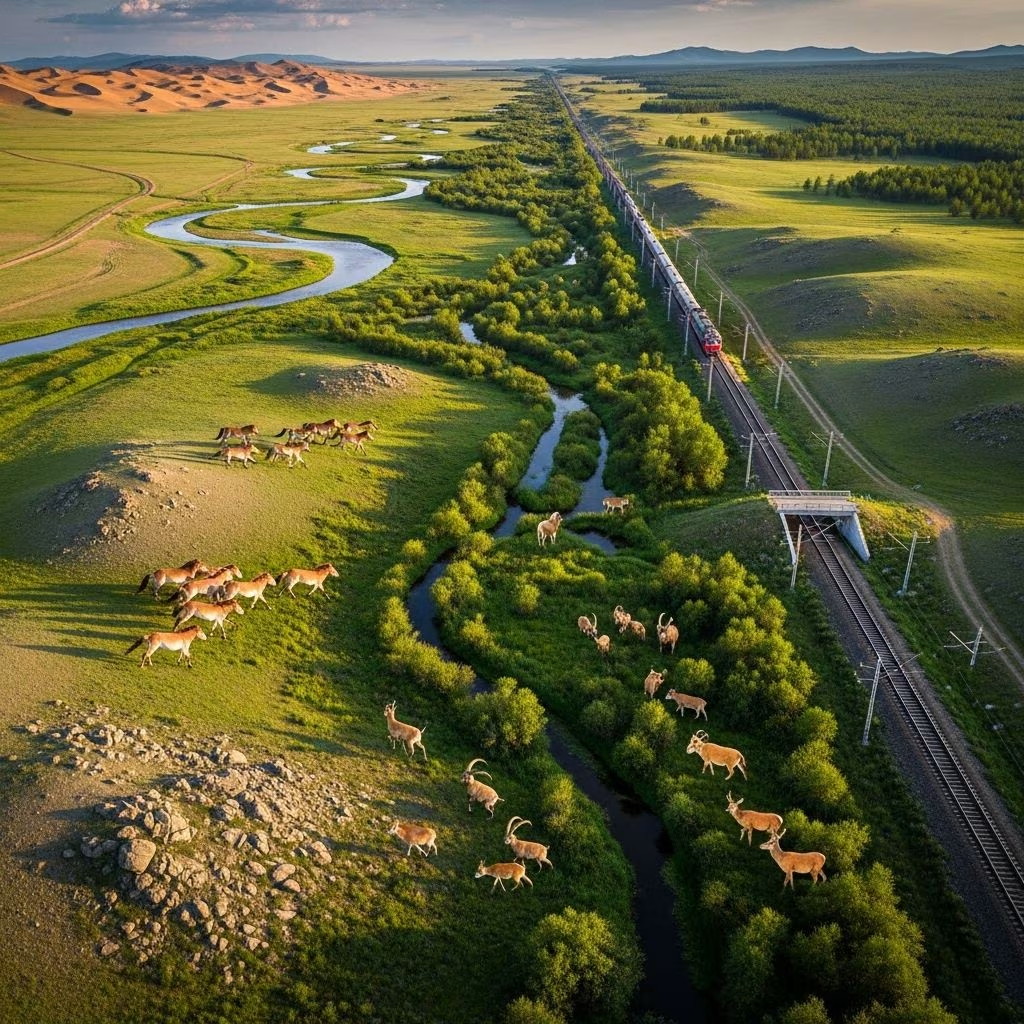
Wildlife crossings along Mongolia’s Trans-Mongolian Railway are restoring migration routes for khulan and other species without compromising train safety.
 Travel Essentials
For over seven decades, the Trans-Mongolian Railway (TMR) has served as a critical transportation artery connecting Russia, Mongolia, and China. Yet alongside its role in commerce and travel, the railway has inadvertently created one of Mongolia’s most significant environmental barriers. Rigorous fencing installed since the 1950s to prevent livestock collisions with trains has fragmented wildlife habitats across the Greater Steppe Ecosystem (GSE), severing migration routes essential for species survival. Today, conservationists, government agencies, and railway operators are collaborating to transform this barrier into a wildlife-friendly corridor—a pioneering model that demonstrates how large-scale infrastructure can coexist with ecological restoration.
The installation of continuous fencing along the Trans-Mongolian Railway fundamentally altered the landscape for species dependent on seasonal migration. The fences, implemented primarily to enhance operational safety and prevent livestock interference, created an impenetrable wall across critical movement pathways. For nearly 70 years, these barriers have restricted the natural movements of migratory species whose survival instincts depend on traversing vast territories. The consequences extend beyond mere inconvenience; wildlife-fence interactions result in mortality of hundreds to thousands of animals annually, with some species experiencing devastating population declines.
The Khulan, commonly known as the Asiatic wild ass, exemplifies the impact of this fragmentation. Once freely ranging across Mongolia’s grasslands and connecting to eastern steppe populations, Khulan populations became isolated on either side of the railway. This separation undermined genetic diversity, disrupted breeding patterns, and created unsustainable population dynamics in compartmentalized zones. Similarly, other migratory species—including various gazelle species and snow leopards—found their traditional seasonal routes blocked, forcing them to either perish attempting to cross or abandon critical grazing and breeding grounds.
The railway’s original design prioritized train safety and operational efficiency, legitimate concerns that remain valid today. However, the purely safety-oriented approach created an ecological stalemate: the railway fulfilled its transportation mandate while inadvertently becoming an extinction accelerator for vulnerable species. Recognizing this tension, environmental organizations, Mongolian government ministries, and international conservation bodies began reassessing whether these competing objectives could coexist through innovative design solutions.
The World Wildlife Fund (WWF) Mongolia played a catalytic role in shifting institutional thinking. By engaging with the Ministry of Road and Transport Development (MRTD) and the Ministry of Environment and Tourism (METM), WWF-Mongolia initiated a coordination platform dedicated to developing wildlife-friendly fence standards applicable to railroads and paved roads. This collaborative approach acknowledged that infrastructure improvement need not compromise safety; instead, thoughtfully designed modifications could enhance both operational reliability and ecological function.
Creating effective wildlife corridors along an operational railway requires sophisticated understanding of animal behavior, engineering constraints, and safety protocols. Wildlife-friendly crossing designs incorporate several key principles:
In 2020, conservation teams implemented the first piloted wildlife crossings along the Trans-Mongolian Railway, with results exceeding expectations. Camera trap monitoring provided documentary evidence of Khulan successfully utilizing the designated gaps—a milestone representing the first confirmed crossings for the species in 65 years. This breakthrough validated the theoretical framework and demonstrated that carefully designed infrastructure modifications could restore natural migration patterns without compromising railway operations.
The success of the initial pilots, however, came with important caveats. The project operates on a year-by-year negotiation basis rather than through permanent institutional frameworks, creating ongoing uncertainty about long-term commitment. Additional gaps have been identified for verification and piloting in subsequent years, yet sustainable, permanent corridor establishment throughout the entire TMR remains aspirational rather than realized. This incremental progress reflects the challenges of transforming large-scale infrastructure in the face of competing institutional priorities.
Establishing wildlife-friendly corridors requires robust legal foundations. Mongolia has developed a strong legal basis for implementing these modifications, including regulatory frameworks that signal a shift away from the purely safety-oriented status quo. This evolving legal landscape provides the foundational support necessary for institutionalizing corridor development.
However, implementation faces persistent challenges. The legal framework must be adapted to manage wildlife-friendly infrastructure effectively, including monitoring protocols for open sections and addressing liability questions when modified crossings are involved in safety incidents. International best practices from other nations provide guidance, yet Mongolia’s unique ecological conditions, species composition, and railway operational context require locally calibrated solutions rather than simple policy transplantation.
Successful wildlife corridor development depends on aligning diverse stakeholder interests. The establishment of a Wildlife Friendly Rail Membership Facebook group created a communication platform enabling dialogue between conservation organizations, government agencies, railway operators, and local herding communities. This grassroots communication infrastructure facilitates message sharing, collective problem-solving, and transparency.
Public awareness initiatives, including poster campaigns distributed to local partners and herders, have helped contextualize the conservation project within the framework of economic and cultural values important to local communities. Herding communities, whose livestock management intersects directly with both railway operations and wildlife movement, represent critical stakeholders. Engaging these communities in understanding how wildlife corridors benefit ecological systems that support pastoral livelihoods has proven essential for social acceptance.
Effective corridor establishment requires systematic identification of locations where wildlife and livestock concentrations create both conservation opportunities and operational challenges. Conservation teams have conducted comprehensive assessments along the TMR to map these zones, informing decisions about where initial corridors should be prioritized and where future gap development should focus.
This spatial analysis reveals patterns of animal movement that might be counterintuitive to railway operators unfamiliar with ecological dynamics. By demonstrating where species regularly congregate and attempt to cross, this mapping work builds evidence-based rationales for modification investment. The data collection process also engages local herders and observers who contribute observational knowledge about seasonal migration patterns invisible to external researchers.
The Trans-Mongolian Railway corridor initiative extends beyond this single infrastructure. Parallel projects are advancing wildlife-friendly standards for paved roads, recognizing that Mongolia’s expanding transportation network presents similar fragmentation challenges. The principles developed and tested along the TMR provide templates for broader infrastructure reform across the country.
Additionally, the model demonstrates relevance for other nations where railways and roads traverse critical wildlife habitat. Countries in Central Asia and beyond face analogous challenges of balancing transportation development with species conservation. Mongolia’s pioneering work in collaborative corridor development offers valuable lessons for international cooperation on infrastructure ecology.
Despite demonstrated ecological success, significant obstacles persist. Year-to-year negotiation requirements create funding uncertainty that prevents long-term planning. Sustainable corridor establishment demands multi-year commitments and dedicated financial allocations, yet competing development priorities often eclipse conservation investments in governmental budget discussions.
Technical challenges remain unresolved. Incorporating wildlife-friendly designs into new railway infrastructure and major renovation projects requires institutional change at operational planning stages rather than post-hoc modifications. This requires shifting engineering protocols, training programs, and procurement practices—organizational transformations that encounter institutional inertia.
Climate change introduces additional complexity. Shifting weather patterns alter migration timing and pathways, requiring adaptive management approaches that adjust corridor locations and designs responsively. Static infrastructure designed for current ecological conditions may become misaligned with future species movement patterns.
Conservation organizations and government agencies envision a fully developed wildlife-friendly corridor system distributed throughout the Trans-Mongolian Railway, with regular, strategically-positioned gaps enabling sustained animal movement. This comprehensive approach would require substantial financial investment, technological innovation, and institutional commitment spanning multiple governmental administrations.
Achieving this vision requires translating isolated pilot successes into systemic policy and practice. Technical knowledge about gap design, appropriate dimensions, and placement optimization must become embedded in railway planning and maintenance protocols. Regulatory frameworks must provide clear standards and enforcement mechanisms. International partnerships can contribute financial resources, technical expertise, and comparative learning from similar initiatives elsewhere.
Properly designed crossings, with strategic placement guided by wildlife behavior studies and clear sightlines maintained through vegetation management, maintain or enhance safety by providing predictable crossing locations rather than forcing animals toward risky fence-climbing attempts. Regular monitoring verifies continued effectiveness.
Migratory species with isolated populations benefit most, including Khulan (Asiatic wild ass), various gazelle species, and snow leopards. Each species requires specifically tailored gap dimensions and placement based on behavioral patterns and physical capabilities.
Institutional frameworks for dedicated wildlife infrastructure remain underdeveloped, and corridor projects compete annually with other transportation and development priorities for budgetary allocation. Establishing permanent funding streams requires long-term political commitment.
Yes. Parallel initiatives are developing wildlife-friendly standards for paved roads, and the principles are increasingly applied to pipeline corridors and other linear infrastructure. The fundamental insights about species movement and barrier mitigation have broad applicability.
