

 Travel Essentials
 Travel Essentials

Explore the ancient origins, Baroque splendor, and cultural significance of the Trevi Fountain, from its Aqua Virgo roots to modern coin-tossing traditions.
 Travel Essentials
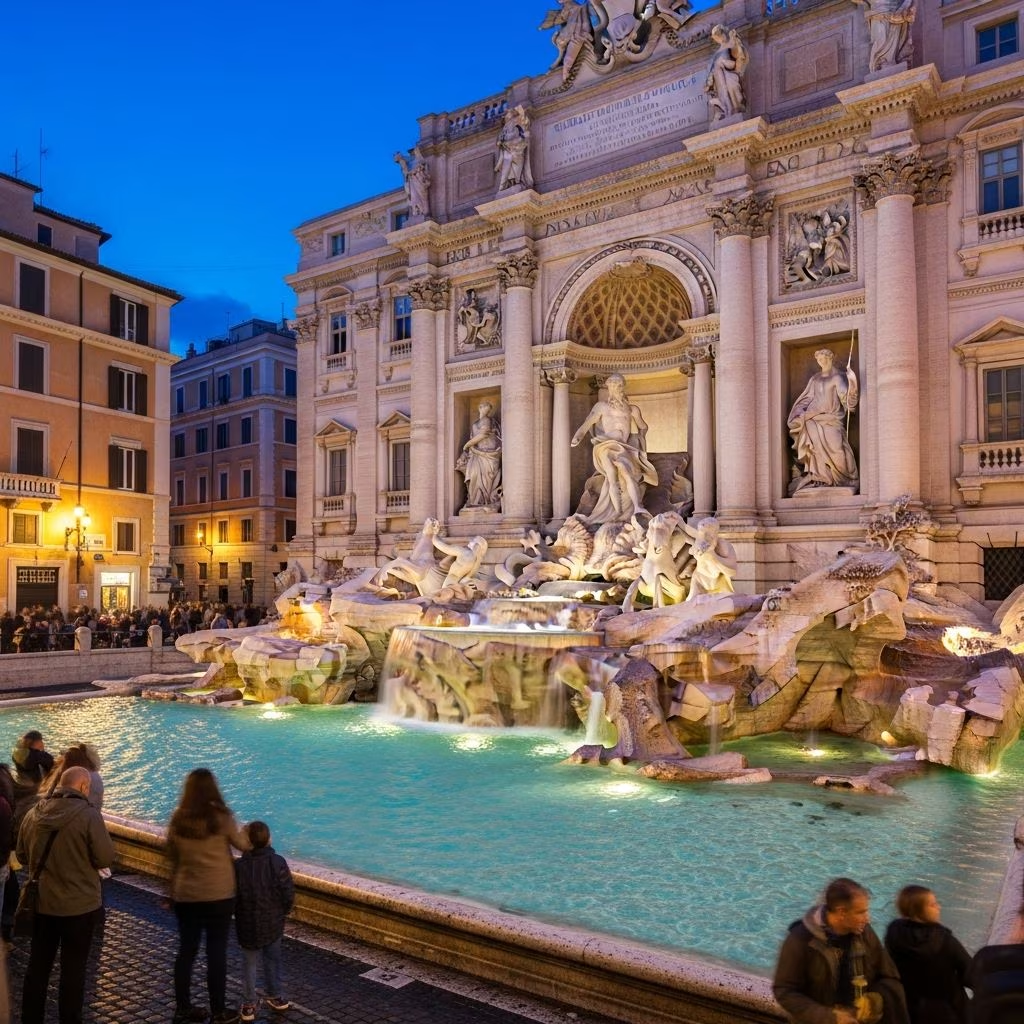
The Trevi Fountain stands as one of Rome’s most breathtaking landmarks, a masterpiece of Baroque art that blends mythology, history, and engineering. Towering at 26.3 meters high and spanning 49.15 meters wide, it serves as the grand terminus of the ancient Aqua Virgo aqueduct, captivating visitors with its dynamic sculptures and cascading waters.
The story of the Trevi Fountain traces back over two millennia to 19 BC, when Roman general Marcus Vipsanius Agrippa constructed the Aqua Virgo aqueduct. This vital water conduit supplied fresh water to the city, ending precisely at the site now occupied by the fountain. Legend recounts that thirsty soldiers, guided by a young maiden—hence the name ‘Virgo’ or ‘virgin’—discovered the pure spring source, a tale immortalized in the fountain’s reliefs.
During the Roman Empire, the aqueduct powered public baths and fountains, symbolizing Rome’s advanced hydraulic prowess. Remarkably, the Aqua Virgo remains operational today, feeding the Trevi with pristine water after more than 2,000 years, underscoring ancient engineering’s enduring legacy.
Prior to its current grandeur, a simpler fountain marked the spot at the intersection of three roads—’tre vie’ in Italian—giving the district its name. In 1629, Pope Urban VIII deemed it lackluster and ordered a redesign, but progress stalled until 1730 when Pope Clement XII launched a design competition.
Nicola Salvi, a Roman architect, emerged victorious despite initial controversy favoring a Florentine contender. Construction commenced in 1732 using durable Travertine stone from nearby Tivoli quarries. Salvi’s vision integrated the fountain into Palazzo Poli’s facade, creating an illusion of architectural harmony. After Salvi’s death in 1751, Giuseppe Pannini completed the work in 1762, with the official inauguration on May 22 by Pope Clement XIII.
At the fountain’s heart presides Oceanus, the sea god, commanding chariots pulled by spirited sea horses—one calm, one wild—symbolizing the sea’s dual nature. Flanking him are statues of Abundance (with a cornucopia) and Health (pouring water from an urn), celebrating the aqueduct’s life-giving waters.
Tritons guide the horses, while bas-reliefs depict key moments: Agrippa approving the aqueduct and the virgin revealing the spring. Four additional figures above represent the seasons, adding seasonal harmony. Sculptors like Pietro Bracci, Filippo della Valle, Giovanni Grossi, and Andrea Bergondi crafted these intricate details, blending motion and mythology in true Baroque exuberance.
Salvi reportedly incorporated a small basin—’la botte’ or ‘the barrel’—to block a barber’s critical view from his nearby shop, who mocked the unfinished design. This quirky feature persists, a testament to 18th-century rivalries.
The project spanned 30 years, involving multiple popes and artists, reflecting Rome’s patronage of the arts. Its scale made it the largest Baroque fountain in the city, rivaling Versailles’ opulence on a Roman stage.
No visit is complete without tossing a coin over the left shoulder with the right hand, ensuring a return to Rome. Two coins promise marriage or love; three, divorce. This custom, popularized by Anita Ekberg’s scene in La Dolce Vita, generates millions annually for charity.
| Number of Coins | Legendary Wish |
|---|---|
| 1 | Return to Rome |
| 2 | Falling in love or marriage |
| 3 | Divorce (or success in love) |
Coins are collected daily, funding Rome’s needy via Caritas. Over €1.5 million is retrieved yearly, proving the tradition’s vitality.
Exposed to pollution and tourism, the fountain has undergone frequent cleanings. A notable 2015 restoration, sponsored by Fendi, cost €2.2 million and restored its luster using innovative techniques.
Past efforts include 1988-1990 works revealing original colors. Today, barriers protect it from vandalism, with ongoing maintenance preserving its splendor.
Avoid midday crowds by visiting at dawn or late evening when lights enhance its drama. Respect rules: no eating, sitting on edges, or dipping hands—fines apply.
Beyond Ekberg, it featured in The Lizzie McGuire Movie and Angels & Demons. Its allure transcends cinema, symbolizing eternal Rome.
It channels the Aqua Virgo aqueduct from 19 BC, discovered via a virgin girl’s guidance to soldiers.
Nicola Salvi designed it starting 1732; Giuseppe Pannini finished in 1762.
Approximately €1.5 million, donated to charity.
Yes, to obstruct a critic barber’s view during construction.
Over left shoulder with right hand, eyes closed, facing away.
The Trevi Fountain endures as a living monument, where history flows eternally. Its blend of antiquity and artistry reminds us of Rome’s layered past, inviting all to partake in its legends.
