

 Travel Essentials
 Travel Essentials

Navigate TSA regulations with confidence. Learn which toiletries, batteries, and grooming items are allowed in carry-on and checked baggage.
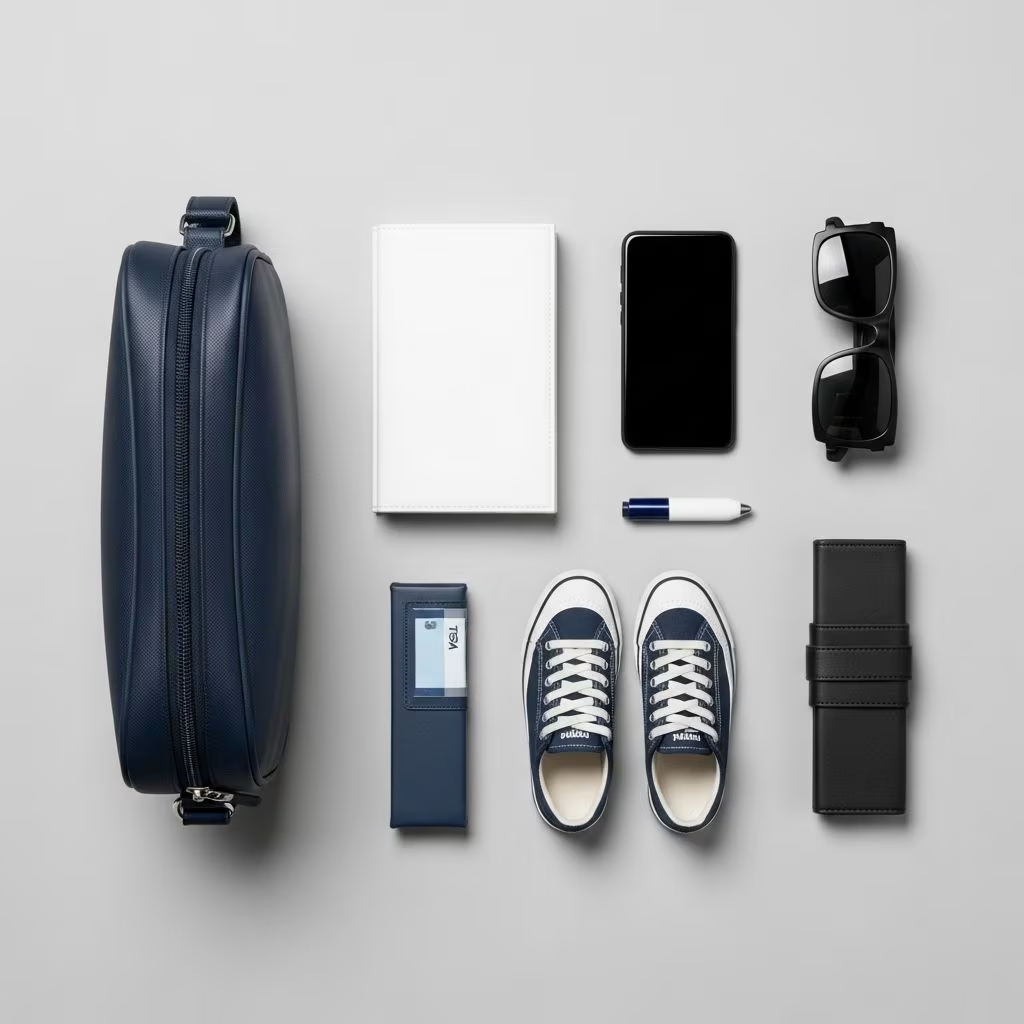 Travel Essentials
Air travel requires understanding a complex set of security regulations, and packing personal care items can feel like solving a puzzle. The Transportation Security Administration (TSA) maintains specific guidelines about which toiletries, grooming tools, and electronic devices you can bring aboard aircraft. These rules exist to maintain passenger safety while allowing travelers to bring necessary items for their journey. Understanding these regulations before you pack can significantly streamline your airport experience and prevent the frustration of having items confiscated at security checkpoints.
One of the most critical concepts for air travelers is the 3-1-1 rule for liquids and gels. This regulation requires that all liquid and gel-based products be contained in individual containers of 3.4 ounces (100 milliliters) or less, and these containers must fit inside a single, clear, quart-sized resealable plastic bag. This rule applies regardless of whether a product appears to be solid or liquid, as the TSA bases classifications on physical properties rather than appearance.
The definition of “liquid” extends beyond traditional liquids to include any substance that can pour, squeeze, spread, smear, pump, or spray. This encompasses products like shampoo, conditioner, face wash, liquid foundation, hand sanitizer, perfume, gel deodorant, toothpaste, and various creams or lotions. Understanding this broad classification helps travelers make informed packing decisions before arriving at the airport.
Makeup presents unique challenges because products come in various formulations with different TSA classifications. Solid beauty products such as powders, lipsticks, and lip balms can be brought onto aircraft in carry-on luggage without quantity restrictions. Powder makeup must be contained in a container with a maximum capacity of 12 ounces, and containers exceeding this volume may be pulled aside for additional inspection, which can add considerable time to your security screening.
Liquid, lotion, gel, paste, or cream-based makeup products must adhere to the 3.4-ounce limit and be packed in your quart-sized liquid bag. This includes liquid foundation, cream contour, gel eyeshadow, and similar products. Many experienced travelers opt for solid alternatives when possible, such as solid perfume, shampoo bars, and cleanser bars, which don’t count toward your liquid limit and often last longer than their liquid counterparts.
Deodorant represents one of the most frequently questioned items at security checkpoints. The TSA prohibits liquid deodorant from carry-on luggage, but stick deodorant faces no restrictions and can be packed without limitation. This distinction is crucial: gel or roll-on deodorants must follow the 3.4-ounce rule, while traditional stick formulations can be brought in full-size containers.
For travelers requiring medically prescribed deodorant products, special exceptions may apply. However, these exceptions require documentation in the form of a prescription or doctor’s note that must be presented to TSA security officers. Any medically necessary liquid product must still be stored in a container no larger than 3.4 ounces and placed in your quart-sized liquid bag.
Shaving equipment rules vary significantly based on razor type. Disposable razors with replaceable cartridges, such as those from major brands or subscription services, are permitted in carry-on luggage. Electric razors face no carry-on restrictions and can be packed freely, though placing them in a clear quart-sized bag facilitates faster security screening.
However, safety razors with exposed blades and straight razors are not permitted in carry-on bags. These items must be placed in checked baggage. If you prefer using traditional safety razors, removing the blade before packing allows the handle to pass through security, though this approach requires reassembly at your destination. The key distinction centers on exposed blade safety: any razor configuration that presents an immediate cutting hazard is prohibited from carry-on luggage.
Aerosol products including hairspray and dry shampoo create confusion among travelers because regulations differ based on location and container size. These items are prohibited from carry-on luggage in most cases but are permitted in checked baggage when stored in sealed containers of 3.4 ounces or less. Some travelers purchase specialized travel bottles designed specifically for aerosol products to comply with size restrictions.
Hair gel and similar styling products must adhere to the 3.4-ounce limit and be packed in your quart-sized liquid bag for carry-on transport. Larger quantities can only be checked in baggage. For extended trips requiring more product than your liquid allowance permits, purchasing travel-sized versions at your destination often proves more convenient than managing space constraints.
Electric toothbrushes are permitted in carry-on luggage without restrictions. To ensure smooth passage through security, pack the device in a clear quart-sized bag so TSA officers can easily view the item without removal. Alternatively, placing battery-operated electric toothbrushes in hard-sided carry-on cases provides additional protection and facilitates inspection.
Batteries present specific regulations that vary by type and quantity. Lithium-ion batteries, commonly found in electronic devices, are limited to a maximum of two per carry-on bag, with each battery not exceeding 160 watt-hours. Different battery chemistries face different restrictions, and airline approval may be required for certain battery configurations. Checking with your specific airline before packing batteries ensures compliance with their particular policies.
Scissors present a nuanced situation: blades shorter than four inches (measured from the pivot point) are permitted in carry-on luggage. Larger scissors must be checked. This allowance reflects the TSA’s risk assessment, determining that small scissors pose minimal security concerns while larger variants require baggage placement. Many travelers prefer packing nail clippers for carry-on travel, as these items face no restrictions and serve similar grooming functions.
Curling irons are permitted in carry-on luggage, with a limit of one per person. The device must include a safety cover and be protected from accidental activation during transport. Hair straighteners follow similar rules. These heat-generating devices must be completely cool before packing and stored where they cannot accidentally activate or contact other items.
Successful air travel requires proactive packing strategies that minimize security delays and maximize convenience. Grouping items by category—skincare, hygiene, makeup, and similar collections—streamlines the removal process at security checkpoints. Organizing your liquids bag so TSA officers can quickly scan contents without individual item inspection significantly accelerates screening.
Choosing solid alternatives whenever possible offers multiple advantages: these items don’t count toward your liquid limit, often last longer than liquid equivalents, and eliminate potential spillage concerns. Solid shampoo, conditioner, and lotion bars have become increasingly available and popular among frequent travelers specifically because they solve multiple packing challenges simultaneously.
Decanting full-size products into travel-sized containers reduces both weight and space requirements while ensuring you have sufficient quantities for your trip duration. Sharing essentials with travel companions represents another effective space-saving strategy, particularly for infrequently-used items or non-essential grooming products.
Historically, many items were believed to be prohibited despite never appearing on official restricted lists. Nail clippers exemplify this phenomenon: after 9/11 security enhancements, widespread misconceptions led many travelers to believe clippers were prohibited. In reality, nail clippers have never been officially banned, though some TSA agents exercised discretionary confiscation authority during the initial security uncertainty period.
Another frequent misconception involves the exact definition of “liquid.” Many travelers assume that thick, viscous substances automatically qualify as solids, but the TSA’s classification focuses on physical behavior rather than consistency. A product that can be squeezed, pumped, or spread counts as a liquid regardless of thickness, which catches many travelers off-guard when packing seemingly solid products.
| Item Category | Carry-On Status | Key Limitations |
|---|---|---|
| Stick Deodorant | Permitted | No size restrictions |
| Gel/Spray Deodorant | Permitted | 3.4 oz limit; must follow 3-1-1 rule |
| Disposable Razors | Permitted | Cartridge-based only |
| Safety Razors | Not Permitted | Must check; blade can be removed |
| Electric Razors | Permitted | No restrictions |
| Liquid Makeup | Permitted | 3.4 oz limit; include in liquid bag |
| Powder Makeup | Permitted | Maximum 12 oz container |
| Hairspray | Not Permitted | Checked baggage only; 3.4 oz max |
| Scissors | Permitted | Blades under 4 inches only |
| Electric Toothbrush | Permitted | Pack in clear bag for inspection |
| Curling Iron | Permitted | One per person; must have safety cover |
| Liquid Shampoo | Permitted | 3.4 oz limit; include in liquid bag |
| Solid Shampoo Bar | Permitted | No size restrictions |
TSA regulations apply specifically to flights departing from United States airports. International travelers flying to the United States must comply with TSA rules in addition to their home country’s aviation security regulations. Conversely, travelers flying internationally from the US may encounter different restrictions at their destination airport. Researching destination airport regulations before departure prevents the disappointment of purchasing items at your origin airport only to have them confiscated upon arrival.
Arriving at airport security prepared and informed transforms the experience from potentially stressful to straightforward. Packing your quart-sized liquid bag accessibly within your carry-on allows quick removal without disturbing other items. Placing prohibited items in checked baggage before reaching the airport prevents last-minute decisions and potential confiscations that can delay travel.
Reviewing your specific airline’s policies alongside TSA regulations ensures comprehensive compliance. Airlines occasionally implement stricter standards than TSA minimums, and knowing these distinctions prevents unnecessary complications. Checking airline websites or contacting customer service before packing unusual items provides definitive guidance for edge-case scenarios.
