

 Travel Essentials
 Travel Essentials

Learn how to capture sharp, colorful underwater photos with the right gear, steady buoyancy, better lighting, and simple editing tips.
 Travel Essentials
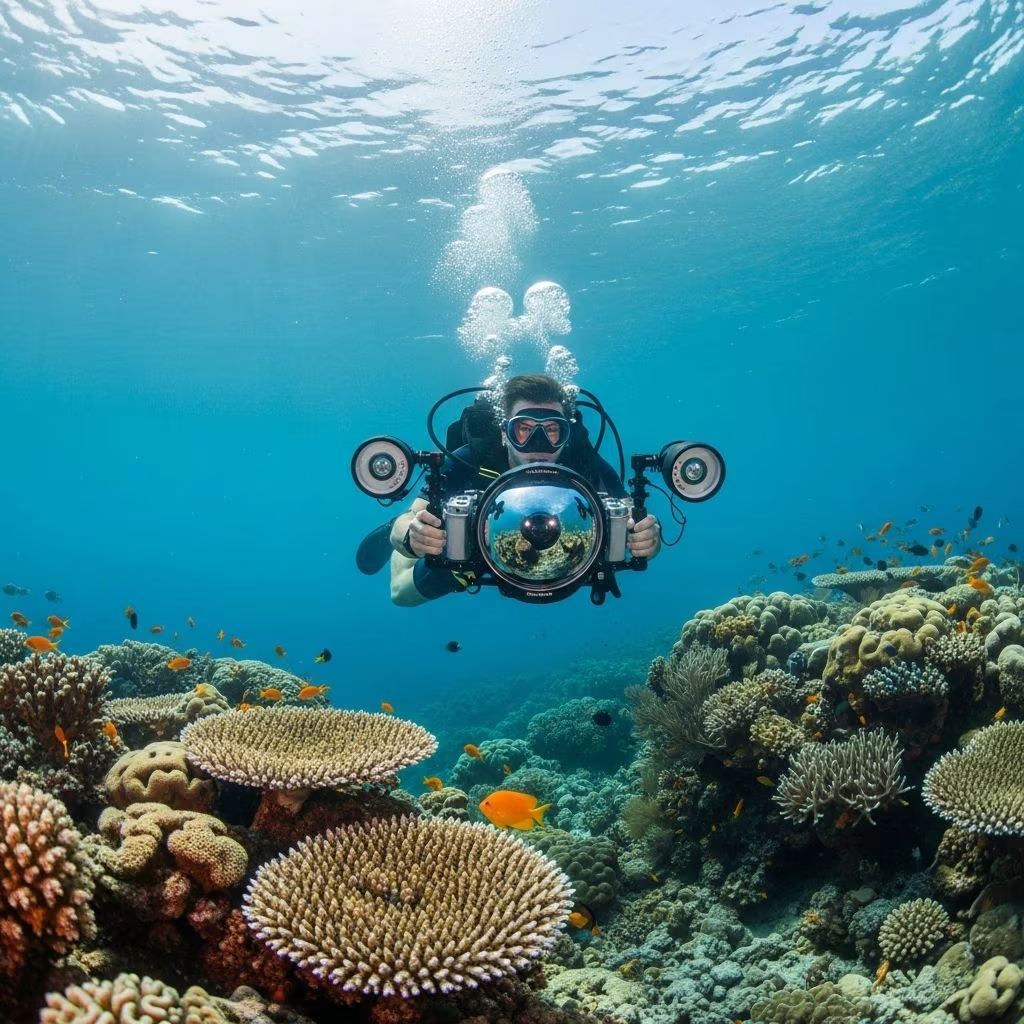
Underwater photography transforms ordinary dives into visual adventures, preserving the vibrant world beneath the waves. This guide equips you with practical strategies to produce sharp, colorful images despite water’s challenges like light absorption and particle scatter.
Choosing appropriate equipment forms the foundation of successful underwater captures. Compact action cameras suit beginners for their durability and ease, while advanced housings enable DSLR use in deeper conditions.
Strobes provide powerful bursts to counteract blue hues from water filtration, unlike constant video lights that aid previewing but limit flash power. For snorkelers, waterproof compacts eliminate housing needs in shallow zones.
Superior buoyancy control prevents blurry images and reef damage. Hover steadily using controlled breaths: exhale to descend gently, inhale to ascend smoothly.
Practice trim and finning techniques to position precisely without stirring sediment. Relaxed breathing maintains stability, allowing time to frame subjects carefully. Poor control leads to crooked horizons and disturbed wildlife, ruining potential masterpieces.
| Buoyancy Issue | Impact on Photos | Solution |
|---|---|---|
| Over-kicking | Sediment clouds lens | Slow, frog-kick finning |
| Erratic floating | Blurry, tilted frames | Breath-controlled hovering |
| Bottom contact | Damaged habitat, poor angles | Neutral trim practice |
Water degrades contrast and color rapidly, so approach within arm’s reach for clarity. Physical proximity trumps zooming, which amplifies distortion.
For macro, inch forward slowly to observe behaviors without startling shy creatures. Wide-angle requires balancing near foregrounds with distant backdrops to minimize water column interference.
Red wavelengths vanish quickly underwater, tinting scenes blue-green. Shallow, sunlit waters yield best natural results; deeper dives demand artificial aids.
Position strobes at 45-degree angles off-axis to banish backscatter from particles. Combine ambient surface light with flashes for depth and saturation. Manual white balance on similar-depth subjects corrects casts dynamically.
For sunbursts, shoot upward toward rays piercing the surface, adjusting exposure to retain detail in highlights. Diffusers soften strobe output, blending natural and artificial seamlessly.
Apply land principles underwater: divide frames into thirds for dynamic placement. Leading lines from coral branches guide eyes to focal points.
Frame subjects with arches, swim-throughs, or fish schools. Negative space conveys scale—a lone shark amid vast blue evokes majesty. Focus sharply on eyes to forge connections with marine life.
Upward angles separate subjects from bland seafloors, silhouetting against sunlit surfaces for drama. Turtles or rays loom majestic, light rays adding dimension.
Avoid shooting down unless layering subjects. Low angles emphasize foreground details while compressing backgrounds, enhancing perceived size.
Marine life moves unpredictably; fast shutters (1/250s+) freeze darts, slower ones (1/30s) trail fins for energy. Continuous autofocus tracks schooling fish, panning to blur surrounds while sharpening leads.
Anticipate: watch feeding rhythms or currents. Burst sequences capture peaks.
Raw files retain flexibility. Adjust white balance to revive reds, reduce highlights mimicking haze (1% cut often suffices). Boost shadows cautiously to reveal details without noise.
Correct horizons, crop distractions, sharpen selectively. Software like Lightroom excels for batch processing dive hauls.
GoPro or Olympus TG7 for rugged simplicity and macro prowess.
Start with natural light in shallows; add for depth and color.
Master buoyancy, approach slowly, maintain distance.
Shallow reefs under 10m for optimal light.
Reduce highlights slightly, tweak white balance.
