

 Travel Essentials
 Travel Essentials

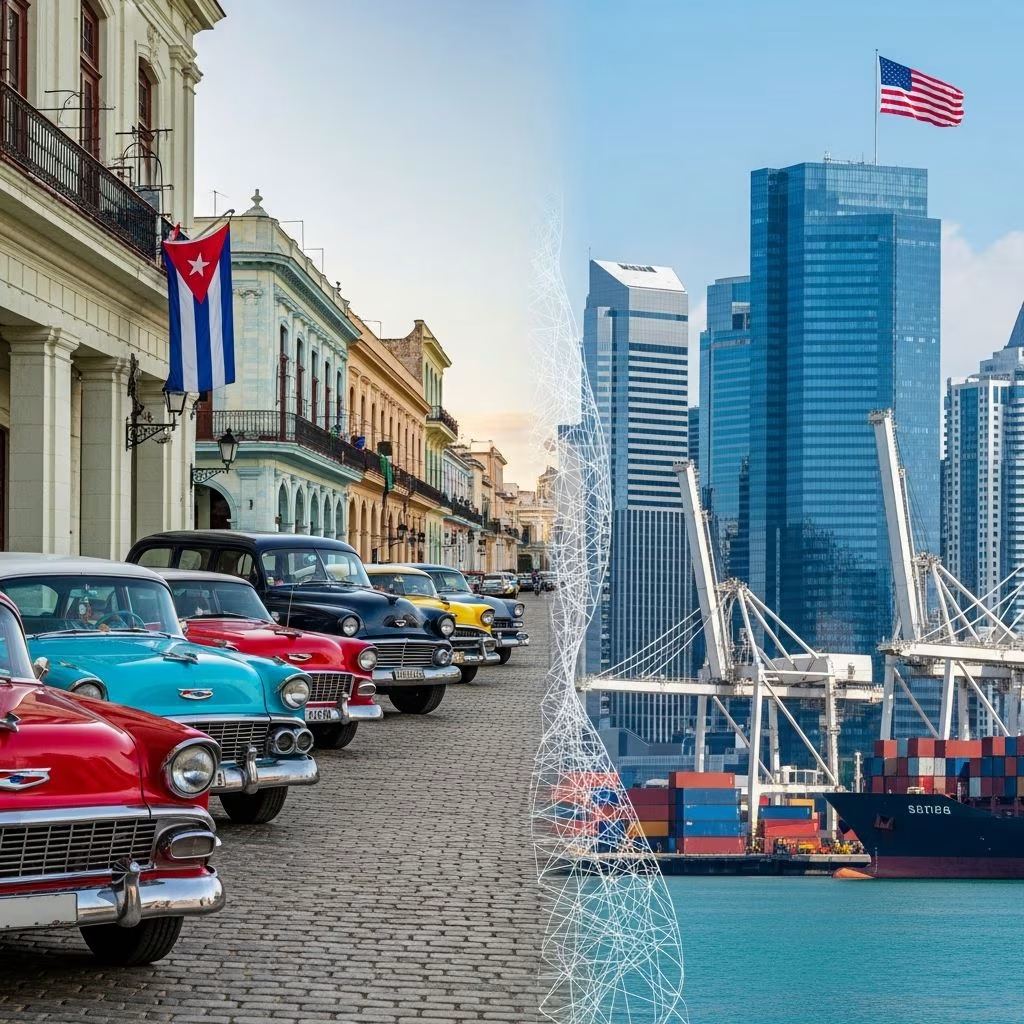
Explore the evolving landscape of US-Cuba relations and what potential policy changes mean for American travelers, businesses, and the region's economic future.
 Travel Essentials
The relationship between the United States and Cuba has long been characterized by tension, restrictions, and diplomatic gridlock spanning more than six decades. However, recent developments suggest potential shifts in this dynamic landscape, with significant implications for American travelers, businesses, and the broader Caribbean region. Understanding these changes requires examining the current policy environment, the historical context of travel restrictions, and what emerging negotiations could mean for the future.
As of 2026, Americans face a complex regulatory framework governing visits to Cuba. The United States maintains a statutory ban on tourism travel, enforced through the Office of Foreign Assets Control (OFAC) under the Department of Treasury. However, this ban does not represent an absolute prohibition on American visitors. Instead, the system operates through a licensing framework that permits travel for specific authorized purposes.
Under current regulations, Americans can legally visit Cuba through twelve designated travel categories, often referred to as “general license” travel categories. These categories enable Americans to engage in activities such as people-to-people cultural exchanges, support for the Cuban people, religious activities, educational purposes, professional meetings, and humanitarian projects. Notably, travelers do not require advance government permission to undertake journeys within these categories—instead, the system operates on an honor system basis where individuals self-certify that their travel purpose aligns with one of the approved categories.
The general license system represents a practical middle ground in American policy toward Cuba. Rather than imposing absolute travel prohibitions, the framework allows for cultural and educational exchange while maintaining restrictions on commercial tourism. This approach has evolved over time, particularly following the reinstatement of people-to-people travel in June 2022, which expanded access for Americans seeking to engage directly with Cuban citizens and experience the island’s cultural heritage.
Travel under these licenses permits Americans to spend money in Cuba for authorized purposes, though restrictions apply regarding which Cuban entities and accommodations travelers can support financially. The State Department maintains a Cuba Restricted List and Cuba Prohibited Accommodations List, specifying properties and businesses where American funds cannot legally flow, ostensibly to prevent dollars from reaching government-linked entities.
Recent diplomatic activity suggests potential transformation of this landscape. The Trump administration has reportedly engaged in high-level back-channel communications regarding comprehensive economic and political arrangements with Cuba, with discussions extending beyond traditional diplomatic channels to encompass broader frameworks for economic engagement.
Should diplomatic negotiations yield agreements reducing travel restrictions, the implications for Cuba’s tourism industry would be substantial. The Caribbean island has experienced significant challenges in recent years, including declining international visitor numbers and persistent energy constraints that have limited the tourism sector’s capacity and quality.
Unrestricted American access would likely reverse these trends dramatically. The United States represents Cuba’s largest potential tourism market, with geographic proximity and cultural connections that make Caribbean travel particularly attractive to American visitors. Revitalized tourism would generate substantial foreign currency earnings, critical for an economy struggling with external constraints and infrastructure limitations.
Beyond tourism, broader commercial engagement could modernize Cuba’s aging infrastructure. Direct American investment in energy systems would address persistent electricity shortages. Telecommunications sector development would expand internet access and connectivity. Port facility improvements would enhance Cuba’s regional trade position, potentially establishing the island as a Caribbean logistics hub.
American companies operating in these sectors would bring capital, technical expertise, and management practices that could substantially upgrade the island’s economic foundation while creating employment opportunities and spurring broader development.
Understanding proposed policy changes requires recognizing the strategic calculations underlying American diplomacy. The current approach emphasizes “maximum pressure” policies designed to create conditions where Cuba faces a choice between economic deterioration or accepting comprehensive market-oriented reforms.
This strategy reflects a shift from confrontational approaches toward engagement mechanisms. Rather than pursuing regime change through military or revolutionary means, the proposed framework emphasizes economic incentives and market dynamics as instruments of policy influence. Secretary of State Marco Rubio has reportedly played a central role in these discussions, advocating for approaches that combine economic opening with human rights protections and democratic principles.
The proposed framework also reflects recognition that regional stability serves American interests. Economic chaos in Cuba could generate humanitarian crises, irregular migration, and broader Caribbean instability. Managed economic transition through negotiated frameworks addresses these concerns while avoiding destabilizing alternatives.
Despite diplomatic activity, significant obstacles remain to comprehensive agreement. Cuban leadership has expressed skepticism toward proposals perceived as threatening national sovereignty or independence. The proposed exit strategy for current Cuban leadership faces uncertainty regarding whether such arrangements could command sufficient support from entrenched interests.
Domestic American political considerations also introduce complexity. Congressional opposition to normalization remains significant within certain factions, potentially constraining executive authority to implement comprehensive reforms without legislative approval.
| Dimension | Current Framework (2026) | Proposed Framework (Anticipated) |
|---|---|---|
| Travel Authorization | Limited to 12 licensed categories; honor system verification | Substantially relaxed; potential move toward unrestricted access |
| Economic Embargo | Largely intact since 1962; selective waivers for specific activities | Gradual easing; increased trade and investment opportunities |
| Business Investment | Restricted; limited to licensed travel-related entities | Expanded authorization; multiple economic sectors opened |
| Accommodation Options | Limited by Prohibited Accommodations List restrictions | Broader commercial lodging and services access |
| Tourism Market | Non-tourist travel only; cultural and educational focus | Potential opening for commercial tourism |
For Americans interested in visiting Cuba, potential policy changes could dramatically expand opportunities. Current travelers must navigate categorical restrictions and compliance documentation requirements. Proposed changes would eliminate these barriers, allowing straightforward vacation travel comparable to visits to other Caribbean destinations.
Expanded access would also enable broader tourism experiences. Currently, travel categories emphasize cultural and educational content. Unrestricted access would permit beach resort experiences, diving expeditions, and other recreational activities previously unavailable to American tourists.
Greater market access would likely increase tourist infrastructure investment, potentially improving accommodation quality and expanding service offerings. Increased competition among providers would introduce market pricing dynamics potentially benefiting consumers through improved value and service quality.
While diplomatic discussions reportedly progress actively, formal timelines remain uncertain. The Trump administration has indicated that resolution appears imminent, though specific announcement dates have not been confirmed. Implementation would likely occur in phases, with initial measures addressing the most politically feasible reforms before advancing to more contentious provisions.
Congressional engagement would likely prove necessary for certain provisions, particularly those affecting the statutory tourism ban. This legislative requirement introduces timing uncertainties dependent on political dynamics and legislative priorities.
Yes, Americans can legally visit Cuba through twelve authorized travel categories including people-to-people exchanges, support for the Cuban people, religious activities, and educational pursuits. The system operates on an honor system without advance licensing requirements.
Violations can result in significant penalties, including criminal penalties up to ten years imprisonment and $250,000 in individual fines, plus civil penalties up to $55,000 per violation.
Yes, unrestricted access would likely stimulate substantial airline service expansion and accommodation development as American demand increased, potentially improving availability and pricing for travelers.
Authorization for American business investment in Cuban telecommunications, energy, ports, and tourism sectors would create substantial commercial opportunities while modernizing island infrastructure.
Current diplomatic discussions reportedly include provisions addressing political prisoner releases and human rights protections as components of comprehensive agreements.
The potential reshaping of US-Cuba relations represents one of the most significant diplomatic developments in recent decades. While negotiations continue and outcomes remain uncertain, the trajectory suggests movement toward greater engagement and reduced restrictions. For American travelers, this could mean unprecedented opportunities to experience Caribbean culture, history, and natural beauty with the ease and accessibility associated with standard international travel.
The coming months will likely determine whether discussions yield formal agreements or stall amid political and diplomatic complications. Regardless of timeline, the current diplomatic engagement itself signals recognition that six decades of isolation have failed to achieve stated objectives, and alternative approaches emphasizing engagement and economic incentives merit serious consideration.
